Meritxell Blay: "A computer for every child? Imagine if an 'Odyssey' were given!"
Greek and Latin teacher

-
CAT -
CAST
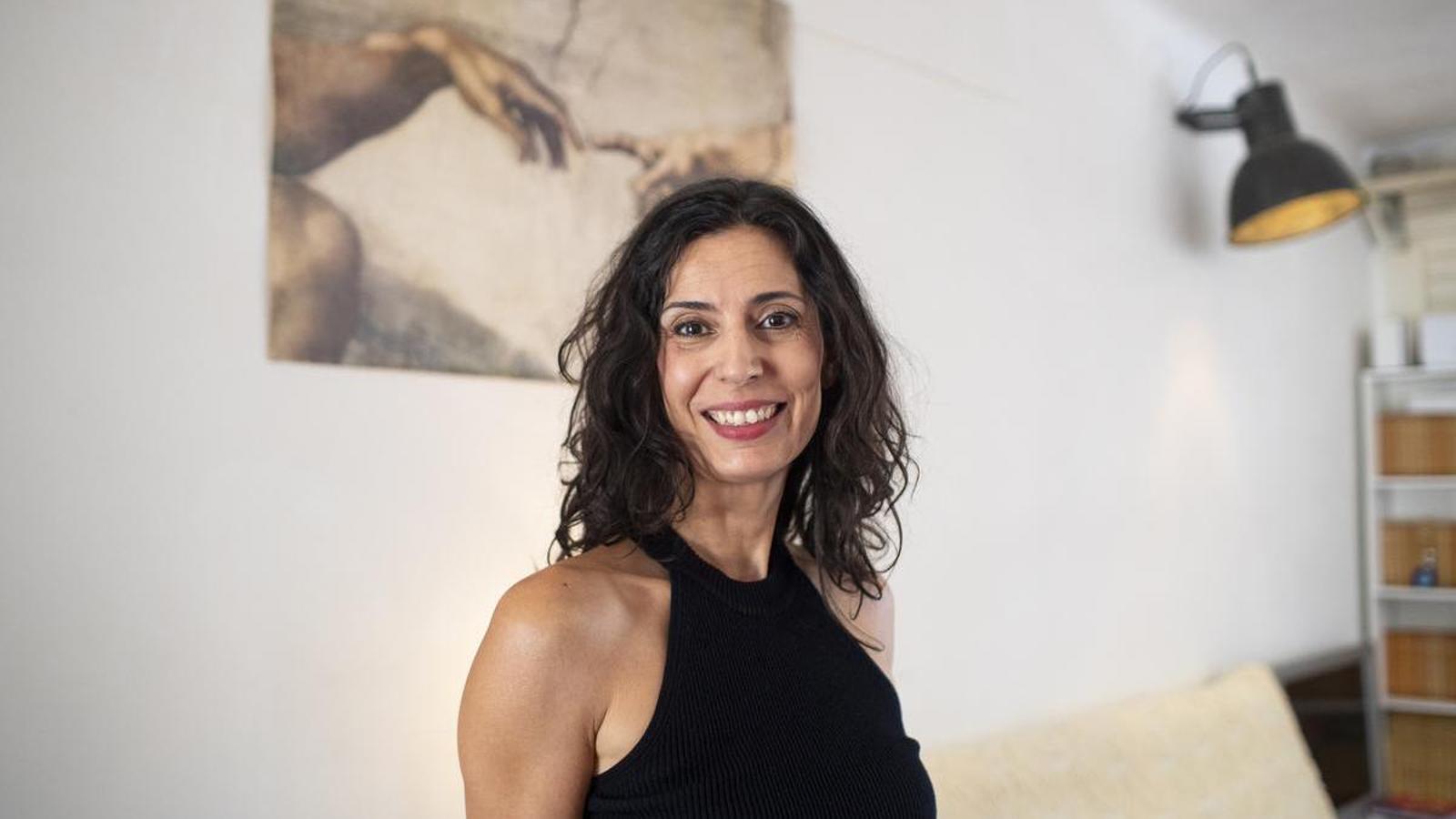
I joke with him saying he must have the Parthenon as his profile picture, but it turns out it's no joke. In the one he chose, we can see the temple's facade in the process of reconstruction, which already allows us to refine the metaphor of his passion a bit: recovering Catalonia's connection with the classics. He has translated into Catalan and for young people the Odyssey and Greek Myths.
First epiphany with the classics?
— At my house, they didn't know who Carles Riba or the Bernat Metge were. It is not until I reach high school that I study Latin and Greek to escape from mathematics. There has been no epiphany: what has made me who I am is school.
Greeks vs. Romans?
— I start like the 19th-century English travelers who only dare to reach Florence because the Greek world scares them. When I want to be a good girl and a diligent student, I stick with the Romans and the Renaissance, the world of order. Greek requires a different alphabet, it is difficult, it seems exotic. It is not until I am a mother that I find the personal strength needed to speak with the Greeks as equals and I can understand them.
What do you find by learning the Greek language and traveling to Greece?
— That Greece is neither that of the Romans nor that of the Germans. I discover its day-to-day life, its pragmatism, the disorder, the lack of rigidity. They dazzle me and at the same time I see all their seams.
Does Nolan's Odyssey contribute to the cause?
— How is it explained that it is the highest-grossing film of the year and Greek the least chosen elective subject? In England, the translator of the Odyssey and the specialists have paraded through all the media and the conversation has been of a very high level. Here we do not have a political or cultural dialogue with the classics.
But we have been talking about it all summer!
— We have talked about the Odyssey of the Americans, who distort it by bringing it into their world until we end up arguing about whether the Greeks were more or less woke or Trumpist.
So, what kind of relationship should we Catalans have?
— At the beginning of the 20th century, in Catalonia, there is a revolution. Cambó bets on an idea of country based on the classics, excavations begin, the Bernat Metge is created. Greece serves them to differentiate themselves from the Spanish: we have the Greek soul, and they, the Roman one. But today the classics are no longer part of any idea of country nor of our education, they only appear in eclipses and tours.
The Noucentistes said that the Greeks were order, but you find chaos in them.
— At that moment it could have made sense: translating the classics to put the Catalan language on an equal footing with French or German, laying some foundations. Now it would be our turn to establish a more modern dialogue, less elitist, less done from a position of power.
They were also very much gentlemen, and you advocate for reading through a feminist lens.
— Even today it is a man's world. The public is unaware of how great Catalan women have looked to Greece for inspiration: Víctor Català, Maria Àngels Anglada, Mercè Rodoreda. Montserrat Ros translated the Iliad into Catalan long before any English woman did. We must encourage the girls of today to find a place in the world of the classics.
Are the Greeks that important?
— When parents want to educate their children, they buy them a book about Egyptians, one about American Indians, one about the Japanese. And it could be that the Greeks were just one more culture. But I do not think so. For two thousand years, our world has only held up because of the Greek world. Everything is based on it.
What is your vision of a country based on the Greek world?
— Return to the Mediterranean. Mediterranean means sea between lands, the sea in the middle. The Mediterranean is not a border, it is a space of encounter. In a rapidly changing world where most of us have nothing in common, the sea of the Greeks teaches us that everyone can find their Ithaca and take root in another place from which to build. Contrary to what is often said, the Greeks are not pure in their origin, everything is a mixture.
Isn't this Nolan's hospitality?
— He does this very well. Although calling it "Zeus's law" is an absolute invention. And why doesn't Nolan want us to know what the Cyclops says? Or who Nausicaa was? Why does he invent that Calypso makes Odysseus eat lotus flowers, when he never wanted to forget anything? We can only understand all of this if we have the tools to engage directly with the classics.
Any difference between your version of the Odyssey and Nolan's?
— Nolan's Telemachus never contradicts Penelope so as not to make her look bad. Mine does, however, unlike Homer's, he does not tell her to be quiet because a matter "is a man's business", because kids do not have the context to understand the difference in era.
What have you learned from translating classics for young people?
— What I am most happy about is the involvement of families in reading classics together with their children, which is the same thing I did with mine. If we talk about the crisis in reading competence, we will have to start regaining ground this way.
What has changed in the 20 years that you have been a teacher?
— Ideas and theory are no longer studied; everything is geared towards technique and everything must have an economic return. Families no longer want their children to be teachers, philosophers, or specialists in Hebrew; they want them to make money.
How have you experienced the pedagogical transformations that we are now beginning to criticize?
— It has been a scam. The computer has entered the classroom to replace the teacher. The student no longer learns through the teacher, it is intended that they learn by themselves. Resources have been invested to give a computer to every child. Imagine if an Odyssey were given to every child!
How were we convinced?
— I totally believed it. I was the first to defend ICTs. I took courses, I created my own materials. Putting the classroom in direct contact with Pompeii seemed wonderful to me. But we have been devoured.
And now?
— We are bracing for the impact, returning to reading aloud in class, returning to master classes, to going on field trips outside the classroom. It is necessary to return to textbooks because they have status. If the teacher has to download a worksheet from the internet that explains who Hypatia was, we are back on the surface.
You are also a fighter against the grievance of the Camp de Tarragona...
— When I decided to study classical philology, it was the first year it was no longer offered in Tarragona. It will soon be 40 years that we have been forced to go to Barcelona. Tarraco is a World Heritage site, it was the capital of Hispania Citerior: this neglect cannot be tolerated. I think a good tandem should be created between research, museums, archaeology, and tourism to raise awareness among people about the heritage we have.
Any trick to awaken vocations for Greek?
— For years I recited the uses of languages: that they will know a lot of syntax, that they will speak other languages better, that they will multiply intelligences. Until I got tired of it and now I only lead by example. I ask parents: "Do you believe that what I do is useless, that I have thrown my life away by dedicating myself to the classics?"
