The foundation that gives a second life to used clothing
The Formació i Treball Foundation trains and inserts into the labor market hundreds of people every year

-
CAT -
CAST
BarcelonaTraining as an insertion tool. The Formació i Treball Foundation is a true institution in Catalonia. It was founded in 1992 by Caritas and its main objective is to train people at risk of social exclusion so that they can subsequently be inserted into the labor market. Their model is radically opposed to that of traditional companies: while companies usually seek to retain talent, the foundation provides jobs to hundreds of people so that they can later work in conventional companies. "Our reason for being is the labor insertion of people," the entity's president, Misi Borràs, assuresCompanies.
However, beyond offering courses and support, the peculiarity of the foundation is that they also have their own companies, through which they offer jobs to people so they can gain experience. Among these initiatives, two businesses stand out: on one hand, the foundation has a large textile recycling plant and, on the other, it also has a network of gastronomic establishments. These tools, in fact, are key to keeping the organization alive, as they allow it, in large part, to self-finance without depending on subsidies. Specifically, according to the data provided by the company, last year it had a budget of 35.5 million euros, of which only 27% came from subsidies. The rest was generated thanks to its own production.
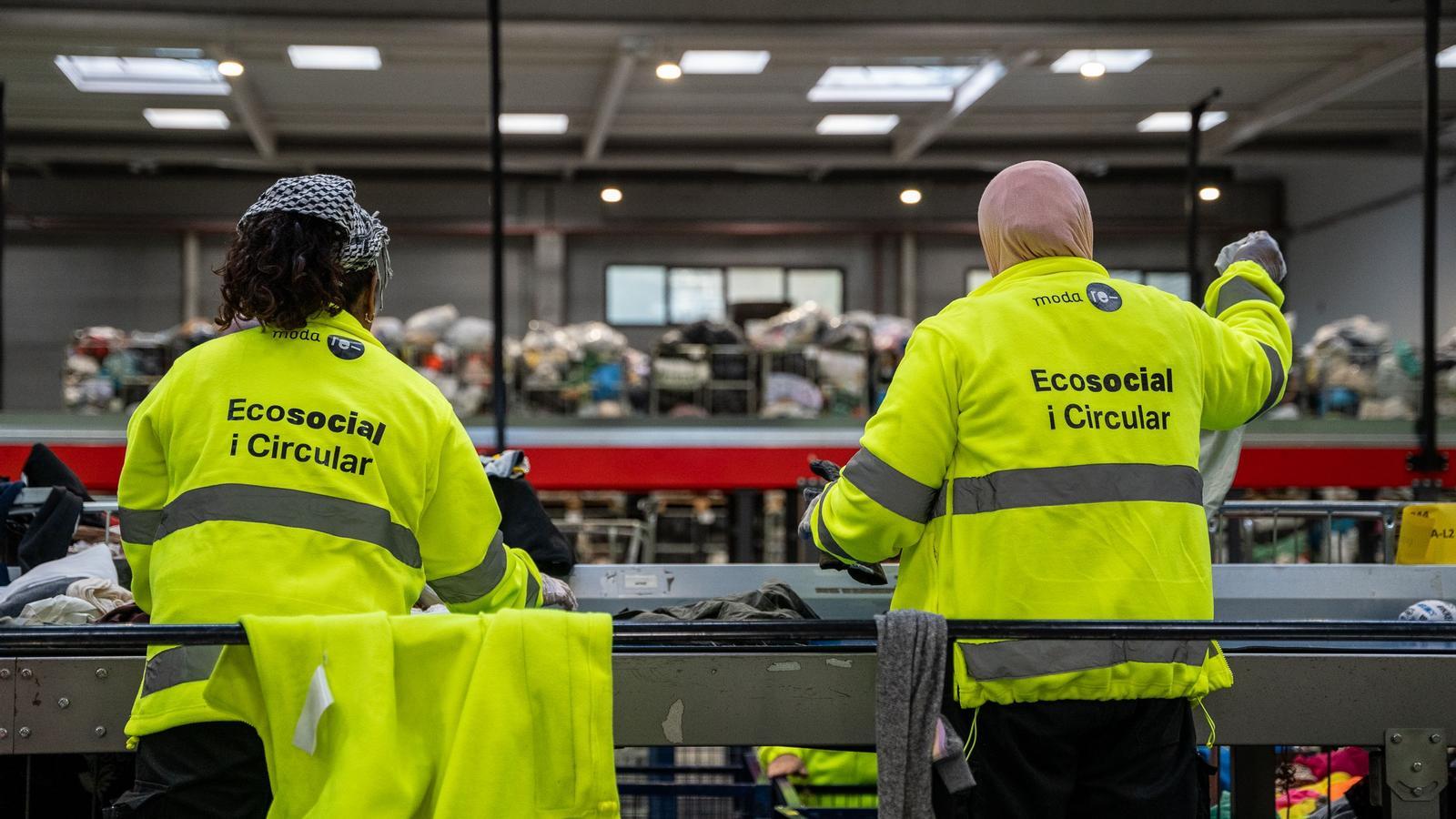
But, exactly, what are these businesses about? In the textile sector, the Formació i Treball Foundation manages hundreds of clothing collection containers distributed throughout Catalonia and gives a second life to the collected garments. One of the project's key moves occurred five years ago, when they decided to buy a 30,000 square meter warehouse in Sabadell to generate a large volume of production. Furthermore, as Borràs assures, they have allied with large companies in the sector to provide them with recycled clothing. Currently, the plant is working at 60% of its capacity, but the foundation expects production to increase even more once the regulations requiring a greater presence of recycled clothing in production chains come into force. In total, the foundation provides insertion jobs to 487 people thanks to the textile sector.
Another of the entity's great commitments is gastronomy, a field in which the foundation has 133 people in insertion. With the D'ins project, it has promoted a hospitality school aimed at people in vulnerable situations and a restaurant located on Carrer Llull, in Sant Adrià de Besòs. It also manages bars at different universities. Furthermore, it works on food recovery. However, all these initiatives are aimed at training cooks and waiters so that they can subsequently make the move to other restaurants. Thanks to these projects, the Formació i Treball Foundation has served 237,457 meals and has recovered 255,877 kilos of food. Aside from textiles and catering, the foundation develops many other lines of insertion: specifically, it works in 28 different activities.
A 62% insertion rate
From the creation of the foundation until now, as Borràs explains, the profile of the person served has been changing. When they started in 1992, the volume of immigration was much lower, while today the majority of the people who enter are foreigners. Furthermore, the president of the foundation also highlights that the qualification level of the people who arrive has decreased compared to years ago and that they now serve people with less prior training. As she explains, the ideal insertion process consists of making the training period last between one year and a year and a half to make the leap to the conventional labor market, although in some cases it can be extended longer, up to a legal maximum of three years. In 2025, of the 803 people the foundation accompanied, 62% obtained a job.
The bulk of its activity is located in Catalonia: it has the large recycling plant in Sabadell, the school and the restaurant in Sant Adrià, and it also has a presence in Tarragona, in the Garraf, and in other parts of the territory. In addition, as Borràs explains, outside of Catalonia it has a small representation in Madrid (with 25 people) and collaborates with operators in other territories, especially regarding clothing collection. The president of the foundation explains that she does not rule out growing further outside Catalan borders, although she assures that she does not want to compete with other actors already operating in these territories.
