Ayla Madison: “At 23 years old I left a stable job to turn art into my business”
The illustrator explains her relationship with work and money
-
CAT -
CAST
Making a living from painting is practically a utopia, the fine arts professors used to say in Ayla Madison's (Cardedeu, 2001) classes. But, until you try it, you don't know. With perseverance, effort, and motivation, the illustrator has defied the predictions they made for her at university. She left the stable job she had to dedicate herself fully to her artistic project.
Social media served as a loudspeaker for her to make her personalized portraits known: “I worked as a graphic designer and I liked it, but I wanted to be an artist, I wanted to try. With the free time I had, I created my project. I would post the works I painted on social media. I started doing free commissions and creating content on the internet”. Today she has almost 70,000 followers on Instagram: “I am very proud of the community I have created, of all the people who follow my work”.
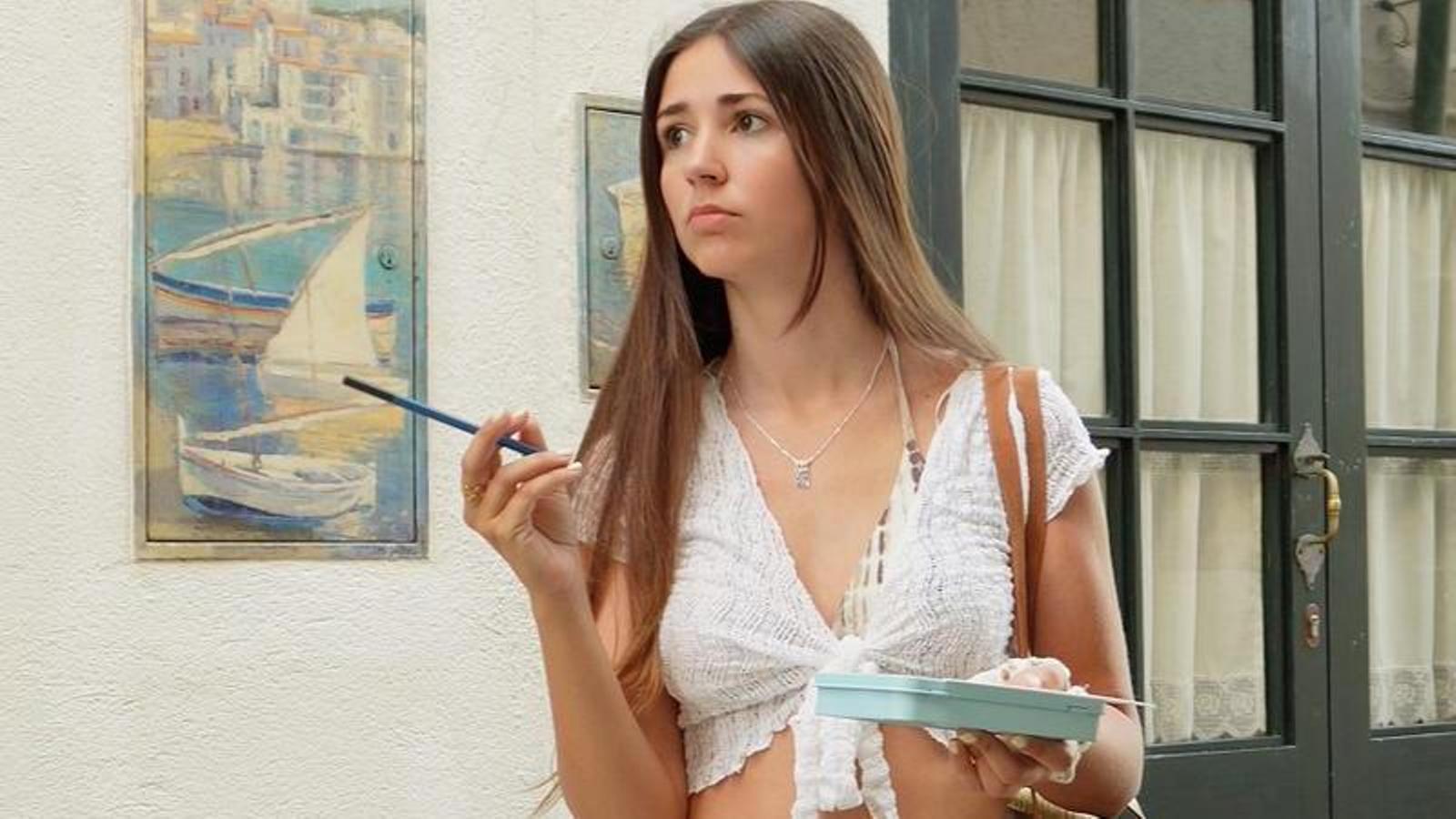
The illustrator is the pioneer of live art in Catalonia, the practice of creating a work live in front of the public, often at events: “I wanted to build a portfolio and I launched the free proposal to go to weddings to paint the guests”. Inspired by the trends in the United States, where her father is from, she bet on an unusual formula here. The initiative had a good reception: “When I saw that I could earn a salary, I left everything behind and went one hundred percent for art”.
The decision, however, was not easy. She doubted whether the project would work beyond the initial success: “I took the plunge. When you are self-employed and launch a project, nobody promises you anything”. At only 23 years old, she began her own path. Enthusiasm and motivation have accompanied her on a journey marked by constant learning: “Whenever I look back half a year, I think 'but what was I doing?' I feel like I have learned more in these two years being self-employed than during the whole of university”. “The biggest challenge has been learning to set limits. There have been moments when I should have slowed down the pace, because I was carrying many projects at the same time and it is complicated. I am learning to manage time and say no”, says Madison. At the beginning she accepted practically all the commissions, but, as the project has grown, she has learned that you cannot do everything.
For two years, all income has come from her business, which combines various activities: “I have Snail Mail, a monthly package for subscribers; custom prints; watercolor workshops; advertising for brands; I am also making a book for a publisher and I paint at weddings, which is the most profitable, but also what takes up the most hours”. Diversifying is a way to maintain activity: “I don’t like to depend on a single job. There can be a lot of passion and love, but it’s still a business. Besides, I really like to innovate and have different projects”.
Without disconnection
In fact, she asserts that she really likes being self-employed because it offers her "a lot of flexibility," although this means more responsibility: "It entails a lot of discipline and a lot of consistency. I work much more now. There is no comparison; before, I had my 9-to-5 schedule and then I would disconnect; now I never disconnect."
Regarding remuneration, she acknowledges that making a name for herself has allowed her to gain confidence. "At the beginning, I was not well paid at all. The first year I did a lot of free work and I constantly had to justify my prices; I constantly felt the impostor syndrome," she adds. Over time, however, she has confirmed that "in the art world, once you earn a name for yourself, it is easier to set prices." Even so, she tries to keep the products as accessible as possible.
She considers herself a frugal person and, in fact, looks to the future with ambition: "My intention is to be able to buy an apartment or a house: that is my aspiration. And, in the long term, I see it as viable." The subject of invoicing for the company, on the other hand, she delegates: "A manager handles everything for me and I simply try to focus on painting and creating services and products that are pleasing."
Regarding the future, she wants to continue in the art world: "I would like to have more personal work, be able to paint my own paintings, and have more freedom when creating. Even to give watercolor courses."
