"Sometimes you get the urge to leave the ball on the ground and walk away, but you have to hold on"
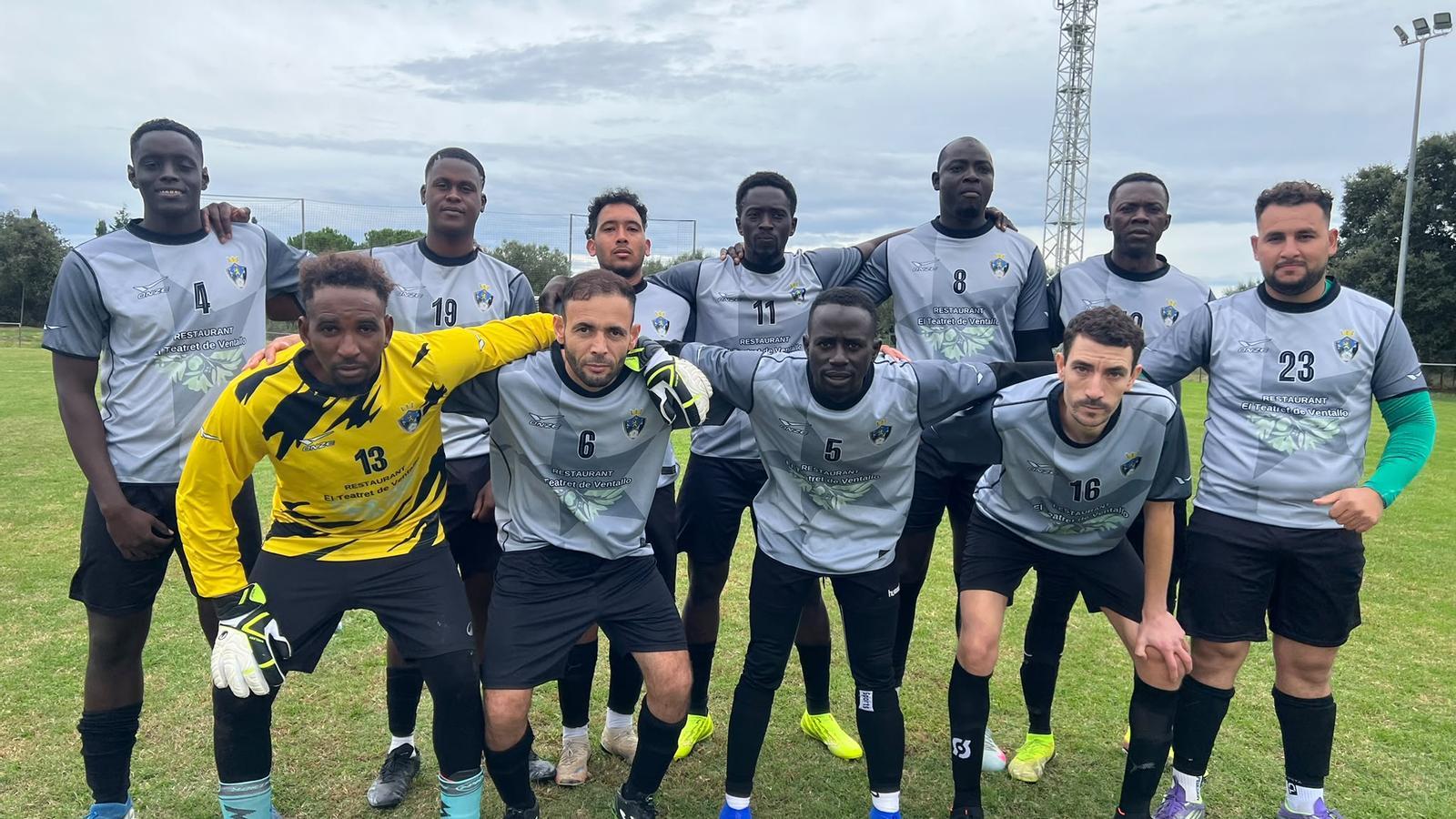
The small village of Ventalló, in the Alt Empordà, has a federated football team thanks to a group of Africans
-
CAT -
CAST
Ventalló“I thought that life here would be easier than it is. When I arrived, I was surprised by the cornfields. I thought there wouldn’t be any. I thought everyone walked around in a suit all day long,” sighs Aliou Sarr (Thiongue Wolof, Senegal; 1994). “Sometimes I have regretted coming. Television is very deceptive. They show you Barça, Madrid, big cities, everything beautiful. And you arrive and find yourself in Gualta or Fontanilles and you think: ‘Damn, this isn’t what I thought,’” spits Abdoulaye Kone (Abidjan, Ivory Coast; 1984). They are the coach and the ‘10’ of Esportiu Ventalló: the club of a town in the Alt Empordà that doesn’t reach a thousand inhabitants and has become a standard against racism in the Quarta Catalana. All the players are of African roots, except for one. On Sunday they celebrated their first victory after nine crushing defeats.
Ventalló is yet another small town that is bleeding out due to population loss. The bars and restaurants closed, as did the grocery stores and the bank branch, and it has been a long time since there was an ATM. The bus doesn’t pass through here either. The historic club also died, and the field was left orphaned. Until one day a group of people from different countries began meeting on the field. “They jumped the fence and played soccer. Soccer is a single culture, the only language that everyone understands,” asserts Maria Sey (Ventalló, 1990), the club’s secretary. That is how Ventalló was born, in the year 2023.
The club brings life to the town. “We take the town’s name everywhere. At the beginning, people asked us where it was. Now many people know it,” adds Sarr. And it also brings life to the players. The vast majority work in the fields, but there are also those who work at the slaughterhouse, at the factory, or on a pig farm.
“Most are alone and go from home to work and from work to home. They don’t go out. Here they have a meeting point and a community and an opportunity to have a social life and escape their reality. It is a tool for integration,” asserts Sey. Kone has found friends, work, and housing through football. Sarr nods: “We all come from the same place, maybe we have the same grandfather, but we didn’t know each other and didn’t know we lived side by side. Everyone has their own life, but here we have a life together. We talk and laugh and forget about everything else.”
They have always suffered from racism, but they point out that there has been a rise in recent times. “Now people spit out like it’s nothing what used to be shameful or what they wouldn’t dare to say. Everything is becoming more and more aggressive. It’s horrible,” laments Sey. They have made a thousand complaints to the federation about the behavior of rivals or even referees. Last season, one refused to shake their hands. “These are things that hurt a lot, a lot, unbearable. Comments from rivals and from the stands. Elderly people, children. You feel like leaving the ball on the ground and walking away. But you think: 'It’s only 90 minutes. You have to endure it.' It’s something that cannot be changed and that will always be there,” explains Sarr. They are already used to the “go back to your country.” “Now some speak of an invasion and it surprises me because many of us were already born here,” emphasizes Sey.
The veterans arrived regularly, a long time ago, like Sarr or Kone. “You think you can play for Barça and in many cases the reality is that you arrive and have to give it up. My father didn’t want me to play. 'I didn’t bring you here to play football. You came to help the family.' He would threaten me, saying he would make me return home if I played football,” explains Kone, who arrived on April 29, 2000. Sarr, on a Thursday in July at 6:15 in the evening.
“I don’t want them to call me and tell me that my brother is no longer here”
Then there are all those who arrived by sea, the majority. The word "pastera" [small boat] touches them all closely and opens old wounds. “Many have seen how they threw people overboard because they were dying,” points out Sey. No one wants to tell their story. Today, crossing the Mediterranean can cost between 800 and 1,500 euros, but it is only the last leg of an eternal journey. “They also speak of the desert. They explain that it is where most tragedies happen, that many dead are seen along the way, on land, and that the sand covers them up,” he adds.
Sarr’s older brother arrived by small boat, after days lost at sea: when he arrived, they discovered that the person who had their feet on him was not sleeping, that they were dead. Kone’s younger brother wants to arrive by small boat. “I’ve already told him that I won’t give him the money. I don’t want everything that some companions explain to happen to him. I don’t want them to call me one day and tell me that he is no longer there, that there is no body and there is nothing. It scares me. Because it’s a lottery, buying a ticket to live or die,” he acknowledges.
He speaks with a certain discouragement: “If you come without papers, you cannot go back; you get stuck. And you cannot go back to Africa without money, empty-handed. They would look at you badly: ‘What did you go there to do?’. You don’t live here and you don’t live there. Sometimes I talk to people from there and they don’t understand me. I tell them: ‘Look: what you have there is what I would like to have here’.” They say Kone is the grandfather of the team because he is already 42 years old, but he doesn’t want to quit. The ball instills hope and draws a small smile.

