Sergi Belbel returns to the musical with a mother who wants to turn her children into light
'El forat blanc' premieres on December 2nd and is the first show of the Sala Beckett in this format
-
CAT -
CAST
BarcelonaOf all the works by the playwright and director Sergi Belbel (Terrassa, 1963), there is one that left a deep mark on him: El temps de Planck. Premiered in the year 2000 at the Teatre Romea, that musical about the death of a father was born from a proposal by Calixto Bieito: “Go crazy, Sergi, write something that goes beyond yourself”. That is why when the director of the Sala Beckett, Toni Casares, gave Belbel a similar commission –to write something special during the season that the theater celebrates 10 years in the Poblenou building–, he followed that same path. Thus arose El forat blanc, the story of a woman at death's door who gathers her four children so they can resolve their disagreements before she leaves. The show, with a score by Òscar Roig, is the first musical at the Sala Beckett, where it will be performed from December 2 to January 17.
“El temps de Planck did not have stratospheric success with the public, but over the years I have realized that it has remained in people's imagination, that whoever saw it keeps a very strong memory of it. If there I spoke about the death of a father in a conventional 20th-century family, now I have written about the death of a mother in a dysfunctional family, very much of the 21st century”, explains Belbel. As in that creation, which equated death with a black hole, he has grasped onto physics to build the dramaturgy. “A book by the Italian astrophysicist Carlo Rovelli about white holes fell into my hands and I decided to turn the loss of the mother into that, into a universe where all the matter that disappeared into the black hole reappears in the form of light”, says the playwright.
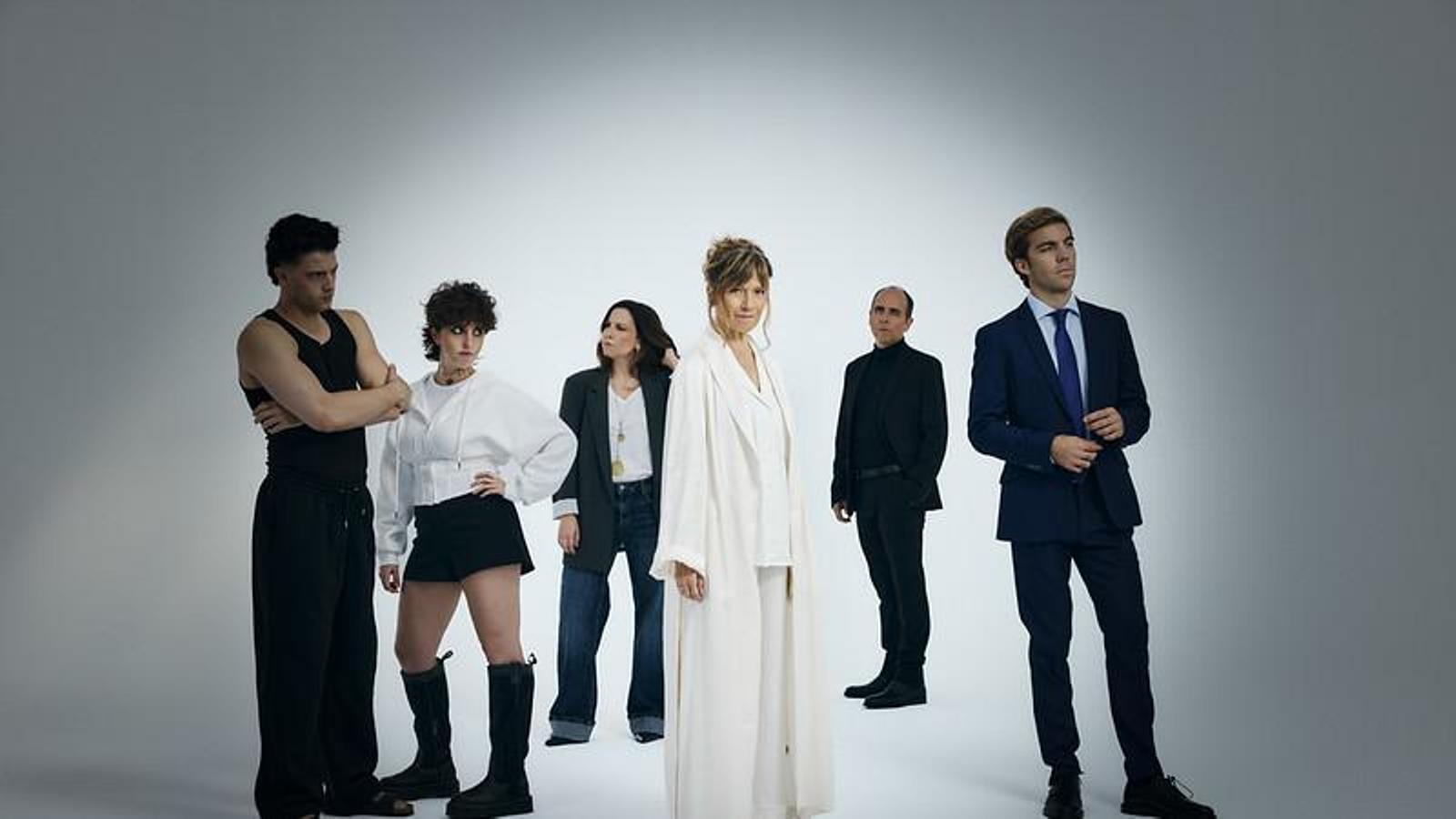
The pieces that make up this family puzzle share bonds and hatreds. There are two siblings (Eloi Gómez and Júlia Jové) from the protagonist's (Mone Teruel) first marriage, a third child (Pau Oliver) who does not share blood ties with her –because the biological parents are the second husband and another woman– but who has problems and the mother has adopted, and a daughter (Berta Luna) she had with the second husband. “She is the only one who has the blood of everyone, and the mother reminds her of it several times,” emphasizes Belbel. The sixth character of the show is played by Jordi Vidal and is the uncle of the two youngest children. “The mother has a long terminal illness and will ask this character, her brother-in-law, to help her die. Before that, however, she gathers all the children at the family home with the mission of getting all the darkness they have inside out,” points out the playwright.
An Oulipian creation
El forat blanc lasts for three hours (with an intermission) for a mathematical reason. When writing it, Belbel followed a method with Oulipian airs that helped him overcome his creative paralysis: there is not a single scene in the entire show where the same cast appears. “On stage there are all possible variants: six scenes with one character, 15 with two, 20 with three, 15 with four, 6 with 5 and 1 scene where all 6 appear,” explains the playwright, who is particularly proud of this production because it maintains a strong bond with Sala Beckett since its beginnings. The set design, by Max Glaenzel, reproduces a 70s design house and the costumes, by Mercè Paloma, transition from black to white as the characters evolve.
For the soundtrack, the show features the same musical creator as El temps de Planck, Òscar Roig. “He is one of the least known and best composers in Catalonia and part of the universe,” highlights Belbel. The musical score consists of 33 songs with influences from Sondheim, Legrand, and Streisand that will be performed live by a nine-piece band from the Catalonia College of Music (Esmuc).
