Judith Viader: "At Frit Ravich we are open to being a data management company"
Chief Executive Officer of Frit Ravich
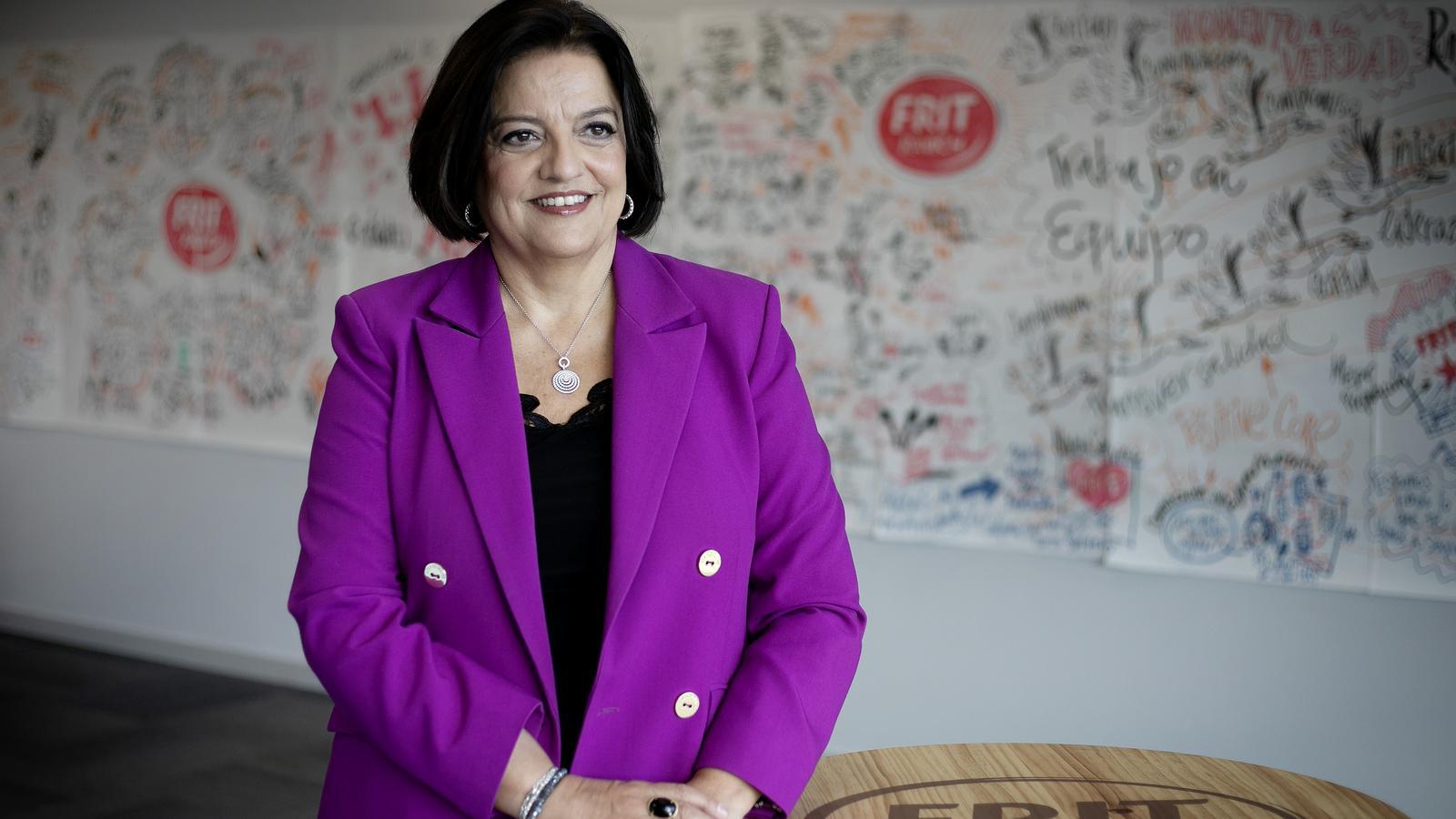

Barcelona131 million bags of potato chips, snacks, and nuts per year and 73,200 kilos of daily production establish Frit Ravich as a leading company in its sector. Its CEO, Judith Viader (Maçanet de la Selva, 1968), who welcomes 'Empreses' at the group's central offices in Maçanet de la Selva, aims to lead the company, which combines the production of its own brand with the distribution of third-party products, to sales of 600 million euros by 2030, compared to the 400 it expects to close with this year. Its roadmap includes a new factory to double production and a distribution center in Madrid with an investment of 115 million by 2030. It bets on digitalization and artificial intelligence (AI) as a driver of transformation and business model redesign.
Furthermore, she rules out the stock market for now, sees more possibilities for acquisitions than for the entry of any shareholder into the capital, and defends the values of a family business—the shareholders are herself, her parents, and her brother. Her father, the founder, Josep Maria Viader, 85, handed over the helm, and in earnest, in 2007, but he does not lose sight of the business. Even today, he still asks daily: "How are sales going?", his daughter assures.
How does one go from a family business founded in 1963 to a large company that competes today with multinationals?
— With years and a lot of work day by day. There are two recipes: enthusiasm and effort. This is one of my father's legacies.
How is the essence of a family business maintained?
— It is one of the challenges. We compete with multinationals, with whom we have a good relationship. We have always tried to bet on quality product segments. We have not gone for mass products, but rather to look for our target [target consumer] to provide more quality, whether it is the olive oil segment, pairing with other flavors, or popcorn, the experience of eating it at the cinema or being able to make it at home, with the healthy trend. My obsession has been that, even as the company grows, we must not lose this essence of a family business and must maintain our values.
As a family business I suppose that debt is almost a taboo...
— We are prudent, in general. This is closely linked to the long-term vision of family businesses and the sense of responsibility. This feeling of responsibility must be well-managed. It is not a responsibility that paralyzes you, but rather you combine the long-term vision and the sense of responsibility towards people and also with the whole process of company transformation, the new times, the new consumption moments... There are some values that must prevail and that you must protect. And there is another set of values that you must acquire to adapt to new realities, and one of the things that has always guided my leadership is that no one is left behind.
What assessment would you make of the generational change that took place in 1997?
— I started by leading the marketing department with an external CEO. Afterwards, he left, and that was the moment when my colleagues on the management committee proposed that I take on the leadership in 1997. They were years of transition with my father, but also with two key people, Josep Busquets and Miquel Sureda, one as commercial director, but more focused on clients; and the other on the management more of the people in the commercial department. I learned a lot from them and also a very important premise when you assume a responsibility like this: you must know the business and its orientation very well. We define it as a dual model, as manufacturers and as distributors. I have always been very imbued with this commercial outlook. Even today, my father, at 85 years old, the only question he asks me every day is: "how are sales going".
And did his father completely cede management, or does he rule from behind the scenes as happens in some family businesses?
— Not at all. I would say even the opposite. Surely at that moment, so many years ago, I was not aware of his generosity. Now I see it differently. He could be talking to the technical director or the production manager and say: "Look, I see it this way, but whatever Judith tells you." More than stepping back, he stepped aside and it was very good for me to know he was there. It gave me peace of mind and security.
And anything else about the terrain?
— Another very important topic was the role that my mother played. In the moment of the transition, it is also important that family prevails. My mother played an exemplary role: she never let us talk about work at home. She also played a crucial role of accompaniment and management at the moment of the transition.
And are they considering the stock market?
— The truth is that it is not. It is not among the things that have been on the company's radar.
They have a dual model, of own production and distribution of other people's products... How is that combined?
— It has its peculiarities. It allows you to be in contact with many companies that do it very well, and for them, we are their sales network. Therefore, you learn from many markets, from many categories, and from the way many companies do things. All this knowledge allows you to transfer it to your own brand. It does add complexity to the business because, at the end of the day, you combine manufacturing and protecting your own brands, making them grow, and adding value to them while doing the same for others. And we are also omnichannel; we work in food, hospitality... It is fun and very interesting.
Logistics must be key.
— It is crucial. It must work like a Swiss watch. For us, logistics is a total strategic advantage. We serve 50,000 points of sale every week. We fulfill 85% of these orders within 24 hours, and therefore, the challenge is significant, because there is only one logistics center in Maçanet and one regulatory warehouse in the Canary Islands. We also serve the north of Spain within 48 hours. Already in 1997-98, the warehouse was practically fully automated, which was truly a competitive advantage over other companies. Digitization and the emergence of AI must be a motor for transformation. It is an exciting and challenging time to rethink the entire company, how it transforms. We must not take the company's model and apply a layer of AI on top of it, but rather it allows us to rethink the business model.
And how do you adapt the product catalog to changes in consumption habits, less fat, less sugar? I suppose we can include the recent launch with Lacasitos here...
— We have some axes of transformation. One is the consumer, the client, the value chain, innovation, data and above all, people. We have a very present radar of where consumption trends are heading, listening a lot to our client. In 2016 we took advantage of our digitalization process to be able to listen to our consumers in a more efficient and closer way and understand what it is that they are asking of us.
I suppose inflation has increased their costs: have they passed that on to their customers?
— We have done as most manufacturers have, we are containing prices, but evidently we are affected by all the energy costs, logistics, and the procurement of some products. There comes a time when we must converge prices, but I believe that, in general, the entire industry and distribution sector have made a significant effort of containment.

What is the current weight of international expansion?
— It represents approximately 7% of the turnover. It is a product that expires in six months and takes up a lot of volume. Therefore, many times, logistics weighs more than the product itself. We started this export process many years ago, although not internationalization, but, for now, our growth process is framed here.
How do they approach sustainability?
— It is integrated from the product's conception. Many years ago my father spoke about sustainability, when no one talked about it. We do it from three perspectives: environmental, economic –for the company to endure over time– and social, throughout the entire chain, from the farmer and having the utmost respect for the agricultural world, to the last mile and our final client.
What impact will the new factory they are going to build have on production capacity? And the distribution center they are planning in Madrid?
— The current capacity will be doubled. With the new factory, we will produce the potato section, which will free up that part of the current factory that continues to run at full capacity, and there will also be a warehouse section. The first investment is the factory part and, afterwards, the next step will surely be to set up the distribution center in the central part of the peninsula in order to provide service.
How many hires are planned with the new factory?
— About 500.

And what is the calendar?
— The data we are providing is to finish by 2030. From 2027 to 2030, it must be graduated according to the needs we have. There is a very important point regarding the current acquisition of talent for new technologies.
Could it be local people?
— Yes. We are kilometer zero for many things. Also when we make investments, there is always a small part of them that we reserve for people in the area.
All these projects are part of the strategic plan, right? What are the essential points?
— Grow and strengthen the brand. We believe that we still have room for growth and that we can be a benchmark in the market. To grow in number of clients, in areas and in categories that we distribute, because we can still expand the portfolio. Make all operations more efficient and grow in productive and logistical capabilities.
And in numbers?
— The goal is to reach a turnover of 600 million euros in 2030. This year we expect to close at around 400 million and last year it was 359 million.
Have acquisitions of other companies been proposed to grow in your strategic plan or is the growth strictly organic?
— The possibility is not ruled out. We receive proposals in both directions: Entering with a stake in Frit Ravich and buying stakes in other companies. We listen more to the ones about buying than those about someone entering. At this moment, the feeling of the family and the team is for us to continue, but we must not close ourselves off to listening.
Are you thinking about expanding or diversifying within the food industry?
— Within the world of food, we are exploring different categories. We are very attentive to which categories are growing the most and which ones our consumers and clients may ask us for.
And in third-party distribution, as well?
— Yes. Third-party distribution is something we had always done in the impulse and hospitality sector, and during COVID it was one of the things we considered. With the closure of some clients, we considered becoming distributors for other channels and we have been working on it since then. Now we represent 3 or 4 brands in the food world as well. We work with 50,000 points of sale, and about 4,000 references weekly. We have a lot of information. What we did was to work well with the data we have from our clients, turning them into trends and information. We work with our suppliers on the management of all this to also revert it back into the business. We are even open to being a data management company.
How will they finance the planned investments?
— There is a portion of own resources, as in every good family business, and, obviously, also financially with all the banks and travel companions.
Banks make proposals to a company like yours.
— Yes, we can be very happy. I always say that we have companions on the journey. We have always received a very warm welcome.
How are they facing future generational handovers?
— My parents conveyed to us that we could do whatever we wanted. Even now, it is something they repeat a lot: that you should be able to do what makes you happy. If it is work, perfect; and if it is something else, then it is something else. I believe we were privileged to have that idea and that option. I do not have children, my brother has two, and I believe they have the same privilege of being able to choose. They are still very young.
Do you have any family protocol for the future?
— It is one of the things that must occupy me over the coming years. We do have a family protocol, but it is so informal that it is an agreement between my parents, my brother, and me, who are the shareholders of the company. It is more of a family-partner agreement than something very strict or highly formalized.

Why did you create the Viader Codina Foundation, which will be presented on November 12th?
— I was very excited to pay tribute to my mother, to everything she has always done for us, and especially for having given me the opportunity. I grew up among boys, but they made me believe that, as a girl, I could do whatever I wanted, that I shouldn't limit myself, and I wanted to thank her for that. Within the foundation, there is the legacy part for my mother, Rosa Codina. And on the other hand, there are these teachers, mentors, friends... One of them was Miquel Sureda, who unfortunately died very young from cancer. He was a person with a very special perspective on sales and customer relationships. I learned from him, and I didn't want that legacy to be lost. And the other part of the foundation is the Miquel Sureda Sales School, because I also believe that the sales profession, which I have enjoyed a lot, does not have specific formal training, and I think it should be given prestige.
This continues to be a very masculine world. What differences do you see between the way feminine and masculine management is approached?
— A few years ago, I thought this would go a little faster. In fact, with other CEOs, we have an association called I'm Women. Consumer Goods. I feel very proud of it, but it really saddens me to see how we are moving at the speed we are. I want to make the role of women visible. If we can be an example for any girl or young woman, you are more than welcome.
And the leadership differences?
— I think that nowadays there are not so many. In any case, I do not think it should be all women, diversity is good, because the sum of perspectives always adds up and contributes more. But there should indeed be parity. One of the things I am most proud of is that at Frit Ravich, 50% of the steering committee is made up of women. It is important that we women acknowledge that we also like to lead and have power, and that there is absolutely nothing wrong with that. It is a personal choice like any other. If you like to lead and take on responsibilities, we should be able to say so without any problem.
