"Only someone from eastern Georgia would start a meal with a bottle of Rkatsiteli". In the novel A Gentleman in Moscow, Count Alexander Ilyich Rostov guesses the origin of a Red Army colonel solely by the wine chosen during a dinner. This white grape variety from eastern Georgia becomes a more defining factor of identity than one's accent.Georgia is a wine country. With 8,000 years of winemaking history, it claims to be the first place on the planet where it was produced. And it still maintains a traditional production method, with qvevri, the ancestral clay vessels with which wine is aged underground. Most of the wine produced in Georgia is made this way and with local grape varieties. The most famous for red wines is Saperavi, which is used to make, for example, the delicious Kindzmarauli wine. Lovers of sweet flavors: don't forget to try pomegranate wine.
Trip to Georgia: nature in its purest state and Soviet vestiges
The small Caucasian country is a perfect destination, still quite untamed, for lovers of mountaineering, wine, and history

-
CAT -
CAST
TbilisiThe first photo I have on my phone's roll from the trip to Georgia is of a khachapuri. The second, of a khinkali. Two names that will quickly integrate into your vocabulary if you visit this corner of the Caucasus; there can't be many restaurants whose menus don't offer the two great emblems of this small country's gastronomy. Georgian cuisine, which used to be considered the best in the Soviet Union, is one of the country's heritages and a key element of its identity. Always with the permission of wine, the true reason for Georgians' pride, who claim to be its inventors. Georgia is a gastronomic and wine jewel; a treasure (still quite preserved and untamed) for lovers of nature and mountaineering; a must for fans of Soviet architecture and urbex. The "beautiful homeland of Stalin", as American journalist Robert D. Kaplan called it in The Revenge of Geography, enjoys (or suffers) a key strategic position, where Europe and Asia meet; "where Russia ends and the Middle East begins", as Kaplan summarizes in the book, which is a good resource for imagining what this turbulent area of the world was like during the post-Soviet chaos. Georgia has a colossal natural border to the north: the majestic peaks of the Greater Caucasus, with Russia on the other side. To the west, the Black Sea; to the south, Turkey and Armenia, and to the east, Azerbaijan.
This enclave has been both a gift and a curse for Georgia, which throughout history has been both a meeting point and a clash of civilizations. Georgians have resisted invasions from Byzantines, Mongols, Ottomans, Persians, Russians, Soviets. And even now, it lives with 20% of its territory under Russian occupation, since in 2008 Vladimir Putin militarily invaded South Ossetia and Abkhazia. Almost twenty years later, the wounds of this war remain open, as shown by the numerous graffiti on the walls claiming Georgian sovereignty over these two regions and rejecting the embrace of the Russian bear.

"Fuck Ruzzia!", "Never back to USSR", "We are Europe". Flags of the European Union, Georgia and Ukraine. The facades of abandoned buildings serve as a public backdrop for the demands of Georgian society, overwhelmingly pro-European according to all polls, despite the pro-Russian drift of the Georgian Dream party government, which has become one of Putin's regional allies.
Tbilisi, the capital of Georgia, is the main stage for this effervescence and political agitation, which has intensified since November 2024, when the last legislative elections were held, considered a fraud by the country's opposition and a large part of the international community. At that time, the Georgian Dream party government announced that it was halting the accession process to the European Union. For more than a year and a half, the daily protest in front of Parliament continued, which is now still alive with weekend gatherings, despite the "sophisticated architecture of repression" built by the Georgian authorities —in the words of a recent Amnesty International report—, with thousands of arrests and more than 150 people imprisoned.
Those who still resist continue to block Rustaveli Avenue, the main artery of the Georgian capital, on Saturday evenings. In addition to Parliament, a mix of imposing Stalinist architecture and European neoclassical style, this wide avenue, a kilometer and a half long built in the 19th century during the rule of the Russian empire, hosts some of the city's main buildings, such as the Opera and Ballet Theatre, the National Theatre, and the National Museum.
At the southern end of the avenue, Liberty Square acts as a transition between the city of the imperial era and the old town. The name of this large roundabout has changed five times in the last two hundred years, an example of Georgia's turbulent history. Inaugurated at the beginning of the 19th century with the name Paskevich-Erevansky Square, in honor of the Russian imperial army general who conquered Yerevan in the war against the Turks, it was renamed Theatre Square in 1851. The first time it was named Liberty Square was in 1918, when Georgia declared independence from the Russian empire. But independence was short-lived, and the square's name changed again: first, in honor of Lavrenti Beria, Stalin's fearsome head of political police. After he was executed for treason, the Georgian square changed its name again, this time in favor of Lenin, with a large monument to the Bolshevik leader, which remained until the fall of the USSR. In 1991, freedom returned to the country and to the square's plaques. Now, in the center reigns an enormous column crowned with a golden statue of Saint George slaying the dragon, a recurring symbol in the country.
In the old quarter of Tbilisi, your calves will be worked by walking up and down the cobbled streets, and you will admire the houses with carved wooden balconies painted in pastel colors and the conical bell towers characteristic of Georgia's ecclesiastical architecture. It is in the capital that the amalgamation of cultures is best perceived. Medieval churches, neoclassical and modernist buildings that evoke a more glorious past, and some of the best examples of Soviet brutalist architecture, such as the current headquarters of the Bank of Georgia, a kind of giant Tetris.

In Tbilisi, there are also signs of its proximity to Central Asia. In the Abanotubani district, the photogenic facade of the Orbeliani bathhouse is reminiscent of the Registan buildings in Samarkand. This thermal bath area next to the Kura River is characterized by brick domes, like small mounds, which help retain the steam from the sulfurous waters below. In fact, the capital's name comes from the word tbili, which in Georgian means warm or hot.
Untamed nature at the borders of Russia
From the capital, the easiest way to reach the impressive mountains of the Greater Caucasus is to drive along the so-called Military Highway, heading to Stepantsminda (better known by its former name, Kazbegi), the main population center of the region, at the foot of Mount Kazbek, 5,047 meters high. Here is one of the most depicted images in Georgian travel guides and articles: a medieval church on top of a hill with an imposing mountain in the background. The Gergeti Trinity Church has become a symbol for its isolated location, which perfectly summarizes the country's strengths: a rich historical and cultural heritage amidst superb nature.
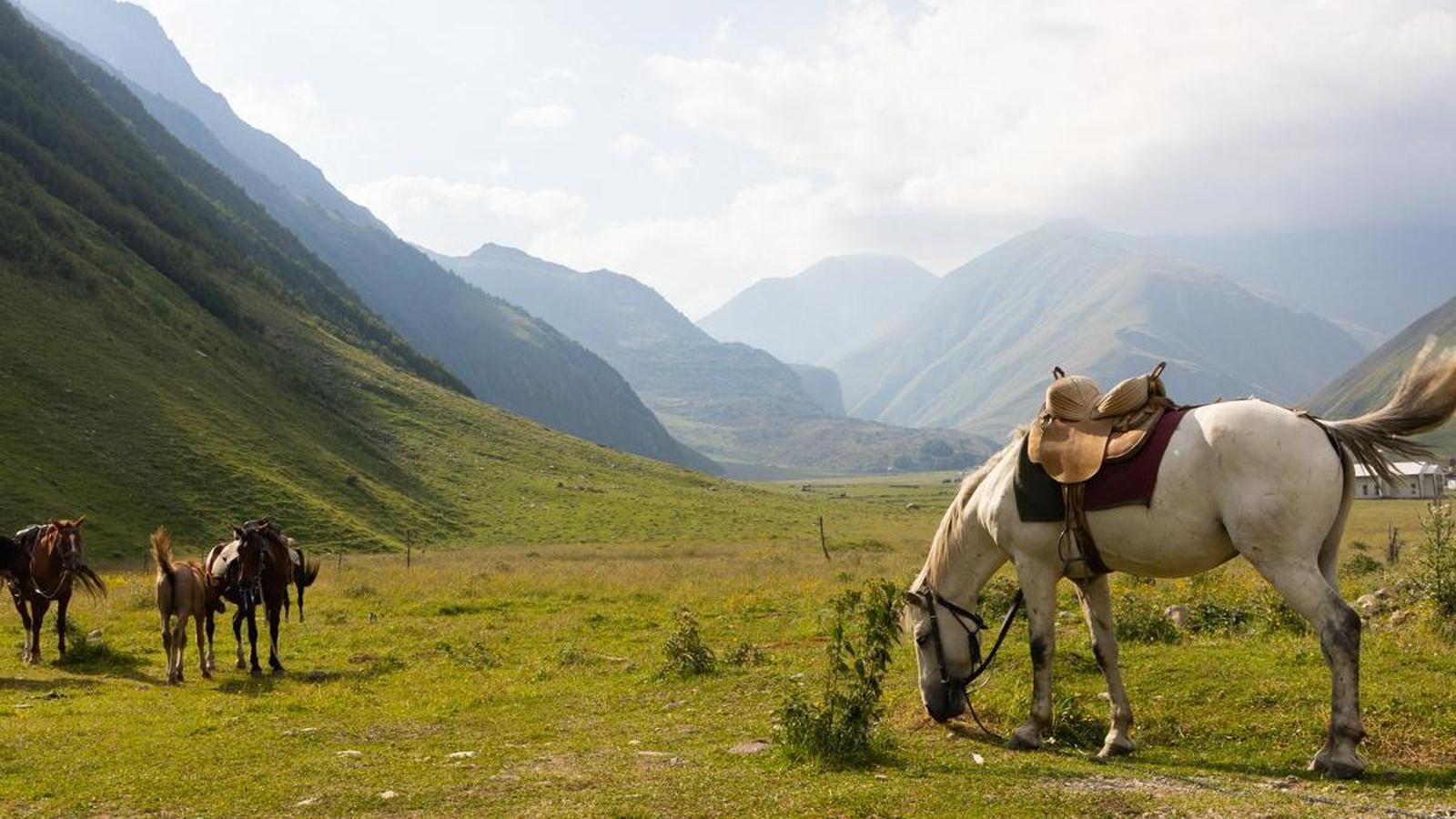
Stepantsminda will serve as your base for easy access to two beautiful valleys, Truso and Sno. Green meadows surrounded by imposing mountains, horses and cows grazing freely, thermal waters, winding rivers, and historical ruins.
But before reaching Stepantsminda, the four long hours of travel from Tbilisi already offer views that make the journey worthwhile. Especially when you reach the Djvari Pass, a mountain pass at almost 2,400 meters above sea level, from where you can already get a taste of the Greater Caucasus. A little before, it's worth stopping at the Monument to Friendship between Russia and Georgia, a large circular stone structure decorated with a colorful mosaic that runs along the entire inner circumference, with scenes from the history of the two countries. One of the many vestiges of the Soviet era that remain in Georgia, interesting for the monument itself and for the views from the viewpoint, although don't expect tranquility: it is surrounded by stalls selling souvenirs and commercial music in the background.

The Military Highway is the only possible route to travel from Russia to Georgia and it is also a vital passage for Armenia and other countries in the region, such as Turkey and Azerbaijan. This makes it common to see long queues of freight trucks and tankers waiting to enter or leave the country, sometimes stuck for days due to bad weather. But this is relatively close to changing. A monumental Chinese project is underway to build a new road that will avoid the twists and turns of the mountain pass and the dangers of landslides and will facilitate the transport of goods, and will probably also boost the tourist exploitation of the area.
Georgia is also establishing itself as a destination for winter sports lovers. In recent years, it has invested in modern ski resorts and cable cars that allow access to slopes at 3,000 meters above sea level. The largest and most modern complex is Gudauri, in the east of the country. In 2019, the cable car connecting the resort with the village of Kobi was inaugurated, allowing access all year round, considering that snowfalls and landslides often cut off the road to Djvari pass during winter.At the other end of the Greater Caucasus is the Tetnuldi ski resort, about 20 kilometers east of Mestia, which offers 25 kilometers of slopes, and also the Hatsvali resort, smaller and at a lower altitude, but more accessible from the capital of Svaneti.
Georgia is a small country, but never trust what the browser tells you. There are stretches where livestock own the roads, especially cows, but also horses and some pigs –especially on bridges, where they seem to like to rest–. But you will also take longer than you expect because you will stop and stop and stop to take photos and videos. And in several stretches you will have to slow down because the road is full of potholes. Especially to reach the western part of the Georgian Greater Caucasus, the remote region of Svaneti, one of Georgia's main tourist attractions for its exceptional mountain landscape and fortified medieval towers. Svaneti is home to the Svans, a sub-ethnic group of Georgians with their own language who have lived isolated for centuries, something you will probably notice in their rather dry character, despite the openness of recent years thanks to tourism.
Here, the must for those who are in shape is to do the famous hike between Mestia and Ushguli, a little less than 60 kilometers surrounded by 5,000-meter mountains, including Mount Elbrus, the highest peak in Europe, already in Russian territory. But from Mestia there are many other very worthwhile day trip options, such as the one that easily allows you to reach the Chalaadi glacier.
Soviet relics and urbex
Georgia is also an ideal destination for those interested in Soviet culture. One of the points you should mark on the map is Gori. It cannot be said to be a beautiful city, but it is famous for being the birthplace and upbringing of probably the most famous historical figure in the country: Iosif Vissarionovich Dzhugashvili, that is, Stalin. The main attraction is the museum dedicated to the dictator, which has practically not changed since it was inaugurated in 1957, four years after his death. It is a place to visit with a critical eye; it basically continues to be a patriotic exaltation of Stalin's life and work (with practically all explanations in Georgian and Russian), without any reevaluation having been made. The only mention of the atrocities of the Stalinist dictatorship is a room at the exit of the museum, a ridiculously small addition compared to the scale of terror unleashed by Stalin for almost three decades.
In Gori, make an effort and look for the KE&RA restaurant — it's not easy to find —. And near the city, it is worth stopping at Uplistsikhe, one of the oldest settlements in the Caucasus, a pre-Christian rock-hewn city, built into the stones.
Continuing with the Sovietophilia, you must stop in Chiatura, a city that at the beginning of the 20th century produced around 60% of the world's manganese, a key mineral for the steel industry of which the USSR was one of the main world powers. Until a few years ago, it was an open-air museum of Soviet industrial glory and its main attraction were the old cable car cabins suspended over the city. Now it is difficult to find them because efforts are being made to revive the city, although for the moment it still has the air of a ghost town and allows you to explore some ruined Soviet vestiges.
The same is happening in Tskaltubo, the benchmark in Georgia for urbex lovers: an old spa town abandoned after the fall of communism, with about twenty hotels that with their colonnades and spiral staircases hint at the splendor that only the regime's elite could enjoy. Now, although many are closed or under renovation, some can still be explored (be careful with the stray dogs that have made them their home). Some of the abandoned buildings have become a refuge for Georgians who had to flee South Ossetia or Abkhazia during the 2008 war and who have not been rehoused in more dignified buildings.

The subtropical Black Sea
When you approach the Black Sea, one of the first things you notice is the thermal shock: in a few hours you can go from the cold of the high mountains to the stuffy subtropical climate of the autonomous republic of Adjara, a border area with Turkey that has a predominantly Muslim population. Batumi, the capital, has become the beach destination par excellence in the country after Russia occupied the coastal region of Abkhazia. But Adjara has an interior worth visiting, a world totally different from the coast, with the Lesser Caucasus Mountains, scattered villages with wooden houses and tin mosques. A good option is to travel through the interior of this region along the road that connects Batumi and Akhaltsikhe, which crosses the Goderdzi Pass at an altitude of 2,027 meters.
I cannot finish an article about Georgia without mentioning the pleasures of the table. It is precisely from Adjara that khachapuri comes, probably Georgia's most iconic dish, often described as a Caucasian version of pizza, basically made with a boat-shaped bread base, melted cheese, and an egg in the middle. If you want to take home an original gastronomic souvenir, you can opt for churchkhela; you will see them everywhere: strings of them hanging in shops and street stalls that from a distance might look like a cured sausage similar to salami, but they are a sweet made with nuts coated in a thick grape juice. One last piece of advice: before trying the other great benchmark of Georgian cuisine, khinkali, for the first time, ask how it is eaten. And, of course, accompany all the meals you can with a local wine.
Whenever I travel to a new place, I try to read a book or watch movies or series that help me understand its society and culture a little better. In the case of Georgia, I recommend the film And then we danced, by Levan Akin (you can find it on Filmin). A story of young love and self-discovery set in contemporary Tbilisi, still too conservative for the protagonist, Merab, a dancer who must fight against his desires and his environment. The common thread is traditional Georgian dance, with an aesthetic and dramatic force that captivates.
