Five-square-meter apartments and more Mandarin in the streets: the metamorphosis of Hong Kong
The escalators of the Central neighborhood traverse a vertical metropolis that changes at every section
-
CAT -
CAST
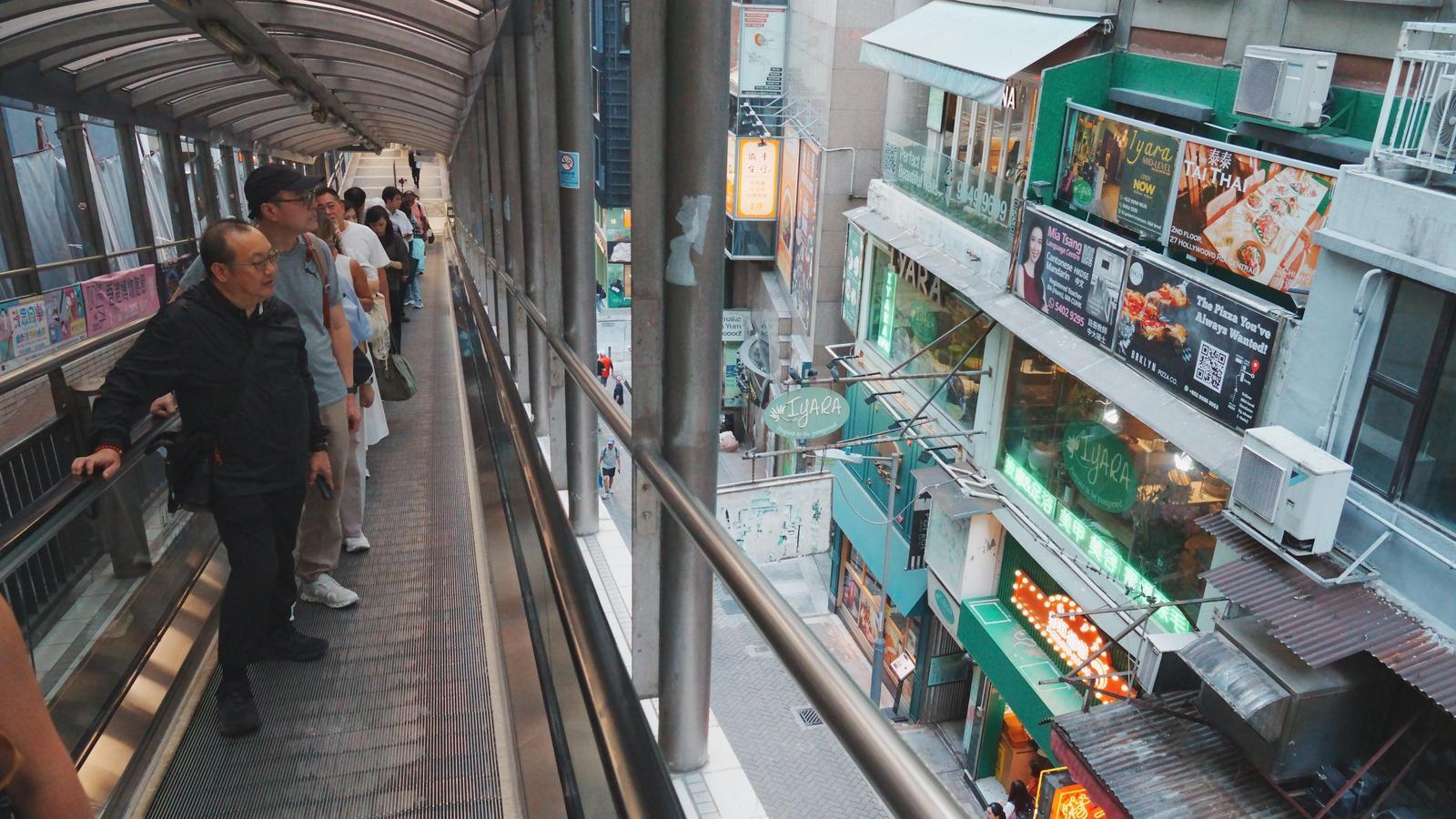
The covered escalators of the Central district are one of the most unique urban infrastructures in Hong Kong. With a route of over 800 meters, they connect the financial district with the residential neighborhoods located on the hillsides of the island and overcome an elevation change that would make the daily commute of thousands of people much more complex. But this transport system is much more than an engineering solution: it is a privileged viewpoint of a city that changes at every section and that continues to reinvent itself between tradition and modernity.
The route starts next to the renovated Central Market, a former municipal market now converted into a cultural and commercial space. The first section crosses one of the areas with the most activity in Hong Kong. Around the market and the adjacent streets, traditional shops, century-old restaurants, and new establishments coexist, reflecting the constant evolution of a city accustomed to transforming its spaces without completely losing its memory.

A few meters further up, one passes by the old colonial Parade Ground, now integrated into the Tai Kwun heritage complex, before continuing towards the SoHo neighborhood. Here, art galleries, international restaurants, and small independent businesses coexist with the constant presence of the financial district's skyscrapers. In a few minutes, the urban landscape changes seamlessly, revealing the multiple layers of a city where different eras coexist just a few meters apart.
The journey is also a lesson in urban planning. Hong Kong is a city built vertically, constrained by steep geography and limited land availability. Buildings climb the slopes of the island and daily mobility has adapted to this terrain, to the point that the escalators are part of the daily life of thousands of residents. Inaugurated in 1993, they have become over the years one of the most recognizable symbols of a metropolis forced to find solutions to live with its own limits. The verticality of Hong Kong is not just an architectural feature; it is also the consequence of a city that has learned to grow upwards because it could almost no longer expand horizontally.
Wong Ming-wai, a 29-year-old graphic designer from Hong Kong, uses them every morning to get to work. From there, he watches how the skyscraper windows reflect the light while the city wakes up, but he also knows the other side of this verticality. He shares a flat of only 22 square meters with his partner, for which they pay approximately half of their combined income. "Living in Hong Kong is an exercise in constant sacrifice: you give up having space, privacy, and making plans for the future," he explains. "The city grows upward, but our life expectations seem to get smaller and smaller."
Micro-apartments and the housing crisis
It is when the stairs lead into the residential neighborhoods that another side of Hong Kong appears. Behind the facades of large housing complexes hides one of the most strained real estate markets in the world. The price of land and the lack of available space have forced many families and workers to adapt to increasingly smaller homes, while so-called “micro-apartments” have become the most extreme symbol of real estate pressure that affects broad sectors of the population.

Residential precariousness remains a structural problem in Hong Kong: the latest population census counted about 108,200 subdivided housing units in which nearly 215,700 people lived. The average habitable surface area per person in these homes was six square meters, compared to 16 square meters for all Hong Kong households. To regulate the conditions of these apartments, the government approved regulations in 2025 that came into force in March and established minimum requirements for habitability, hygiene, and safety. The rule provides for a transition period of 48 months to register existing housing units and adapt them to the new requirements.
From the stairs, it is hard to imagine what is hidden behind many of these facades. The residential buildings project an appearance of normality, but inside, every square meter has an extraordinary value. For many people, living in Hong Kong implies a constant negotiation with space: small dwellings, layouts designed to the millimeter, and a daily life conditioned by dimensions far removed from the expectations common in other large cities.

This reality especially affects the new generations. The housing crisis cannot be understood only through square meters: it is also a generational and social issue. For many young Hong Kongers, becoming independent or accessing a space of their own has become an almost impossible challenge, forcing them to delay personal projects such as moving out or starting a family. In a city where housing has been for decades one of the main symbols of status, the lack of space is also a clear indicator of the metropolis's internal inequalities.
Despite these tensions, the Central escalators continue to show an extraordinarily dynamic city. During the journey, workers from the financial district, students, residents of middle-class neighborhoods, and tourists who use this infrastructure almost as an urban viewpoint coincide. In a few hundred meters, this route concentrates some of the multiple realities of a metropolis where different economic, social, and cultural levels coexist.
Throughout the day, the rhythm of this route also transforms. In the morning, the movement is marked by workers heading down to the financial center and transport connections; in the afternoon, the flow reverses and the escalators become the path home to the neighborhoods located on the island's slopes. An apparently simple routine that reveals the extent to which geography shapes daily life in Hong Kong.
Over the years, the escalators have become a natural extension of the city's streets. For a few minutes, the differences between the worlds this infrastructure traverses fade into the background: the executives working in the skyscrapers of Central coincide with the residents living on the steep streets of the mountain slopes.
A social transformation
But Hong Kong is also changing beyond its architecture. In SoHo, the change is also felt behind the counters of small businesses. Mr. Lau, 62, has been running a restaurant next to the escalators for four decades. When he started, he explains, his day-to-day life took place mainly in Cantonese, with the English of expatriates and tourists as a common second language. Now, he says, more than half of his customers are young professionals from mainland China.
“At first it was hard for me to see, but Hong Kong has always been this: a transit station where people arrive, mix their culture, and reinvent themselves,” explains Lau. “The language of the streets is changing, the rhythm is different, but the city’s spirit of survival remains intact beneath the concrete.”
The transformation that Lau describes is not just an impression from someone who has been behind a counter for four decades. In recent years, the city has experienced a significant demographic transformation, marked by the departure of some of its residents to other countries and the arrival of new inhabitants, especially from mainland China.
These demographic changes cannot be separated from the political transformations that Hong Kong has experienced. The reforms driven by the Chinese authorities have gradually eroded the “one country, two systems” principle, which since the 1997 handover was supposed to guarantee the former British colony a high degree of autonomy from Beijing. The 2014 Umbrella Movement, which demanded more democracy, and the mass protests of 2019 preceded a new stage of confrontation with the Chinese authorities. In June 2020, Beijing imposed a national security law that expanded penal instruments against dissent and has been used against pro-democracy leaders and independent media.
The arrest of 47 activists and politicians opposed to the dictates of the Chinese Communist Party in 2021, the closure of media outlets such as Apple Dail, and an electoral reform that restricted opposition participation contributed to creating a climate that pushed thousands of residents to leave. The United Kingdom, Canada, and Australia enabled specific immigration pathways for Hong Kongers, among whom were qualified professionals and families with school-age children. In parallel, at the end of 2022, the Hong Kong government launched new programs to attract talent from abroad, which have facilitated the arrival of qualified workers from mainland China.
Hong Kong retains many of the elements that have defined its personality for decades, but the city that goes up and down these stairs is no longer exactly the same. Walking up the sections of SoHo, today it is as common to hear Mandarin as Cantonese, a change that no architectural plaque records but that becomes evident in restaurants, shops, and conversations.

This evolution does not necessarily imply the disappearance of the previous Hong Kong, but rather the incorporation of new layers into a city that has always been marked by a mixture of influences. The colonial past, the Cantonese tradition, its role as an international financial center, and its increasingly close relationship with mainland China are part of the same urban reality. The Central escalators are a good metaphor for this complexity: a daily journey where different stories and ways of understanding the city coincide. The Central mechanical escalators do not only connect two points of the city: they also explain a metropolis that continues to adapt to its geography, its past, and the changes in its society.
