Journey to the African Machu Picchu, origin of the legend of King Solomon's mines
The Great Zimbabwe is the most important historical construction of sub-Saharan Africa and witness to a great disappeared civilization
-
CAT -
CAST
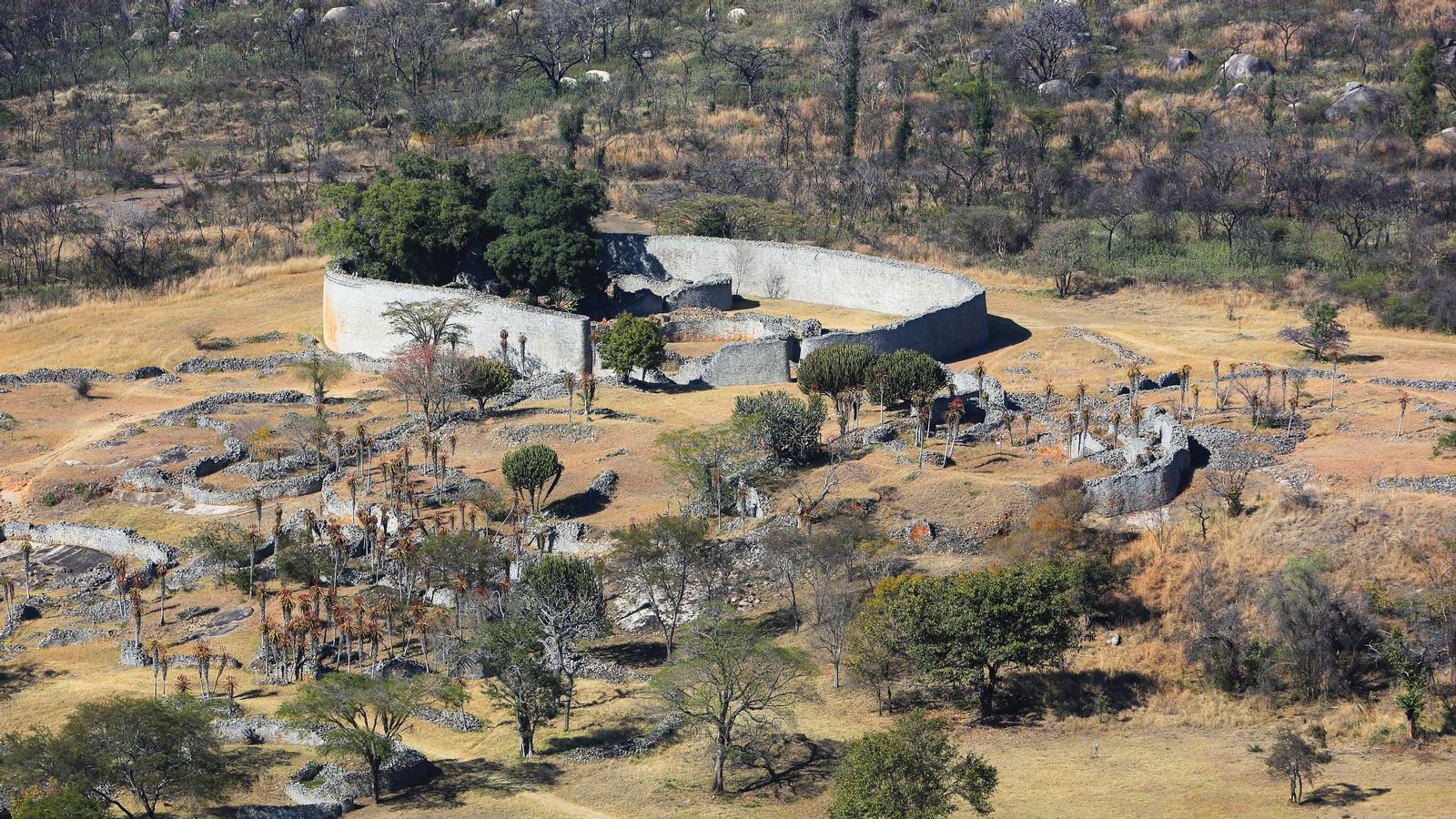
ZimbabweIf there is one place in Africa that is worth visiting to understand the deep mystery of the continent, it is Great Zimbabwe. These are enigmatic ruins that rise in the southeast of Zimbabwe, far enough from the capital, Harare, and the country's second city, Bulawayo, for most tourist circuits to ignore them. A big mistake, since when you walk among the walls of Great Zimbabwe, or when you climb to the fortifications on the high part, you realize that Africa is much more than what historians say who insist on narrating the history of Africa starting from the arrival of the first explorers.
The ruins of Great Zimbabwe, which some define as "the African Machu Picchu", are the most important construction that was made in sub-Saharan Africa. It is believed that they have their origin in the 12th century, that it was the capital of the Monomotapa Empire, which extended between Zimbabwe and Mozambique, and that it housed more than 20,000 inhabitants. Its inhabitants exchanged gold and other products with European and Asian merchants who arrived by ship to the coasts of Mozambique and in caravans to Great Zimbabwe, until one day its inhabitants abandoned the settlement to go live in other places.

Be that as it may, walking today among the ruins of Great Zimbabwe, through a genuinely African landscape dotted with flowering jacarandas, is a unique experience.
A great civilization
When the first Portuguese arrived at Great Zimbabwe in the 15th century, the Monomotapa Empire was already in decline, but they were surprised by the monumentality and extent of the ruins, which occupy a radius of seven square kilometers. The perfection of the wall joints, made with hand-cut stones, was attributed to the intervention of a civilization that came from the north. Later, the first archaeologists who studied the ruins insisted on this hypothesis, as they thought that Africans were not capable of making constructions like this. Over the years, however, it has become clear that Great Zimbabwe was built by Africans.

The Great Enclosure and the Hill Complex are the two most prominent sites of the ruins. In the former, the high walls and a mysterious conical tower raise questions for the visitor, while in the latter, the fortification and the palace, along with the great views, leave those who arrive there amazed and allow them to imagine the splendor of this civilization.
Some birds carved in stone, most likely eagles, were one of the notable findings of the ruins. In 1889, a German missionary, Wilhelm Posselt, bought one from a tribal chief and sold it to the English millionaire Cecil Rhodes. He liked it so much that he kept it in his library in Cape Town. Currently, it is one of the symbols of Zimbabwe and appears on both the coat of arms and the flag of the country.
Cecil Rhodes died in 1902, when he was only 48 years old, but he had already established, thanks to the money he had obtained from diamonds and also to his imperialist spirit, the foundations of what would be Rhodesia, a non-recognized state in Africa that was named after him in 1965 and which existed until 1980, when free elections gave independence to the country that is today called Zimbabwe.
King Solomon's Mines
The legend of King Solomon's Mines has its origin in Great Zimbabwe. The first archaeologist to work in these ruins, the German Karl Mauch, speculated with the hypothesis that this place was the legendary kingdom of Ophir, from where a thousand years earlier sandalwood was extracted for King Solomon of Israel. Starting from this theory, Henry Rider Haggard published, in 1885, one of the great adventure novels that have been written about Africa: King Solomon's Mines.
Haggard had lived in South Africa and knew the Zimbabwe area well. Furthermore, a brother of his had been a British vice-consul in Lamu, the beautiful city in Kenya. All of this gave him extensive knowledge of Africa which led to the great success of King Solomon's Mines, a novel that is still being reprinted today and of which several film versions have been made. The adventurer Allan Quatermain, the protagonist, is inspired by Frederick Selous (1851-1917), a great hunter from this part of Africa, a friend of Cecil Rhodes.
The city of Bulawayo
About a five-hour drive from Great Zimbabwe, along a road in poor condition, lies Bulawayo, the country's second city. Unlike Harare, the capital of Zimbabwe, it is a colonial city with old buildings, such as the Bulawayo Club, which dates back to the late 19th century. Now converted into a hotel, the old walls and stately rooms, covered in mahogany, still retain the flavor of old Rhodesia, with large portraits of Cecil Rhodes and the Ndebele king Lobengula in the main hall.
The Bulawayo Club, in any case, is one of those places where you feel like having a gin and tonic, the drink invented by British colonists to fight malaria. The tonic, they argued, was the medicine; and the gin, they added with a smile, gave it joy.
Bulawayo, by the way, means "city of slaughter," in reference to a battle that took place in the area with a bad outcome for the Ndebele. In any case, the name is so grim that they now prefer to call it the City of Kings.
Not far from the Bulawayo Club is the old train station where a retired rhodie railway worker, Gordon Murray, explains with enthusiasm the history of the railways of old Rhodesia. Among the material on display is the oldest train preserved in the country, from 1897, which was Sir Cecil Rhodes' personal train, and some photographs from when Queen Elizabeth II visited the country by train.
Murray places special emphasis on the old project that Cecil Rhodes had to unite Cape Town with Cairo with a train line. Not far away, in the heart of the center, in a 1931 building, one can still see a reference to the old project, with a sign indicating that Cape Town is 1,150 miles (1,850 km) away and Cairo 3,500 (5,600 km) away. The train, however, does not always run. As an alternative, nearby is the chaotic bus station.
The tomb of Cecil Rhodes
A few kilometers from Bulawayo is the Matobo National Park, full of mysterious rounded rocks. On one of the hills is the grave of Cecil Rhodes. The view from the top is beautiful, but the people of Zimbabwe point out, in a low voice, that they do not have good memories of Rhodes. "Anyway, we maintain the tomb because it is part of the country's history," comments a guide with a conciliatory attitude.
Rhodes, who made money in South Africa with diamond mines, led, with his company, a column of pioneers that occupied the lands of present-day Zimbabwe and Zambia. His imperialist dream, however, collapsed years later, in 1980, when Zimbabwe and Zambia became independent countries.

In this same park, not far from Rhodes' grave, there are a few white rhinoceroses, a species that the rangers strive to keep away from poachers.
Under the guidance of an armed ranger, and maintaining a cautious attitude, it is possible to approach the rhinoceroses on a walking safari. Seeing them up close, usually resting under a tree, is one of the thrills of a trip to Zimbabwe.
The elephants of Hwange
About three hundred kilometers from Bulawayo, along a road with many roadworks and frequent detours, lies Hwange National Park, the largest reserve in the country, covering 14,600 square kilometers. There, one can see "the big five", including numerous elephants, without the crowds of tourists usually found in Kenya and Tanzania.
What is great about Hwange are several viewpoints, near large waterholes, from where one can watch the animals that come to drink. Seeing herds of impalas, kudus, giraffes, and especially elephants from so close makes you feel very close to Africa. In case the visitor hasn't had enough during the safari, at the Hwange Safari Lodge, they have the elephants very close, on the other side of a security trench that separates the hotel garden from a waterhole. From time to time, a daring elephant manages to jump the trench and enter the garden to eat the grass. When it happens, while tourists run to take photos of it, the hotel staff try to chase it away with shouts and gestures.

In another accommodation in the same park, Robins Camp, the scene can be repeated, with a dining area located very close to the waterhole where the elephants drink. Not far away, at the airstrip, the guards explain that they have had to put up a fence to prevent the hyenas from approaching the light aircraft, as they like to eat the rubber of the tires.
The spectacular Victoria Falls
When leaving Hwange Park and approaching Victoria Falls, the most touristy town in Zimbabwe, baobabs begin to abound, those trees that look like they were planted upside down and are one of the most powerful images of Africa.
The great spectacle of Victoria Falls does not take long to appear. They are on the Zambezi River, on the border between Zimbabwe and Zambia, have a width of about 1,700 meters, and plunge down a 130-meter-high fault. They were discovered for Europeans by the explorer David Livingstone in 1855 and he named them after Queen Victoria. The original name, however, is Mosi-oa-Tunya, "the smoke that thunders".
Contemplating the falls from the path on the Zimbabwe side is a wonder, as you have the entire front of falling water in front of you. On some occasions, the wind sends the water towards the path and soaks you from head to toe, but that is also part of the great spectacle. Tropical vegetation, with some baobabs growing near the river, completes an exceptional panorama.
The falls attract tourists, but also some clever ones, like Jimmy, a taxi driver from Victoria Falls who takes advantage when the wind blows towards the road to start washing his car, as if it were a free natural car wash.
Victoria Falls has become a tourist town over the years, with many hotels, restaurants, and shops. The star of it all is the Victoria Falls Hotel, a five-star hotel built by the British in 1904 that withstands the passage of time very well. From the garden, one can contemplate the smoke raised by the mist of the falls, and from its colonial-style bars, one can evoke the adventures of David Livingstone, who died in Zambia in 1873 while searching for the sources of the Nile. Two years earlier, on the shores of Lake Tanganyika, Henry Stanley had found him when he was considered lost and had uttered the most famous phrase of exploration: "Doctor Livingstone, I presume".

Apart from contemplating the famous waterfalls, in Victoria Falls you can see the majestic baobabs that are nearby, among them the so-called Big Tree (with 22.40 metres in circumference and 24 metres in height), or sail in the evening along the Zambezi River having a cocktail on the deck of a boat while you hear the cries of the wild fauna and watch as the sunset dyes the sky a fiery red.
For those who want more, they can take advantage of the fact that Victoria Falls is on a triple border to go to Botswana, to visit the Chobe National Park, or to Zambia, where the city of Livingstone is located, with a museum that evokes the spirit of Great Zimbabwe and that seems to revive the spirit of the explorer who gives his name to the town.
