"It was night, I was inside the ocean, tired, and right underneath I had a shark"
The swimmer Fernando Espina has specialized in extreme crossings swimming in icy waters for charitable purposes

-
CAT -
CAST
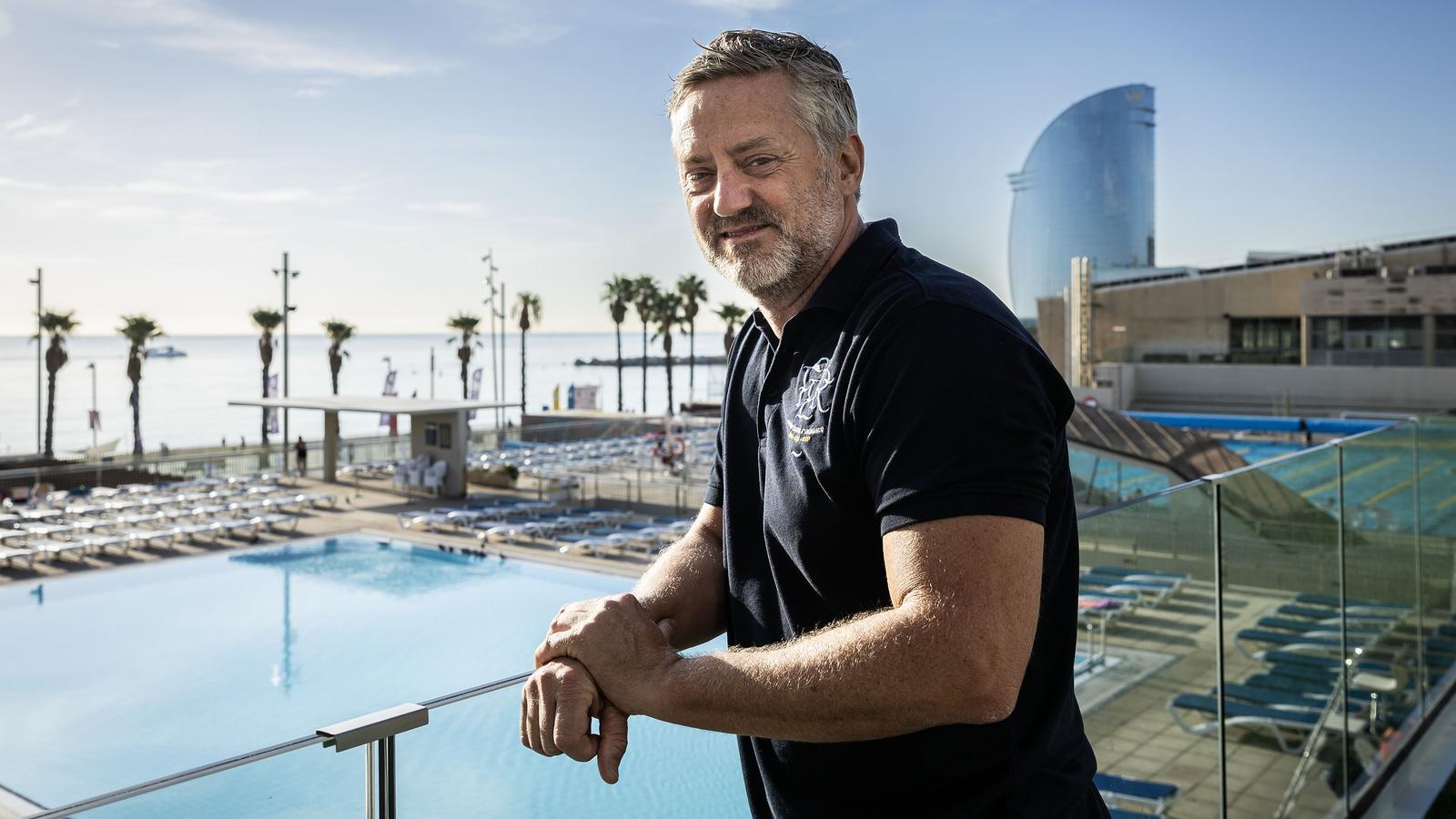
BarcelonaWhen most people in Barcelona start their day, Fernando Espina has already been swimming for almost two hours. Once out of the water, he walks calmly through the Club Natació Atlètic-Barceloneta bar, thinking about the work meetings he will have during the day. He looks like just another member of the club. But Fer, as everyone knows him, is different. His passion is swimming to find out where his limits lie. And it is not just about swimming a lot. It is also about swimming in icy waters. "I define myself as an absolutely normal person. I have a normal life, I work 40 hours a week in the systems engineering sector, I have a family... and, in fact, for more than 20 years I didn't do much sport. I had done swimming in Buenos Aires, where I was born, but when I came to Barcelona I didn't swim due to work issues," he explains. Now he is capable of spending 24 hours in the water swimming, defying the cold, animals, and currents. No, it is not a normal life.

"When I was young I was much thinner. I did swimming but speed. The only thing I had done was an open water race of 1500 meters in Mar del Plata, on the Argentine coast. And I came out almost with hypothermia," he explains with a laugh. I resumed swimming in Barcelona and I gradually got hooked on the world of open water. The Catalan coast is a paradise for swimming: for the temperature, the landscape... But always with logical reasoning, without having the feeling that I am putting my health at risk. But I like to push the limits further and further. It's a challenge. And so I went on doing longer and longer distances," he explains. The distance was getting greater and he felt good. So he decided to go all out. "The World Open Water Swimming Association, the WOWSA, has a triple crown that consists of doing three mythical crossings: crossing the English Channel (about 33 kilometers), swimming from Santa Catalina Island to the California coast (about 32 kilometers) and going around Manhattan Island (about 7 or 8 hours and about 46 km). And when I went to New York I thought 'What if we go around the island twice?' When I decided to do it, the butterflies returned to my stomach and my legs trembled with emotion," he explains. Said and done. Fer went around Manhattan Island twice, a crossing in which one must have good technique and in which it is key not to swallow much water. Since it is not the cleanest water on the planet, the risk is ending up in the hospital intoxicated.

But he didn't end up in the hospital. And seeing that he was overcoming the milestone with strength, he decided that he would try to do the Santa Catalina crossing... also twice, there and back. About 25 hours in total. The way there was very tough, as he was swimming against the current. The way back, with the current in his favor, was not easy either due to fatigue. "And you have the animals. I swam for a good while with a shark just below me. And I encountered a whale shark. And you see them from a different perspective. I was on top and he was below, underneath me, swimming at night. I wasn't afraid. Spielberg did a lot of damage; people think that a shark will always attack and that's not the case," he says laughingly. Also, Fer always swims in small trunks, and applies cream against the sun and jellyfish stings. He doesn't use a thermal swimsuit that covers the whole body. "This way I enter a kind of communion with my body, a connection that is hard to explain and that I have never felt outside the water," he says.
If he had managed to complete two of the three challenges of the triple crown with a round trip, the next step was easy. To do the same in the English Channel twice. "At the moment I made the decision, only two people had managed to complete the triple crown by doing it there and back. In fact, the triple crown, in its simple modality, has been completed by about 350 people," he explains. But the English Channel is a special place. "They give you a window of time to cross it, and everything is conditioned by the tides and the weather. It is a violent climate that has even sunk ships. I was already there when they took me to the starting beach at dawn, near the port of Dover. And the person in charge said that we couldn't leave, that it wasn't safe. Finally, one day they gave me permission. And inside the water I felt the current and the wind; very tough. The challenge was not to swallow water, with those waves. When I arrived in France, my airways were very blocked and I knew that this prevented me from returning. So I could only do it one way. You have to accept it. When you have these experiences, what depends on you must be 30%. The rest depends on nature. I will have to return," he argues. Fer could not finish a titanic challenge, since going and returning through the English Channel without a thermal swimsuit has only been done by "18 people". "Think that every year 800 people reach the summit of Everest and that 26 people have orbited the Moon," he defends.

Fernando, who trains at Barceloneta and is part of the AquaMasters club, will return to the port of Dover, as it is not just about surpassing himself; he also wants to help. "If you are a lucky person, like me, you have to give something back to society, right?", he asks himself. In his latest adventures, Fer has acted as an ambassador for good causes to raise funds. "A year ago we made a donation to the Casa de Sofia, a hospital center that depends on the Sant Joan de Déu Hospital to care for children with rare diseases, high complexity, or terminal conditions. And with the English Channel challenge, I wanted to help with donations to the Projecte Únicas, which works with children with rare diseases". The funds raised will go to this home care program that seeks to improve the lives of hundreds of children.
Swimming in freezing waters
Always ready to find new challenges, Fer has ended up creating a very special connection with cold waters; so much so that this January he participated in the European ice swimming championship, a still little-known modality that can be done both in pools and in controlled environments, with "waters from 0 to 5 degrees without any kind of thermal protection". "You cannot wear a protective swimsuit. There is a risk, it's true. If you don't train, you can have problems. But at the championships they have it very well organized; you swim with a safety belt and people nearby in case they need to pull you out of the pool. There is a possibility that ice swimming will become an Olympic sport and, coincidentally, the Olympic Committee came to watch the competition on the day I was there", explains Fer. The championship was held in a pool in the Italian Alps and now he is training to go to the world championships. "Inside the pool you don't feel anything. At 50 meters you lose sensitivity in your extremities. Inside the icy water, in a few seconds you no longer feel parts of your body. A person who hasn't trained will suffer hypothermia. If you have trained, you hold out longer. When I swim in these conditions, what I do is stay focused to understand what is happening. Stay focused to be clear that I maintain control. I do mathematical calculations, I think about my son's name... Likewise, during the race there is a safety system. Every 100 meters they ask you how you are. During sea crossings they do the same. They ask you questions from the boat to see that you are in control of the situation. They ask you to do sums and you have to answer with your fingers, for example. If you can see what they are telling you, do the calculation and answer with your fingers, it means you are fine. If you are about to have hypothermia, you cannot move your fingers and your mental capacities will surely not even allow you to add two and two", he says.
And since that is not enough for him, he has added a new challenge that consists of doing a mile (about 1.67 kilometers) in icy waters on all continents, including the North Pole and the South Pole. He wants to start this year. The challenges never end for this man, who might seem normal walking outside the pool.
