When Catalonia opened up to the world: 40 years after joining the EU
On the 40th anniversary of the accession to the European Union, the commemoration is also a claim for Catalonia's commitment to a more united, stronger and closer Europe to citizens in the face of the rise of extremisms
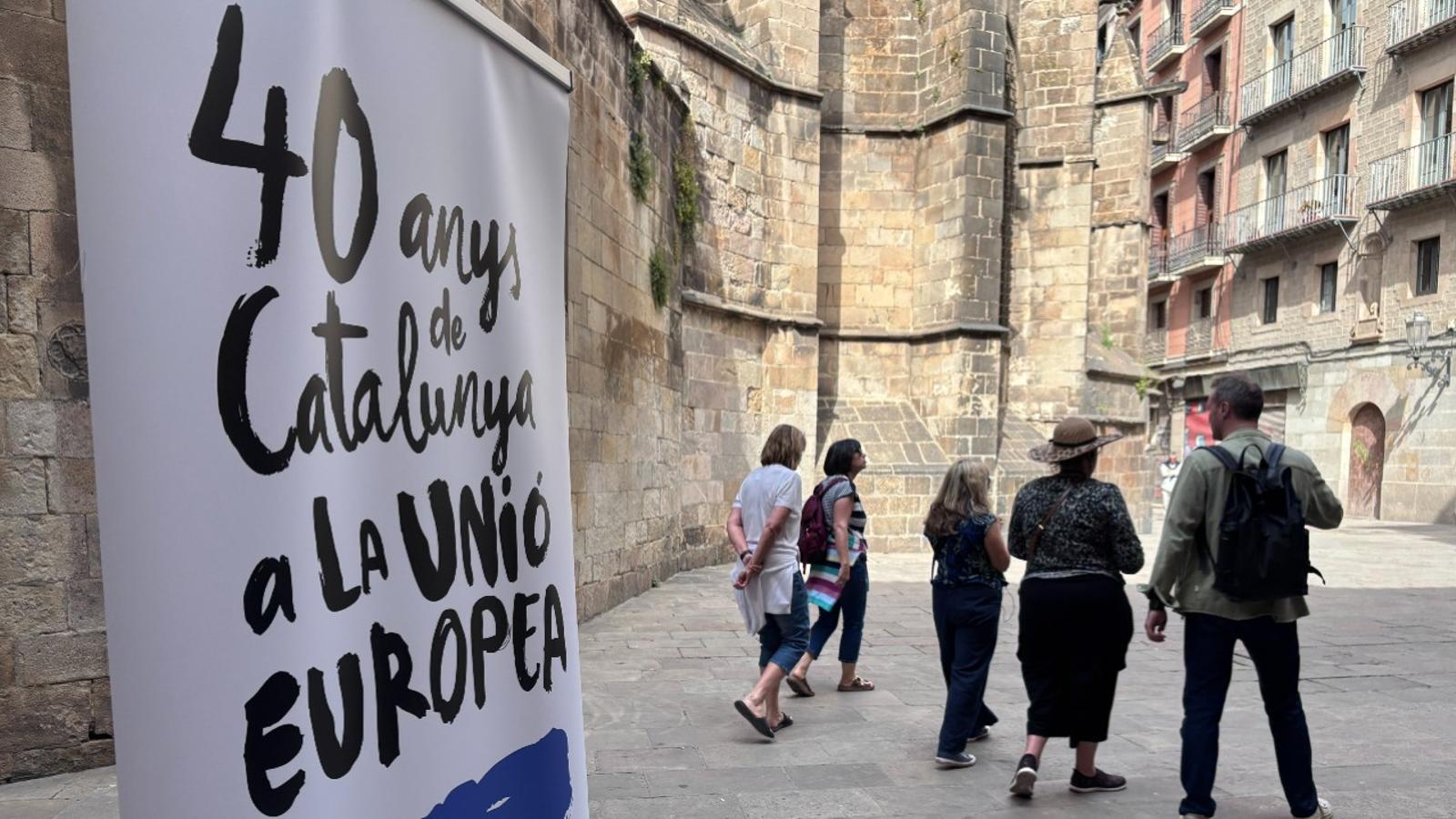
In 2026, the 40th anniversary of Spain’s – and therefore Catalonia’s – accession to the European Union (EU) will be commemorated, a milestone that has decisively contributed to the country’s democratic, institutional, economic, and social progress. Accession was crucial for the consolidation of democracy and the adoption of values such as human dignity, freedom, justice, equality, and the rule of law. At the same time, Catalonia opened up to the world and has since undergone significant economic, demographic, and quality of life transformations.
Accession to the European Union marked a turning point. The country opened up to the world and consolidated its role as a territory with solid industrial capacity, leadership in innovation, research, and technology, an exporting economy, and a cultural and linguistic richness that have made it a relevant player within the European project. From day one, Catalonia has maintained a firm commitment to European construction, contributing to a more integrated, more autonomous, and stronger European Union on the international stage.
This is the role that a European Union, which has decisively contributed to the country’s economic and social progress, has played – and continues to play. With this same vocation, the Government advocates for continuing to strengthen a more united, stronger European Union, endowed with sufficient resources and based on truly multi-level governance. For this reason, it aims to promote a Europe of the regions, which grants more voice and decision-making power to territories as administrations closest to citizens and directly responsible for many strategic policies.
We Demand Europe
In a moment of enormous geopolitical complexity such as the one we are experiencing, the call to have a cohesive European Union, with robust institutions and endowed with a budget commensurate with its objectives, becomes more necessary than ever. Only in this way can the security, well-being, and freedom of present and future generations be guaranteed.
The rise of extremism and the questioning of the democratic and humanistic foundations of the community project make it necessary to also make this celebration a claim, and with this intention, the Government will deploy throughout 2026 a program of actions to foster the feeling of belonging to the European project throughout the territory, from the Department of European Union and External Action. The programmed activities count on the active participation of the local world and civil society and incorporate youth as a priority audience.
Active participation
Within the framework of the European Union, the Generalitat de Catalunya undertakes various actions: with the Brussels Plan as a guide, it works to strengthen relations with European institutions, while holding meetings with their representatives to influence strategic policies and instruments, such as the multiannual financial framework 2028-2034 – on which the Government has approved its own position and promoted a joint one with the Four Motors for Europe – or the future industrial acceleration law proposed by the European Commission. It also re-launches political initiative in the European Committee of the Regions, where, for example, an opinion driven by Catalonia has been approved to empower regions worldwide within the Global Gateway investment strategy.
The reception of several European leaders in Barcelona, as well as contacts with the President of the European Parliament in Brussels, contribute to Catalonia's active presence in Europe. The Catalan presidency during the last year of the Four Motors for Europe network, focusing on innovation, decarbonization, the EU's strategic autonomy, and inclusive economy, and the organization of the General Assembly of the Conference of Maritime Peripheral Regions or the Euromediterranean Summit of Regions, which have consolidated Catalonia's role as a Euromediterranean capital, are other examples.
Debates with young people
The Government also promotes concrete actions to bring the EU closer to citizens, such as the creation of a new service aimed at helping Catalan municipalities – especially the smaller ones – to attract direct management funds from the European Commission and among the initiatives for the celebration of the 40 years already held, the debate day with fifty young people stands out to learn about their vision on the main challenges of the EU. Last May 9th, the institutional act of Europe Day took place, with a round table of Erasmus students, and the itinerant exhibition Europe, our common space, dedicated to the forty years of Catalonia in the EU, which can now be visited at the Moll de Costa of the Port of Tarragona and at the Government Delegation to the EU, in Brussels, and which will soon reach other Catalan cities.
40 years in the European Union
- Economy GDP: from €40.576 million (1986) to €334.765 million (2025), more than eight times higher (+725%). Exports to the EU: +542% (from €9.512 million to €61.037 million). Foreign investment from the EU: +328%. Approximately €6.000 million in European structural and cohesion funds (1986-2021).
- Population and mobility The population has grown by 2.16 million people, to 8.15 million inhabitants. EU citizens residing in Catalonia have multiplied by more than twelve. Nearly 10,000 Catalan students have participated in the Erasmus program between 2021 and 2025.
- Work and knowledge The employment rate has gone from 47.9% to 72.2%. Female employment has increased by almost 40 percentage points. People with higher education have grown by 83%.
- Well-being The average household income has increased by 83%. Life expectancy has gone from 77 to 84 years. The consumption of renewable energies has tripled.
- The impact of European funds More support for the agricultural and fishing sector. Boost for decarbonization, sustainable mobility, and biodiversity. Investments in equality, social cohesion, and accessibility. New hospitals, primary care centers, residences, schools, and Barnahus units. Catalonia has consolidated as a European hub for research and innovation, with nearly €1.900 million attracted from the Horizon Europe program. Advances in the digitalization of administration and education. Support for culture, audiovisual, and heritage conservation.
- Sources: Institute of Statistics of Catalonia (Idescat), Observatory of the Labor Market and Productive Model of the Department of Business and Labor, and Department of Research and Universities.
