Living with a 50-meter free fall at the foot of the window
350 residents of Castellfollit de la Roca inhabit houses suspended over the basalt rock cliff, on the side facing the Fluvià river

-
CAT -
CAST
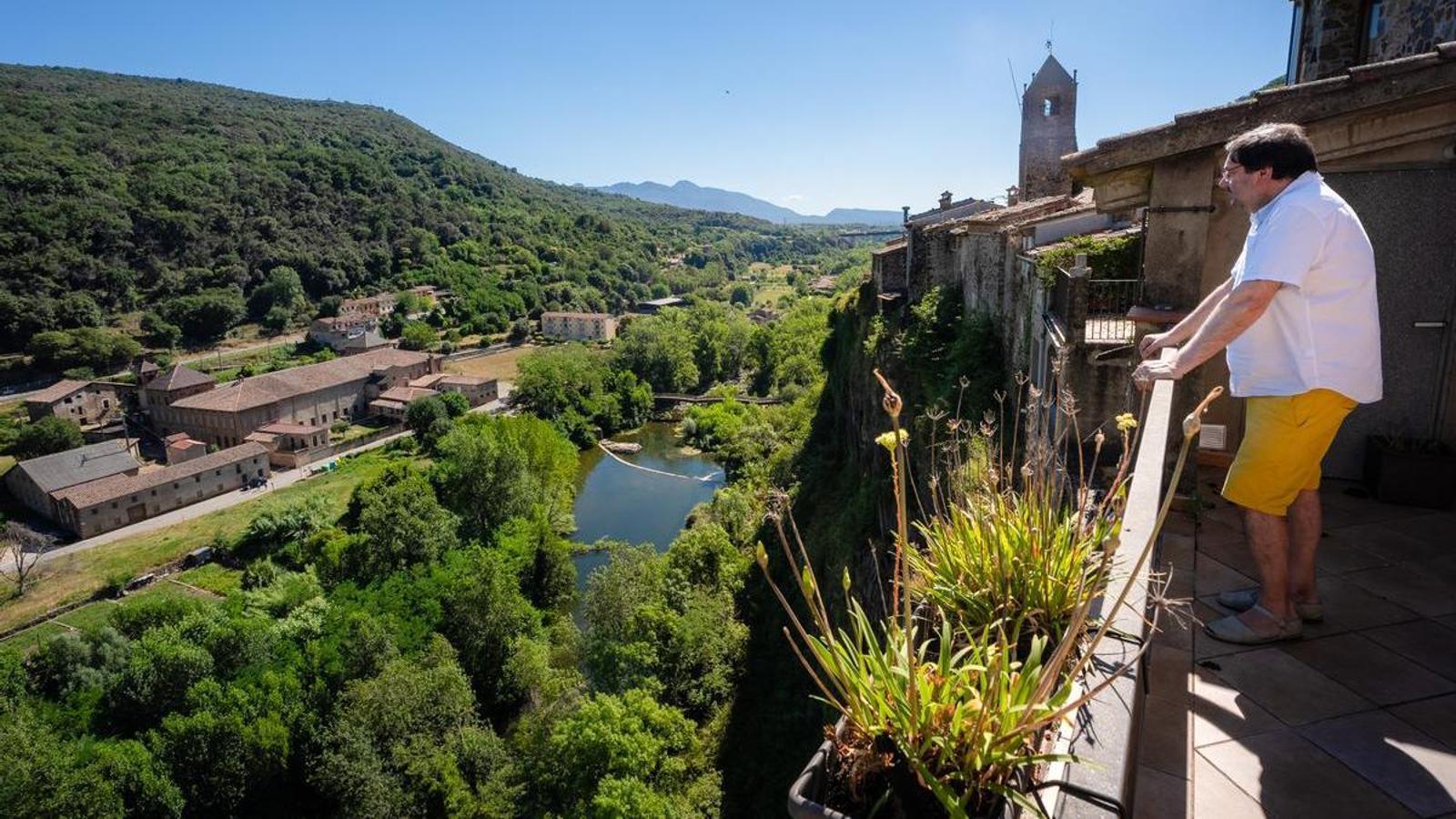
Castellfollit of the RockThe panoramic view of the Castellfollit de la Roca cliff is one of the most beautiful and iconic postcards of Catalonia. A whole village suspended on a basalt rock, with a church and a row of houses settled on the edge of a fifty-meter precipice that drops sharply to the Fluvià river. Approximately 350 residents live on the cornice of this cliff, naturally formed by several lava flows more than 350,000 years ago, more than a third of the inhabitants of this small municipality in La Garrotxa.
One of them is Salvador Ros, who has lived in one of the old houses on the cliff for eleven years. On the ground floor, he has a small shop selling local products where he sells cured meats, craft beers, and souvenirs for visitors. The establishment, El Racó de la Font, faces Carrer de l'Església, in the inner part of the village. Ros lives on the first floor with his wife, Carme, who was born in this house, and above them lives her son with his young partner and their grandson. All the balconies and windows on the north side face directly into the abyss, and at the very top, there is even a terrace where they often have meals and celebrations. The views with the entire green landscape of Alta Garrotxa on the horizon are spectacular, but the sensation of being suspended over the void is not for those who are afraid of heights.
"At first it's impressive, but you get used to it. In fact, my wife has vertigo, in other places with a lot of height she feels bad, but here at home she doesn't mind anymore," explains Ros. For the couple, living with a free fall on one of the building's walls is absolutely normalized. They are not moved nor do they give it importance.
Nor does it worry them or scare them. In fact, the cliff is monitored minute by minute, every day of the year, by the monitoring systems of the Cartographic and Geological Institute of Catalonia. Motion sensors, laser scanners, and cameras allow for the detection of any crack, landslide, or movement that could put the houses at risk. Annual reports register micro-landslides with some frequency, especially on days with bad weather, but they are imperceptible to the population and pose no risk.

"The last incident was in the 70s, when the family was having lunch at the table and heard a very loud noise and the rock fig tree came down the wall," recalls Ros. Since then there have been no remarkable problems. Of course, Ros, who is now a grandfather, takes special precautions every time his grandchildren come: "We block the balconies that overlook the cliff with harnesses to be calmer," he admits.
Dampness on the ground floor and weeds growing up the wall
The house where Carme and Salvador live, like all those in the narrow streets around the church, is made of old stone and mortar. The walls are thick and withstand the inclemencies of cold and heat well. However, as the ground is volcanic stone, the houses have no deep foundations and the floor rises directly on the rock. "If you scratch a little, stone comes out, so on the ground floor we have quite a lot of dampness. We have to paint it often because mold appears immediately," remarks the neighbor.
Besides the floor, the other handicap is the north facade which overlooks the precipice, as its maintenance is not easy at all. On the wall below, weeds and even trees easily grow and climb upwards. The owners can remove part of it, but often the intervention of professionals working suspended with harnesses is necessary. "As far as we can reach, we can keep cleaning it, but the vegetation always returns. Right now there is a fig tree under the house that is already big again and someone specialized will have to come to cut it," Ros concludes.
The cleaning and maintenance work depends on the Castellfollit de la Roca Town Hall and must be done with the authorization of the Natural Park of the Volcanic Zone of La Garrotxa. They have an approximate cost of between 40,000 and 50,000 euros annually, an amount that the council cannot assume alone and, therefore, calls for more support from higher administrations to guarantee the conservation and safety of this precious geological and architectural heritage.
- Three-story building, each 1002On the first floor, two people live, on the second, threeIn Castellfollit de la Roca (Garrotxa)
