The façade of Glory is already in Borges Blanques
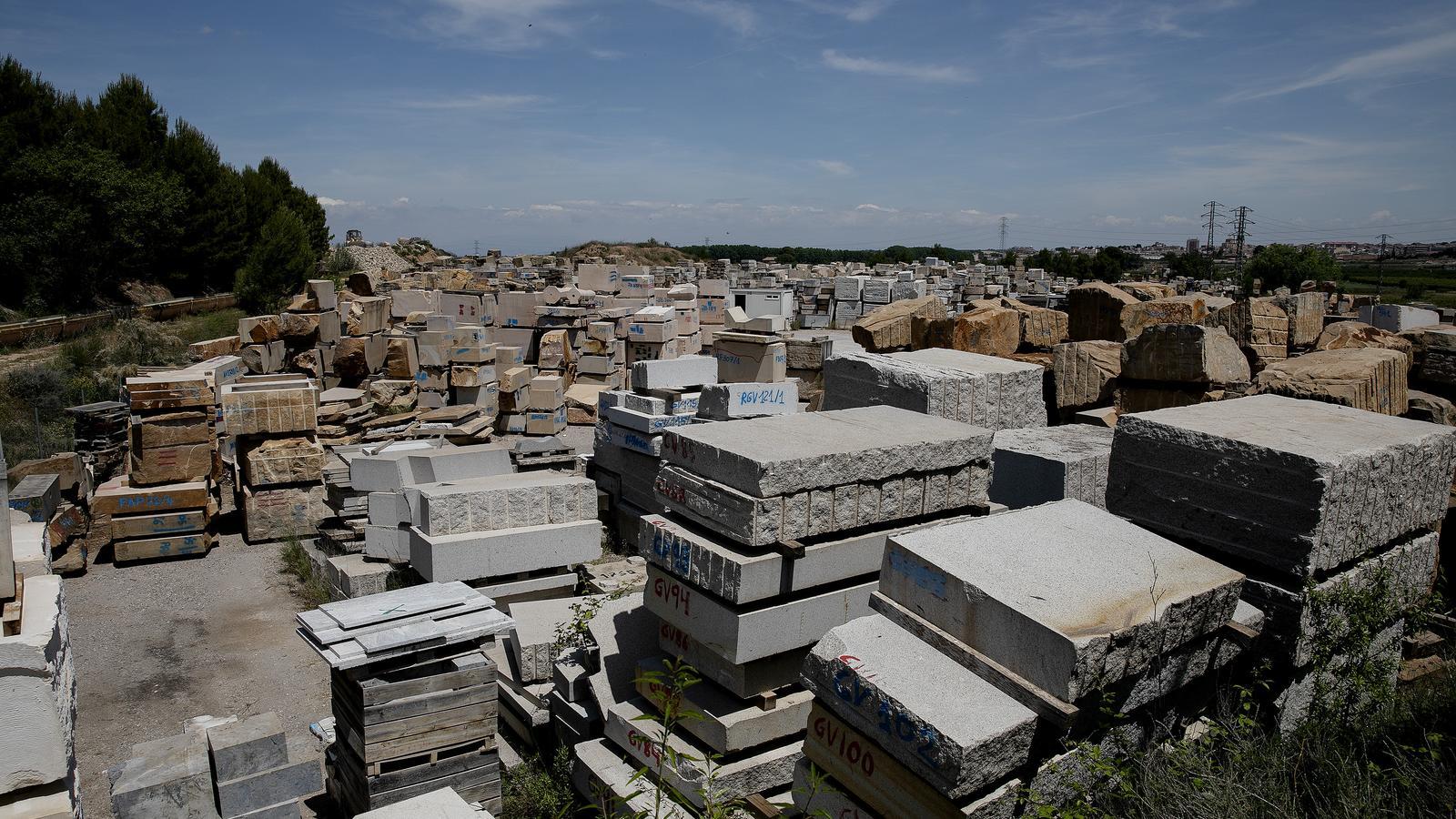
The Sagrada Família logistics center in Les Garrigues accumulates stones arrived from half the world

-
CAT -
CAST
BarcelonaAt first glance, no one would say so, but in an industrial estate in Les Borges Blanques there is one of the key pieces of the Sagrada Família's machinery. There, piled on top of each other, are some of the stones that have made it possible for the temple to reach its roof this year with the completion of the Tower of Jesus, but also those needed to continue the work. In the capital of Les Garrigues, for almost fifteen years now, the stone that arrives from all over the world with which the basilica is being built has been stored. An open-air catalogue of the raw material with which Antoni Gaudí's great dream is made.
It was in 2012 when the basilica decided to open its own stone logistics center. The reason? To prevent the construction schedule from being subject to the quarries' capacity to supply material. By accumulating sufficient stock in the Les Borges yard, work can continue, for example, without depending on whether the quarries are snowy at that moment and it is not possible to extract material. "Without this, it would be impossible to maintain the current pace of construction," explains to ARA the coordinator of the stone supply for the Sagrada Família, Àlex Masdéu. In addition to managing the stone that arrives, this geologist and stonemason is also the one who travels around the world in search of suitable stones to be able to build the temple.

The stone quarrying is a relatively recent phenomenon in the construction of the temple. From the beginning of the works and until the mid-20th century, Montjuïc stone was used, highly valued because, despite being a sandstone, it has a cement with a siliceous component that gives it a consistency and durability superior to many other sandstones. The most evident proof of its value is that a large part of Barcelona's historic buildings — such as the City Hall, the Palau de la Generalitat, the Parliament, the cathedral, Santa Maria del Mar, or the central headquarters of the University of Barcelona — are made with Montjuïc stone.
The problem for the Sagrada Família arises when, in the 1950s, there begins to be a shortage of stone in Montjuïc and, above all, when in 1957 the exploitation of the quarries on the Barcelona mountain definitively stops. This forces them to look for new suppliers. First through an agreement with the owner of a quarry in Galicia. But that quarry also runs out, and this leads to broadening horizons. And what is being sought? "A sandstone that is as similar as possible to that of Montjuïc in terms of composition, chemistry, mineralogy, texture, and also durability," explains Masdéu.

The research, however, is not easy because it is not only necessary to look for a stone with similar conditions to Montjuïc's, but also to find one that does not clash chromatically. A major challenge if you consider that one of the particularities of Barcelona stone is that it has a very wide range of colors, ranging from light gray, greenish gray, beige, yellow, ochre, gold, to purples and reddish ones. Masdéu explains the final trick. "Since we don't find sandstones with so many colors, what we do is buy different sandstones with different colors, and we mix them. We make a piece with each type of stone to offer this pixelated sensation of Montjuïc".
The result is that today at the yard in Borges Blanques, tons of sandstone and granite arrive from Cantabria, England, Germany, Scotland, France, and even India. Also from Montjuïc. When the quarries closed, the basilica made a large purchase of all the stone that was still available in the warehouses, and then it has been supplied by what has arrived from some demolitions — such as the renovation of the Olympic Stadium in 1988—. It still acquires some today. For example, not long ago, a large stone arrived at the depot from a landslide in the Botanical Garden of Barcelona after the recent heavy rains.
The Montjuïc stone in the bell tower — among which are perfectly discernible remnants of Puig i Cadafalch's original columns — is reserved for key elements of the pending construction, but especially for the rehabilitations of parts of the temple that need to be done. In fact, at the logistics center there are leftovers of all the stones used to build the temple for when any repairs are needed. There are all sorts of them, sandstone, but also more particular stones such as the reddish porphyry from Iran, the stone arrived from Brazil with a beautiful bluish color that has been used for the tower of the Virgin Mary or one of the latest stones to arrive and which has not yet been seen in person: the white onyx with which part of the interior of the cross crowning the tower of Jesus is covered.
Not just any stone will do
Today, however, at the logistics center in Les Borges Blanques, the stone to be used for raising the Glory facade predominates. "We must have between a third and half of the stone needed for the facade here," explains Masdéu, who says they usually work with the necessary stone a year in advance, to ensure the supply does not stop. The stone often arrives in a rough block, and there it is cut into blocks of different thicknesses depending on what is needed. "With this cut, you can see the quality of the stone, because in many rough blocks from the outside you don't see anything and when you open it, it's like a melon: sometimes it turns out very beautiful and sometimes it turns out very bad," summarizes Masdéu.

A few years ago, in Les Borges there were four warehouses with eight cutting machines, but the drop in the basilica's income during the pandemic years led the Sagrada Família to cut back in this area and outsource part of the work that was done at the logistics center. Now there is one warehouse, two cutting machines, and the large yard that serves as a warehouse. Once cut into blocks, the stones are sent to other parts of the country where they are cut to the definitive shape they will have to have and are assembled in a kind of Tetris that now allows —through a system of steel tensors— the speed at which the parts of the temple are erected to be much higher.
Further ahead, it will be necessary to secure reserves also for the immense sculptural ensemble that will adorn the façade of Glory. In the coming weeks, the board must deliberate among the three artists to whom it requested proposals —Miquel Barceló, Javier Marín, and Cristina Iglesias. "When we know who wins and what they need, we will have to look for the stone," explains Masdéu. Regarding the stone that will have to serve for the future staircase, there is still no news either.

