
Pope Leo XIV expressed his "concern" on Sunday regarding the "alarming situation in Ceuta". At the end of the Angelus prayer, in St. Peter's Square, the pontiff called for dialogue in Spanish and prayed for "solutions of peace, stability, and justice" to be found.
The right finds in the Ceuta crisis a vein to harden the anti-immigration discourse
Abascal and Ayuso raise the tone: they speak of "invasion" and hold Morocco responsible
02/08/2026 - 21:59 h

-
CAT -
CAST
MadridThe Spanish right and far-right – and also the European ones – have found in the migratory crisis in Ceuta a vein to harden the anti-immigration discourse and, consequently, to push for stricter border control. In fact, it represents an opportunity to isolate the president of the Spanish government, Pedro Sánchez, and his migratory policies with respect to the rest of the EU member states, who on Tuesday are called to a meeting to address, precisely, this matter. The leader of Vox, Santiago Abascal, has not only welcomed the position of countries like Italy, which after the migratory crisis has put more controls on the border, but has also stated that Donald Trump has "fallen short" when he speaks of Spanish policies "of the extreme left [which favor migration]". Abascal, who this Sunday has moved for the first time to Ceuta, has demanded to "permanently militarize" the border, close it and that the army can act with "the necessary forcefulness".
The PP has also spoken along the same lines so far. Its leader, Alberto Núñez Feijóo, stated that he "shared the concern" that different European leaders had shown and has placed all the responsibility for what happened in Ceuta on Pedro Sánchez and measures such as the extraordinary regularization of migrants, even going so far as to question the Spanish government's narrative on migration management: "I don't believe that 60,000 migrants have entered without the government knowing about it".He also called for explanations to be demanded from Morocco, without entering into direct confrontation. This Sunday, Feijóo, who is still in the autonomous city, has gone a step further and has denied the central executive's version, saying that "you only need to step outside to see that the normality the government talks about in Ceuta does not exist".
Abascal and Ayuso raise the tone
"We are facing an invasion", Abascal said this Sunday, raising the tone compared to what Feijóo used yesterday when he called the events "a premeditated occupation". The leader of the Spanish far-right has not hesitated to denounce the responsibility of the Alawite country: "It is an act of war promoted by Morocco and tolerated and permitted by Pedro Sánchez", Abascal added. It should be recalled that Abascal's relationship with Mohamed VI's kingdom has always been subordinate to Vox's firm demand that Morocco "explicitly" recognize Spanish sovereignty over Ceuta and Melilla. This "condition", in Vox's words, has always set the tone of the party towards Morocco. In parallel, the leader of Vox in Andalusia, and second vice-president of the Junta, Manuel Gavira, stated this Sunday that the "migratory invasion in Ceuta is already spreading to the Andalusian coast" and denounced the arrival of immigrants on the beaches of the Campo de Gibraltar with jet skis and speedboats.
Abascal's statement about Morocco and its role in the tragedy in Ceuta had not been shared by anyone in the PP until this Sunday. The president of the Community of Madrid, Isabel Díaz Ayuso, pointed out that behind the crisis is the hand of Morocco and the intention, in her opinion, "to try to take over the sovereignty [of Ceuta and Melilla] in the future". "I fear it is a test by Morocco and it is evident that it will escalate", Ayuso stated. She even spoke of a "rehearsal of their plans for Ceuta and Melilla".
Meanwhile, the Spanish government maintains that behind the crisis are "mafias" that take advantage of the vulnerability of many young immigrants with "interested readings" of the latest Supreme Court ruling. A discourse that, for the moment, does not find many adherents in Europe.
Ultra agitators in Ceuta
The ultra agitator Vito Quiles and the leader of S'ha Acabat la Festa, Alvise Pérez, have also moved to Ceuta. This Saturday, the National Police evacuated them after some residents of the city shouted at them and pressured them to leave. About twenty members of Núcleo Nacional who had called for a demonstration were also evacuated.
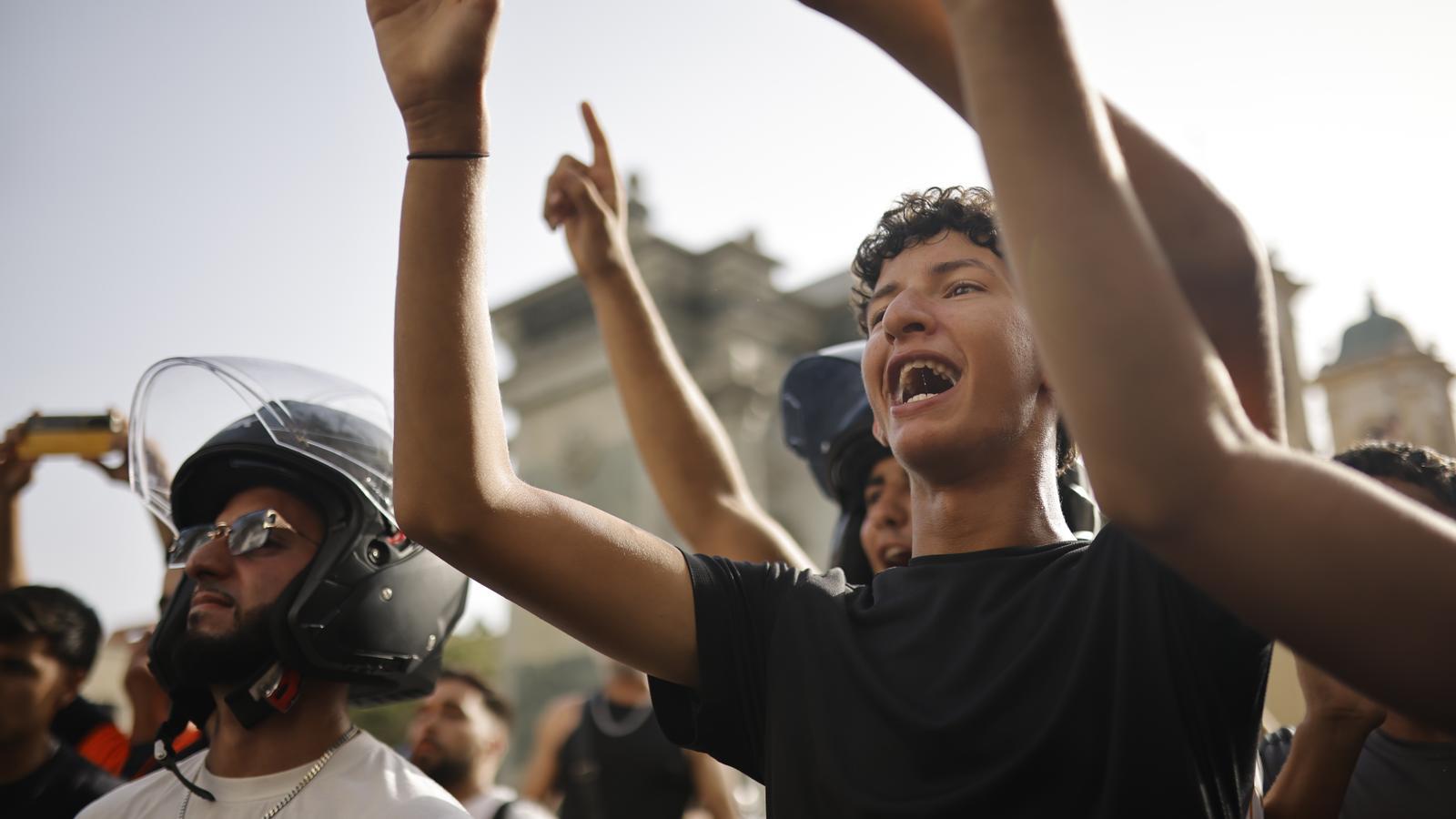
The delegate of the Spanish government in Ceuta, Miguel Ángel Pérez, harshly criticized them this Sunday: "They are far-right groups who came [to Ceuta] with the sole objective of taking advantage of our difficulties to sow hatred, division, and fear," he denounced, and the Minister of Territorial Policy and Democratic Memory, Ángel Víctor Torres, defended that the Ceuta citizenry is “adoptive, multicultural, and open” and appealed to ‘unity in the face of division’. In fact, the president of Ceuta himself, Juan Jesús Vivas (PP), censured it: "Coexistence is a red line that cannot be crossed." The ultra platform S'ha Acabat la Festa (The Party Is Over) called a demonstration this Sunday afternoon in Madrid in front of the Moroccan embassy – where representatives of Vox also went –, which gathered a few hundred people who have claimed, mainly, Pedro Sánchez's resignation.
Pope Leo XIV calls for "peace, stability, and justice" in the face of the "alarming situation in Ceuta"
