Marc Castellnou: "We need managed and functional forests, not a decoration for tourism"
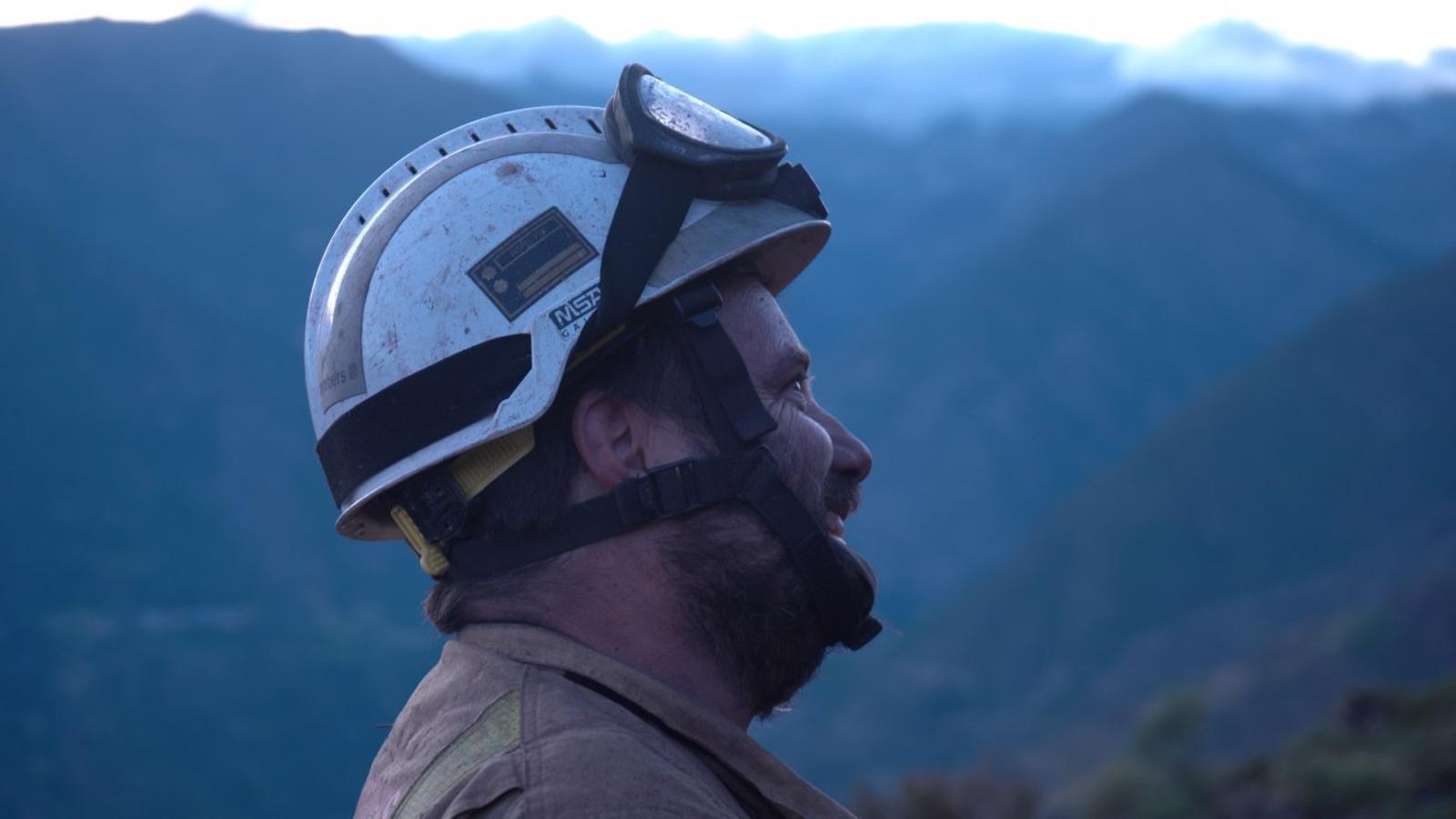
Head of the Forest Action Reinforcement Group (GRAF) of the Generalitat Firefighters

-
CAT -
CAST
Marc Castellnou (Tivissa, 1972) is the head of the GRAF of the Generalitat Firefighters. He is considered an international expert on how to tackle fires; especially large fires. And for this reason he moved to Madrid while the largest fire in Spain – at least since records began – continued to burn out of control. After frantic days – he admits he didn't even have time to share impressions with his colleagues – he returned to Catalonia this Wednesday. "The season is not over yet", recalls Castellnou, who is speaking to ARA just after leaving Madrid. With what feelings does he/she return to Catalonia?
— I wouldn't know what to say. We've seen big fires in other parts of the world and we already know how it goes. It's not a surprise in that sense, but it is that things are changing so quickly. We had planned for this to reach here by the end of this decade, and it has arrived sooner. The feeling, now, is that this will not stop. There is a high probability that these fires will be normal in the coming years. Summers are getting longer and more intense. It doesn't matter if it rains or not; the droughts and the thermal sensation are extreme.
What was the impression on the ground?
— We haven't had time to share impressions. The objective was to control the fire [in Madrid, Ávila and Toledo] and we have achieved it. Now it's time to rebuild the teams because this continues tomorrow. We don't know if it will be in León, Catalonia or Andalusia, but it continues. The heat is still extreme and will continue to be so in the coming days.
What factors fuel fires like this?
— At all times we have been clear about the behavior of the fire and how it would develop. The problem lies in the extreme accumulated energy. After one of the most serious droughts in history, we have had one of the wettest winters in recent years and a warm summer has set in that is proving persistent. This is unsustainable and the vegetation has given up. [The fire in Ávila and Madrid] It burned with disproportionate intensity around 120,000-150,000 kW per linear meter. A firefighter can only survive at 10,000 kW per linear meter. We were 15 times over the extinction capacity. In situations like this, you have to wait for the moments when the fire is weak and contain it, and that's why it has grown like this. While it was growing so much, we didn't have the capacity to extinguish it. The strategy was to take advantage of all its weaknesses by applying what we have learned from similar fires in Chile, Portugal, California, Greece, and Turkey.
Does this force us to broaden our focus when we talk about how we gain resilience?
— Extinction is not the way forward. If the territory and landscape are prepared, extinction works; if they are not, it doesn't. Having a prepared landscape means management and thinking with a country's mentality, and not just about whether we want a protected green paradise or a specific type of economy. The ecosystem and climate in which we live sustain what they sustain, and we must be realistic. We will never have the forests of Switzerland, here [in Catalonia]. We can have very healthy forests, but that means managed and functional forests for the ecosystem, not that they serve as a backdrop for tourism. The country we designed in the 50s, 60s, or 70s assumed that the climate would be constant, and that is not the case. Therefore, we must design another economy.
How?
— Agriculturally, we are a rich country that acts as an importing colony, and that is unsustainable. The decisions [of the past] that we made caused agriculture to go from being primordial to marginal, and the 30% of forest area to now be 70% at the cost of agricultural abandonment. We must invest in the primary sector because it not only produces products, but also creates an agricultural mosaic, but this has a price. However, the country is not cheap to live in when we have these major emergencies. We must think about the future and be clear that today's decisions will design the landscape of the future, which will have certain capacities and consequences. We must have creative thinking, think about tomorrow and not about how to preserve what I have today. If we are a conservative society, time will surely erase us from the map. If we are creative and adapt, we have possibilities. But fires like these put on the table that the worst-case scenario is already here.
I think of other activities that have disappeared like the use of wood.
— Or the pasture. The pasture that we now have inside farms and not in the territory. There are many things we need to rethink. The Pyrenees should have natural herds and not just tourists. Having only trees is not having the whole ecosystem.
Should society assume that the forest needs to be transformed?
— We have to accept it and stop being childish. We all grow, age, and die, and so do forests. They cannot be eternally the image we like. The forest must regenerate, and it is the only way to adapt to the climate. The new forest adapts to the climate of the day it is born, and the climate of the day the forests we have today were born no longer exists. Afterwards, when it burns, it is the fault of whoever did not put it out, and no one takes responsibility for the decisions we have made as a society.
Are we at a turning point?
— The turning point was in 2025.
This August will mark 40 years since the great fire of 1986 in Montserrat. What are the differences with the fires of this 21st century?
— We are not facing the same situation because at that time they were predictable fires in which meteorology, typography, and vegetation played in our favor. These fires we have now are extremely more virulent and faster. They are of a superior level, and this makes them very difficult to extinguish. At that time, we solved the problem by investing in extinction because it was a direct solution, and we stabilized the problem. Now we cannot stabilize the problem by investing more in extinction because it has reached its limit as a solution. It is a different dynamic. Now we must look for the root of the problem: having healthy ecosystems adapted to the climate we live in. But the country must be rethought; in fact, all of Western Europe must be rethought. It is a problem that all advanced economies share, economies that thought they could face all problems thanks to technology, and this is not the case.
