'Here no one can live': the unfaithful series that jumped to Antena 3
The chain tried to prevent Telecinco from broadcasting a series with the same spirit and type of humor
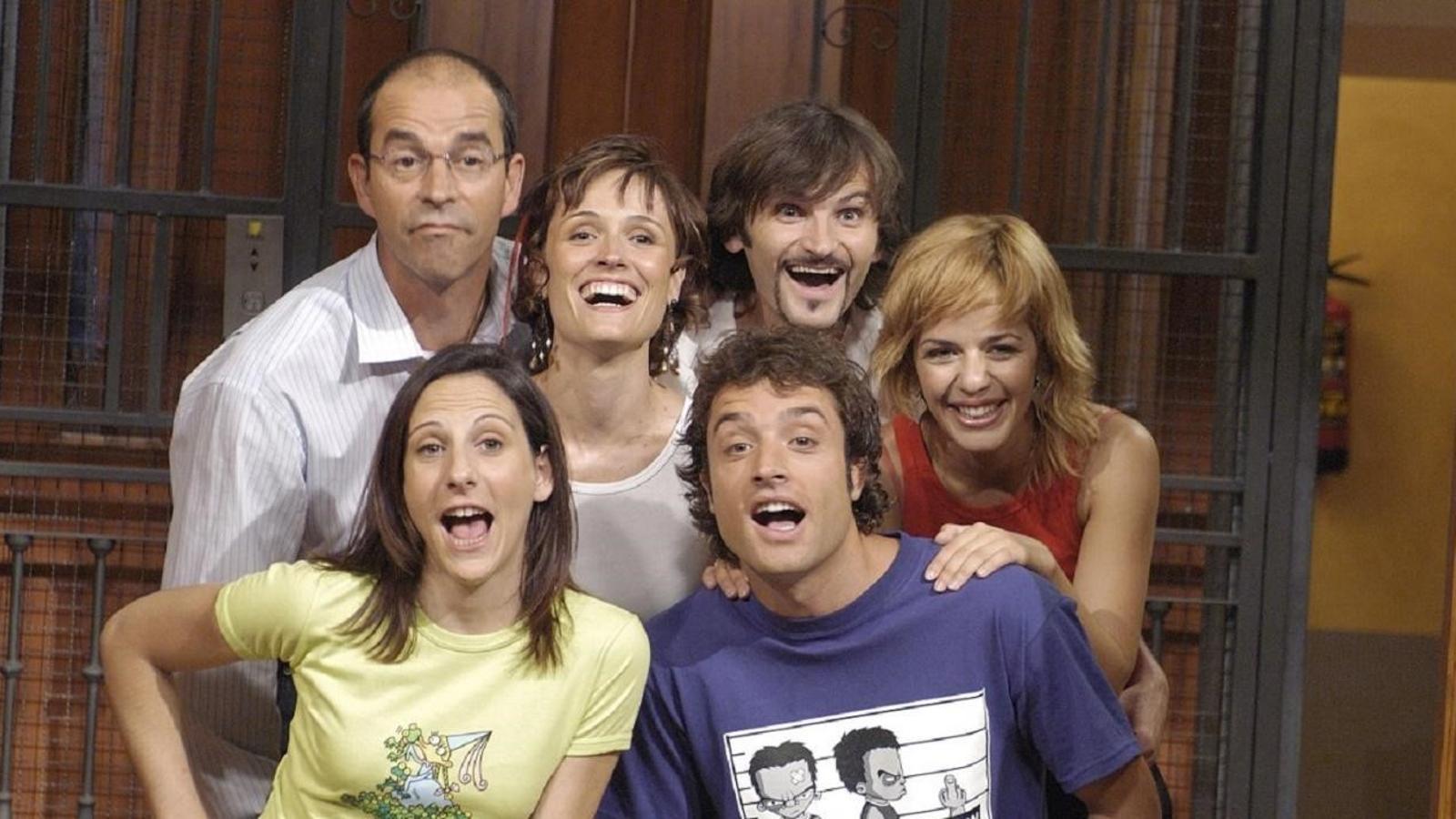

-
CAT -
CAST
Barcelona(As every summer, ARA dedicates a series of Sunday Media articles to review television history. This year, we are rescuing some of the most notable channel changes that historical fictions experienced.)
Stealing a series is not always as easy as offering creators a blank check to jump to the channel that first bet on them. This is what happened to the Caballero brothers – Alberto and Laura – when they decided to break with Antena 3 after five seasons and 91 episodes of Aquí no hay quien viva, the best Spanish comedy series according to industry polls, with 19.8% of voters. In fact, now that it's been twenty years since its end, it remains a living phenomenon thanks to reruns. According to the Barlovento Barometer, an average of 5.9 million streaming platform viewers in Spain connect to it every month. And one in four viewers has rewatched at least one episode in the last year.
Despite all this, the series creators wanted to end the series even though it achieved screen shares at the time that were close to 40%, thanks to being a choral and intergenerational fiction that updated the traditional genre of the grotesque with touches of social commentary in the television language of the time. The exhaustion of the team, which even reported having to work twenty-hour days, caused the relationship to explode: the channel demanded that the goose that laid the golden eggs continue laying at a frenetic pace, and the artistic and technical team ended up feeling "mistreated" and forced to write scripts in a hurry.
Mediaset watched these tensions with predatory eyes. When José Luis Moreno's production company – uncle of the Caballeros – exhausted the contract that bound it to Atresmedia, in July 2006, Paolo Vasile launched an offer to buy 15% of the company for 11 million euros. However, the operation included a condition: to stop making Aquí no hay quien viva for Antena 3.
However, transplanting the series was not so simple. Antena 3 had registered the trademark and also the copyright on the characters, so a literal sequel could not be made. The solution was to create a kind of spiritual sequel: a new series, but with the same premise – a community of neighbors who were very over the top and in permanent conflict – and also with a good part of the actors. Of course, since they couldn't repeat characters, a whole script tetris had to be created so that each of them would continue to have the type of humor they had become famous for, but with a different casing to keep Planeta Group's lawyers at a safe distance.
It was also necessary to find a name for it. Atocha 20, the name of the fictional community where the action would take place, was considered, but in the end, it was opted for La que se avecina. The formula was successful enough for the series to remain alive, only now it is Amazon Prime who premieres it initially, and then it arrives on Telecinco, where it still gets good ratings – around 10%, which is more than the channel's average – but nothing to do with those of its predecessor, as consumption has become hyper-fragmented in these two decades. And, above all, Mediaset exploits it in reruns on channels like FdF, which for periods has lived fundamentally by broadcasting the 210 episodes of the serial over and over again.
The survival of the two series makes the classic battle between the fans of one and the other inevitable, as if it were a civil war between supporters of omelet with onion or without. Those who prefer Aquí no hay quien viva praise its better-defined episodes and its more customist and realistic tone. The other side highlights its more surreal tone, black humor, and greater daring in general.
Despite the series creators' measures to shield themselves from legal actions against that outright move, Antena 3 tried to present a legal battle. In 2007, when only two episodes of La que se avecina had been aired, they filed a lawsuit for format plagiarism and unfair competition. The claim was admitted for processing, but the precautionary measures to immediately suspend production were not granted. Three million euros in compensation were also claimed, but justice determined, in January 2012, that there were no grounds to grant it. According to the courts' reasoning, Aquí no hay quien viva"was not original enough" to protect a format, that of a neighbor comedy, which was seen as too generic by the magistrates. Antena 3 had to pay the court costs, while the heir series broke audience records.
There is still a recent twist in the conflict. The creators sued Atresmedia for lack of transparency in the revenues of Aquí no hay quien viva and its multiple reruns. While awaiting to see how the case is resolved, one can only invoke the recurring phrase of the character Juan Cuesta, every time a conflict erupted in the community he presided over: "What a mess...!".
