Return to Artana: ash in the houses and hugs in the streets
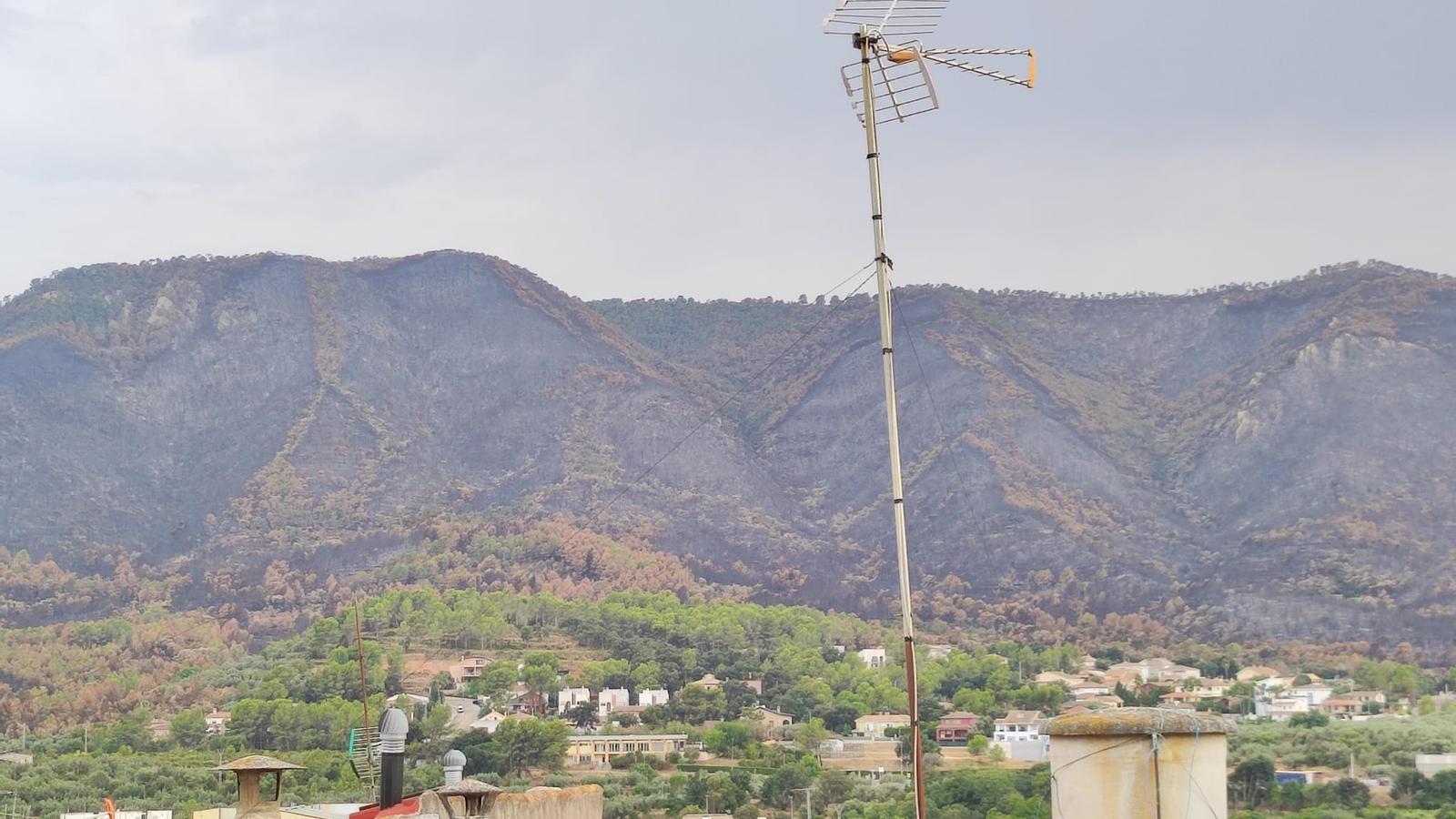
The fire in the Espadà mountain range, still active, leaves a desolate panorama

-
CAT -
CAST
ArtanaIt's three o'clock and we've just made the paella with my father in Borriana. Sara and I look at each other and decide that the moment has arrived, both awaited and feared, to head towards Artana and see with our own eyes how our home is and how burnt the surroundings are. Artana has been, along with Eslida, the village in the Espadà mountain range that has suffered the longest evacuation: a week, from Saturday midday to Friday night. Today is Saturday and we think that most of the inhabitants will have returned by now. Although the start of the fire caught us away, we've been talking with friends and neighbours all week, and that's why we know the houses are fine. But we're afraid of what we'll find. It's one thing to see it on TV and another to see it yourself.
And indeed, television doesn't capture even 10% of the sensory effect of a burnt landscape. To begin with, you miss the smell of burning, which permeates everything, and you miss both the 360-degree perspective and the detail of the burnt trees seen up close and the ash accumulated on the ground. This is the scene that greets us at the entrance of the CV-223 road. Despite the cliché, the word that best describes it is desolate. And then you remember the stories of neighbours who, when they tried to reach the motorway, the Civil Guard made them turn back because the flames were by the road. And so close to the road! From the car, you can almost touch some olive trees, if not millennial, certainly centuries old, that have been reduced to a black carcass.
When we arrive at the village, no one is seen in the streets, probably due to the 33 degrees marked by the car's thermometer. We park in front of the house and, first of all, I'm going to see how everything is. Fortunately, I only have the patio full of ash and the house smells of smoke, but nothing else. Everything else is in order. Later I will see that the ash has left a very fine film of particles everywhere. In the street, we then meet our neighbor Rosa, a true survivor for whom doctors have not given a penny on more than one occasion, but she lives to contradict diagnoses. She explains that she had a very bad time during the evacuation because her children were no longer allowed to enter the village to look for her and she was worried about the house. It is difficult to put yourself in the place of an elderly woman with mobility problems who sees her neighbors leaving the street while she has to wait for an ambulance. In the end, everything went well and Rosa was able to meet her children in Nules.
Housed in second residences
On the short walk I take through the village to park the car, I see several groups chatting and hugging. Ximo sees me pass and gives me the OK sign with his hand from afar while shouting: "Everything okay?". I reply yes and that we'll see each other soon. He tells me that he decided to spend these days in a hotel with an acquaintance. "It hasn't been a vacation because we were worried, but we've been very well and the hotel staff have been wonderful," he tells me as we hug along with another neighbor, Vicente Luis. He's not the only one who has opted for this option, but most of our acquaintances have been hosted in friends' houses or empty second homes. It should be noted that in Castelló it is very typical to have a second residence, which can range from an apartment on the beach to a modest country farmhouse, very close to the first one, so there is a lot of housing availability in emergency situations like this.

I also meet Esteban Soriano, whose followers we are on Instagram and these days we were hooked on his videos in which he explained the situation of the town and, in particular, of his chickens. This is a reality of the town that has emerged with force these days. Our neighbors Blai and Vicent, for example, have hunting dogs at home, and they had to look for a place in the countryside to take them. Other hunters like José Antonio or Vicente had to ask for permission from the Civil Guard to be able to go and bring them food, and they did not always get it.
Returning home, it's time for cleaning. Between the broom and the vacuum cleaner, I opt for the latter, but it soon gets clogged. The water hose is the best solution. While I'm spraying, I hear helicopters flying overhead and then I realize that the fire is not yet extinguished and that my brother Òscar, a volunteer firefighter, is working there today. I also realize that I haven't gone up to the top terrace to see the panorama. I don't feel like it at all, but I know I can't delay it any longer. The impact is brutal. Simply, there is no longer any forest, just a black, gray, and brown mass. I take the usual photos and think about all the people I still have to call. Among them, that family from Eslida who made delicious goat cheeses and had their farm in the middle of the mountain. Their name is La Caseta d'Espadà. Will the farm have been saved?
