The key errors of the railway tragedy in Toledo
The precedents of the last railway accidents point to an investigation that is expected to be long

-
CAT -
CAST
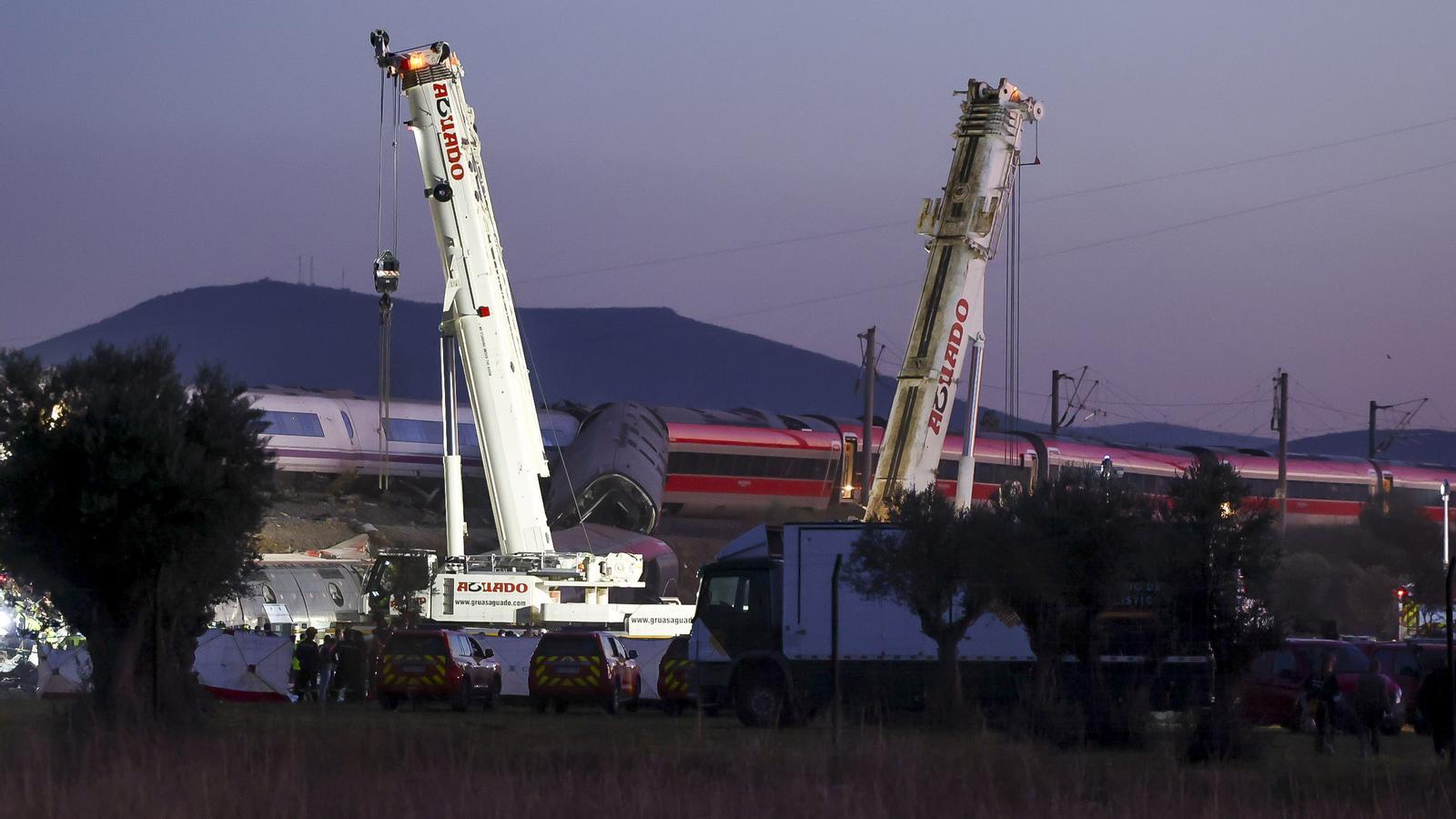
MadridThe tragic train accident in Urda, in the province of Toledo, has resulted in dozens of injured and fatalities. An investigation has now been opened – it corresponds to the civil and instruction section of the Court of First Instance of Orgaz (Toledo), in square number 2 – which, taking into account the precedents of the latest railway accidents, such as the Adamuz accident, is expected to be prolonged over time.
The progress of this investigation will have to resolve some unknowns that remain after the initial explanations about the disaster given by the authorities, specifically the Ministry of Transport. This Wednesday it explained in general terms the chronology of the events.
Why does a system failure occur?
It all starts with a failure of the computer system that controls high speed in the State, the so-called LZB system, at 8:30 a.m. There are 63 kilometers of track left without this system –it has been operating on the Madrid-Sevilla line since 1992–. The reason for the failure is a "computer breakdown," the Ministry of Transport has explained, but no further details are available for now. The same ministry has said that it is "not common" for this system to fail, but acknowledges that it has happened on other occasions. In any case, when this happens, protocols are activated: initially, all affected trains are stopped.
What role does the Adif control room play?
With the LZB system down and the trains stopped, the Adif control center in Atocha comes into play, which is who takes control of the situation and, therefore, of the trains. It is the technician in the room who orders the train drivers to start, or not, again. In this case, the order is given to resume normal operation for the six affected trains. In one of the cases, however, a driver notifies the control center that, instead of applying normal operation, he wants to apply "sight-based" operation, taking into account that the LZB system is not working: according to the Railway Circulation Regulations, applying "sight-based" operation means traveling at a maximum of 40 km/h. The operator at the Adif control center agrees with him and allows it.
The same regulation establishes that one can circulate under these conditions in scenarios where railway safety is compromised or automatic guidance systems have ceased to be reliable, which is what happens with the failure of the LZB system. In fact, this type of operation is prescribed when this system fails.
Why is the order given?
But for the rest of the trains, including the Renfe AVE involved in the accident (at 8:36 a.m.), the order given from control was to resume normal operations, which surprised the Ministry of Transport. It is currently unknown at what speed the train was traveling when the accident occurred, although the affected section allows for speeds of up to 250 km/h. Furthermore, in the case of the AVE that rear-ended the Iryo, the order was given even though the Italian company's train was occupying its track. "Inexplicable," said Minister Óscar Puente hours after the accident.

Why doesn't the Iryo train start?
Another question that the Ministry of Transport has not resolved –the information from the trains' black boxes still has to be extracted– is why the Iryo train remained stopped even though, a priori, it was also given the order to circulate, according to what was explained by the ministry.
Company sources have explained that the Iryo train driver stopped the train at 8:38 AM. At that moment, the driver began communications with the control center to "manage", as Iryo sources explain, "the resumption of the journey". The resumption, however, did not occur. Other sources close to the company go further and assure Europa Press that the driver "was still in conversations" with the control center when the collision occurred, so its circulation had not been authorized. "We believe the Iryo train received the order that it could resume its journey, but we do not know why it did not do so," said the minister.
Why did no one foresee the collision for 15 minutes?
The journey the Renfe AVE train made from the moment traffic resumed normally until it crashed into the rear of the Iryo train covers 25 kilometers and takes about 15-17 minutes. During this time, and according to the information that has emerged so far, no one gave notice that there was an Iryo train stopped further ahead on the same track where the Renfe train was traveling. And, therefore, no one told the AVE train driver to stop.
