The story of the victims of the Toledo train accident: “The seats and the people were flying out”
“The seat hit me, I hugged it and waited for everything to pass”, recalls one of the passengers who has been attended to at the Urda pavilion

-
CAT -
CAST
Urda (Toledo)At 8:54 in the morning, Nicolás was listening to music sitting in the sixth carriage of an AVE train heading to Seville to visit his girlfriend. He makes this journey three or four times a month. But today was different. All of a sudden, the seats were dislodged, a group of people fell together, they ended up crushed and he could not move. “I looked and I realized that I was on the opposite track. It was like Adamuz. I got up and tried to open the door,” he remembers in conversation with ARA. But, with the impact, he had lost his glasses and could not read the instructions, so he had to ask for help from the other passengers. “When I got out, I could hear the screams from the seventh carriage, which was destroyed. And I saw two people on the ground who were begging me while crying to let them have my mobile to call their family. One could not move and I had to hold the phone for him,” he recounts.
He is one of the many witnesses gathering at the Urda pavilion, set up in an emergency and in a hurry to accommodate and attend to the wounded of the railway tragedy that has left 68 dead, in the second worst accident in the history of Spanish high-speed rail. Nicolás, who while talking to us is waiting for his father to pick him up by car, was the first to leave the carriage. And he saw a woman with a piece of iron stuck in her leg. “There was a line to identify ourselves and, literally twenty meters away, there was a line of ten bodies,” he recalls.

Maria was going to a wedding and was traveling in the fifth carriage of the AVE train. She was sleeping and woke up suddenly: “I started to hear screams, all the suitcases started to fall, and the chairs started to break,” she explains. Immediately after, they had to use the tables to break the windows to be able to get out of the train. They noticed that the train was tipping over a bit more and they had to hurry. “Anguish, it was a macabre thing,” she summarizes. Marta was in the carriage behind. “It was a tremendous frontal impact, I was thrown out with my seat down the aisle until I crashed into other seats and other people. I was trapped and they freed me,” she recounts. The seats were loose and they had to move them aside to be able to move. And it didn't take them long to be aware of the magnitude of the disaster: “When you see seats flying, you know the impact was huge.” She became fully aware of it when they saw a “track going through the train”.
Victoria and Josema had come from Brazil for tourism in Spain and were sleeping in the second-to-last row of their carriage. “We woke up when we were flying towards the front part,” she recalls. “The seat hit me, I hugged it and waited for everything to pass,” he adds. And he explains what the moment of the impact was like: “You could see backpacks, people, or seats flying out. Everything. I saw some people who had died or some who were mutilated. I checked myself and saw that I was fine. And the first thing I did was shout my partner's name. After about three or four times, she answered me.” Victoria is an anesthesiologist, she is Brazilian and finds it hard to speak Spanish, but she was able to help the medical teams—who arrived very quickly—by setting up IV drips for the injured. They put a red wristband on the seriously injured, and they were the first to be transferred.

Neighbors and solidarity
“I'm going to get blankets, I have some in the car,” exclaims a neighbor in front of the Urda pavilion at a quarter past twelve in the afternoon, three hours after the accident. It is just one of the countless displays of solidarity and help that are spreading throughout this small municipality of 2,500 inhabitants. When we enter the facility, everything is well organized. There are tables with food and water for the victims, mattresses on the floor, and chairs so the injured can rest. Medical personnel are attending to and treating them. And emergency services of all kinds are arriving.
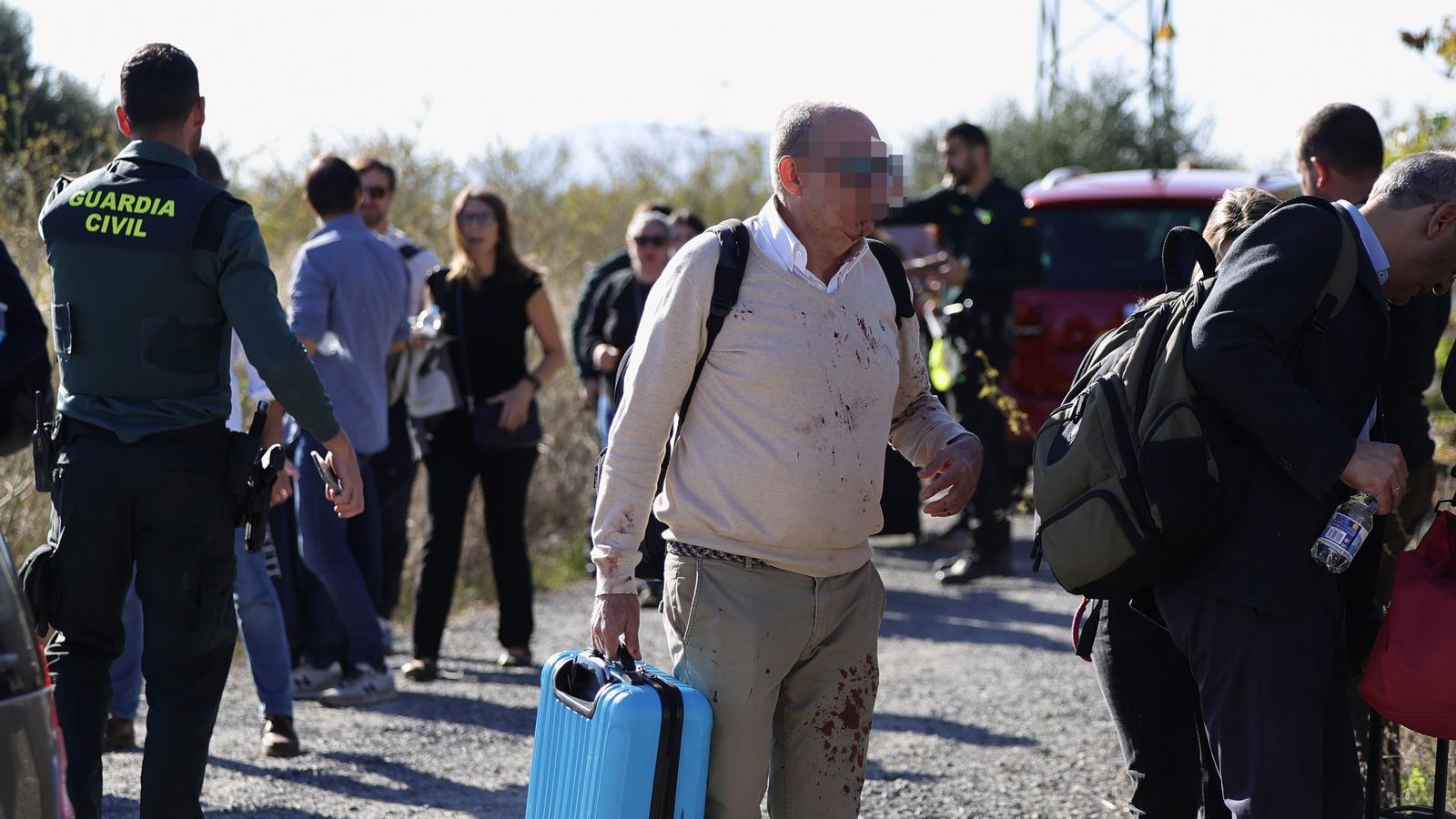
There are volunteers from the town itself who have come to help. A bakery has brought napolitanas. Later, boxes with sandwiches arrive and a cook offers hot broth. People are mostly sitting down. With shirts and pants stained with blood. With wounds. And with bandages on their heads or faces. Every now and then, a man stands on a chair, asks for silence, and calls out names. They are family members or travelers he is trying to locate. Later, he gets a megaphone and a microphone so that he can be heard better.
A resident of Consuegra, a town eleven kilometers away where some of the injured are being sent, suspected something was wrong because she heard sirens. A resident of Urda had the same bad feeling when she saw helicopters. “Nothing had ever happened here,” she says. And she recalls that fifteen days ago the pavilion was flooded with water. Today it has been the epicenter of solidarity.
At one o'clock in the afternoon, four hours after the accident, there are still injured people leaving on stretchers. There are many people talking on the phone. Crying coexists with the travelers' suitcases. All victims leaving the pavilion must leave their details to be located in the future. Outside, they wait while the buses that are to take them to Andalusia or Madrid arrive. While they wait, the journalists—who have been multiplying as the day progressed—look for witnesses to talk to. And some, rightly so, get fed up: “I'm tired of it,” confesses a man after attending to different media outlets. Finally, they board the bus and leave Urda behind, trying to erase a memory that will stay with them forever.
