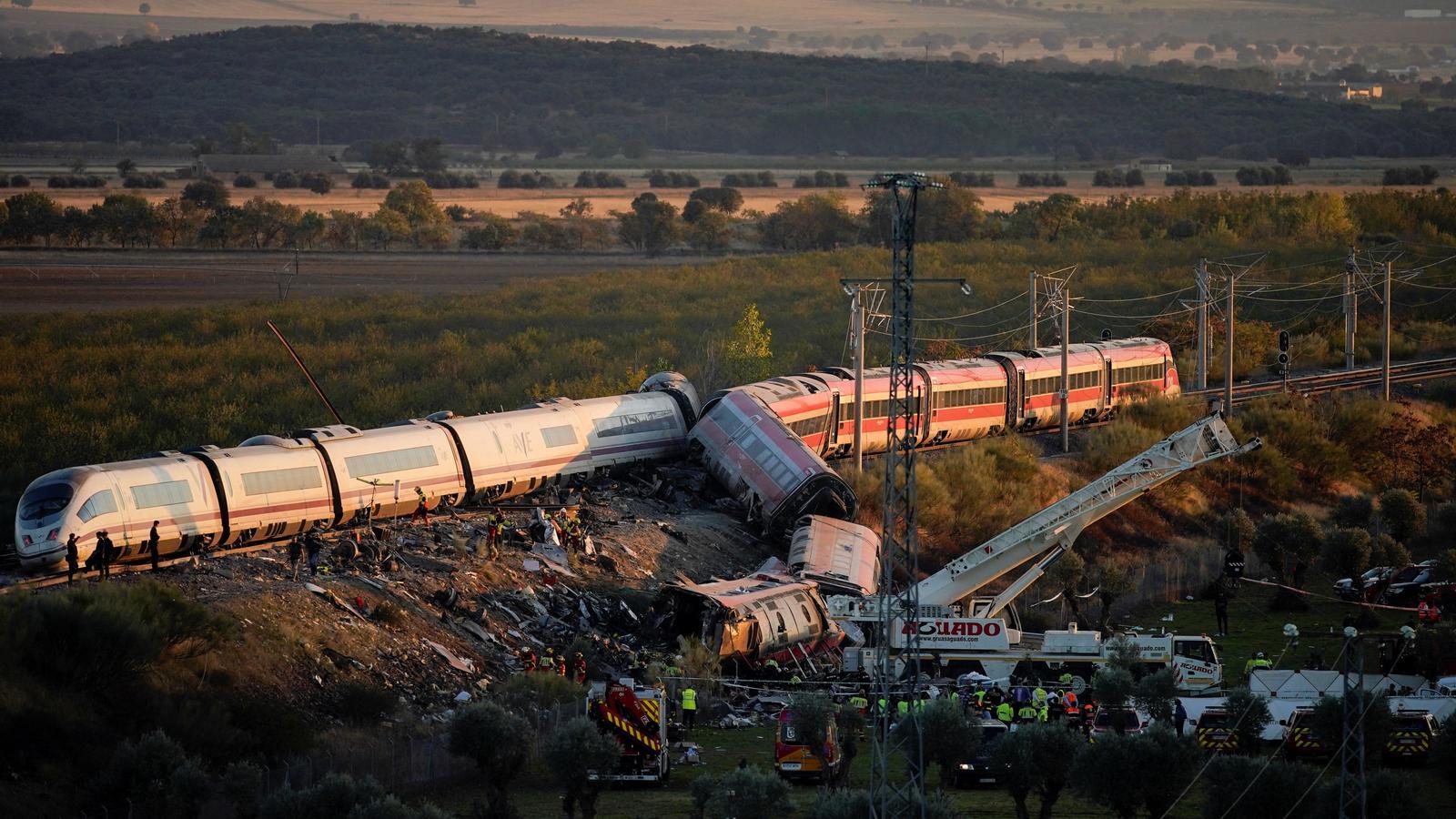
A crash between two high-speed trains in Toledo leaves at least 68 dead
Puente sees as "inexplicable" that an operator ordered the AVE to resume its journey with a train stopped on the track
-
CAT -
CAST
Madrid / BarcelonaSecond railway tragedy in Spain in less than a year on the line between Seville and Madrid, which already ranks as one of the most tragic accidents in the state's railway history. This Wednesday, two high-speed trains, one Renfe AVE and another from Iryo, collided a few minutes before 9 a.m. in Urda, in the province of Toledo. The latest toll of victims stands at 68 dead, and more than a hundred injured admitted to hospitals, according to the government of Castilla-La Mancha. The final number of victims and missing persons, however, is still unknown and authorities fear it will continue to rise.
At this moment, an investigation is already open and under judicial seal –the investigation into the Adamuz railway accident remains open and has been extended until 2027– to clarify the causes of the disaster, and it points to human error at the Atocha control center. "The [Transport] ministry is trying to understand the causes, origin, and reasons for this terrible tragedy," said the Spanish Prime Minister, Pedro Sánchez, in a brief institutional statement from Urda, where he traveled along with the Minister of the Interior, Fernando Grande-Marlaska. Sánchez, who appeared "dismayed" by the accident, said that no efforts will be spared to find out what happened and promised that they will get "to the bottom of it." "If there have been negligence or system failures, it will be known and responded to with total firmness," he stated.
An "inexplicable" decision
The accident occurred at 8:53 AM. The AVE train rear-ended the Iryo train, which was stopped. The Minister of Transport himself, Óscar Puente, explained that everything happened after a failure in the LZB safety system. This incident affected 63 kilometers of the line and caused the trains in that section (the latest information points to six affected trains) to stop suddenly: it is an automatic stop generated by the system that brakes all the trains at once.
The serious problem occurred during the resumption. The Iryo train did not start, for reasons that are still under investigation. In contrast, the Renfe AVE train resumed its journey normally after a technician from the Atocha control room gave it the green light to start at 8:36 AM. A decision that Minister Puente has described as "inexplicable" and which led to the brutal fatal rear-end collision and the derailment of several carriages, some of which were left practically disintegrated.
Puente has detailed the sequence of events that has baffled the authorities. "At 8:36 hours, the control center tells the AVE [which was behind the Iryo] to resume travel as normal." Other trains in the affected section receive the same order and, even, one of the train drivers questions it and asks to resume circulation with what is called "sight-restricted running." That is to say, at a much slower pace that allows for reaction if there is any problem.
In contrast, the driver of the crashed AVE train, who died in the collision, obeys: he resumes travel at normal speed and between 8:36 and 8:53 [time of the collision] he travels a section of about 25 kilometers, reaching about 200 kilometers per hour. It takes "between fifteen and seventeen minutes," Puente recounted. A time during which no one stops him, even though there is an Iryo train stopped on the same track. "And, despite this, he is asked [the AVE train] to resume travel as normal," lamented the minister.
The minister has clearly pointed to the responsibility of the Adif controller (in the room there was also a supervisor and an assistant), who is the one who gave the order to continue the journey. Puente said that he has not spoken to him because he has been isolated and in contact only with his lawyer. Later, he was questioned by the Civil Guard and the Independent Administrative Authority for the Technical Investigation of Railway Accidents and Incidents (AITAT).
And why did the Iryo train not resume travel and remain stopped? The minister said they did not have a clear explanation. In contrast, in the afternoon, Iryo sources told Europa Press that the train driver "was still in talks" with the control center when the collision occurred.
This same Wednesday, the duty judge who has taken charge of the investigation into the accident agreed to prohibit access to the site of the incident to anyone not part of the emergency and judicial services. The removal of any element is also prohibited, as well as the taking and dissemination of images of the affected area. In addition, the magistrate has ordered the seizure and custody by the Judicial Police of Toledo of the black boxes of the damaged trains that are found, for their subsequent analysis, and has asked the judicial police to collect the circulation data of the trains in the area of the accident and the report from the Adif investigation commission regarding the people in charge of command control at the time of the accident.
Two accidents in one year
There were 397 passengers traveling on the Renfe train and 147 on the Iryo train, among them one baby, as explained by the regional government and confirmed by the operators. The train accident in Adamuz (Cordoba) in January left a total of 46 fatalities and the one in Angrois, from 2013, 80. This was the first high-speed rail accident in the State and the most tragic to date. "We are talking about an enormous figure [of deaths]. I am very sorry for everyone, for the families...", said the president of Castilla-La Mancha, García-Page, regarding the Urda accident from the scene.

Many emergency, public safety, and Civil Protection teams (102 personnel) are working in the accident area, in a deployment similar to the one carried out for the Adamuz accident. 200 soldiers from the Military Emergency Unit (UME) have also been deployed at the request of the government of Castilla-La Mancha, along with 422 Civil Guard agents.
Given the number of injured and fatalities, both the regional government and the Community of Madrid have issued an urgent appeal to the public to donate blood in light of a possible increase in sudden healthcare needs. Civil Protection has launched a process to identify and triage the injured from the scene. "The most serious cases are being prioritized," explained Juan Antonio Iborra, general secretary of the National Association of Professional Specialists in Civil Protection and Emergencies. In addition, four offices have been activated to obtain DNA from family members and provide them with psychological support in Madrid, Toledo, Cordoba, and Seville. Furthermore, a pavilion has been set up in Urda for those affected by the accident.
The crash has forced the closure of the line between Madrid and Seville and the suspension of numerous trains. In fact, Renfe has suspended, for now, the sale of tickets for this line until December 13. At the Atocha, Seville - Santa Justa, and Córdoba - Julio Anguita stations, service points have been established for travelers and their families. Renfe has also activated a crisis cabinet and an assistance plan for the victims and their families, as well as a help line for victims and families (900 10 10 20). The Italian company Iryo has done the same. The crash has caused the suspension of practically the entire political and pre-campaign agenda, both of the Spanish government and of the political parties, with the exception of Vox.
