First attempt to organize the 1,800 buses that stop daily on Diagonal
City Hall and Generalitat agree to "loosen" the stops, which go from 13 to 23 points starting Monday

-
CAT -
CAST
BarcelonaThe Rodalies crisis has triggered demand for buses as a mobility alternative, and this, in turn, is saturating some points in Barcelona. Fabra i Puig, Gran Via and also the Maria Cristina area, on Diagonal, have been suffering for months from the effects of an avalanche of alternative plans that, added to the interurban bus lines, are overwhelming mobility. Solving the underlying problem requires rethinking the model, building new stations and interchanges; that is, years of constructing new infrastructure. Therefore, while that doesn't happen, Barcelona City Council and the Generalitat have decided to take a first step to try to "ease up," at least, the Diagonal corridor.
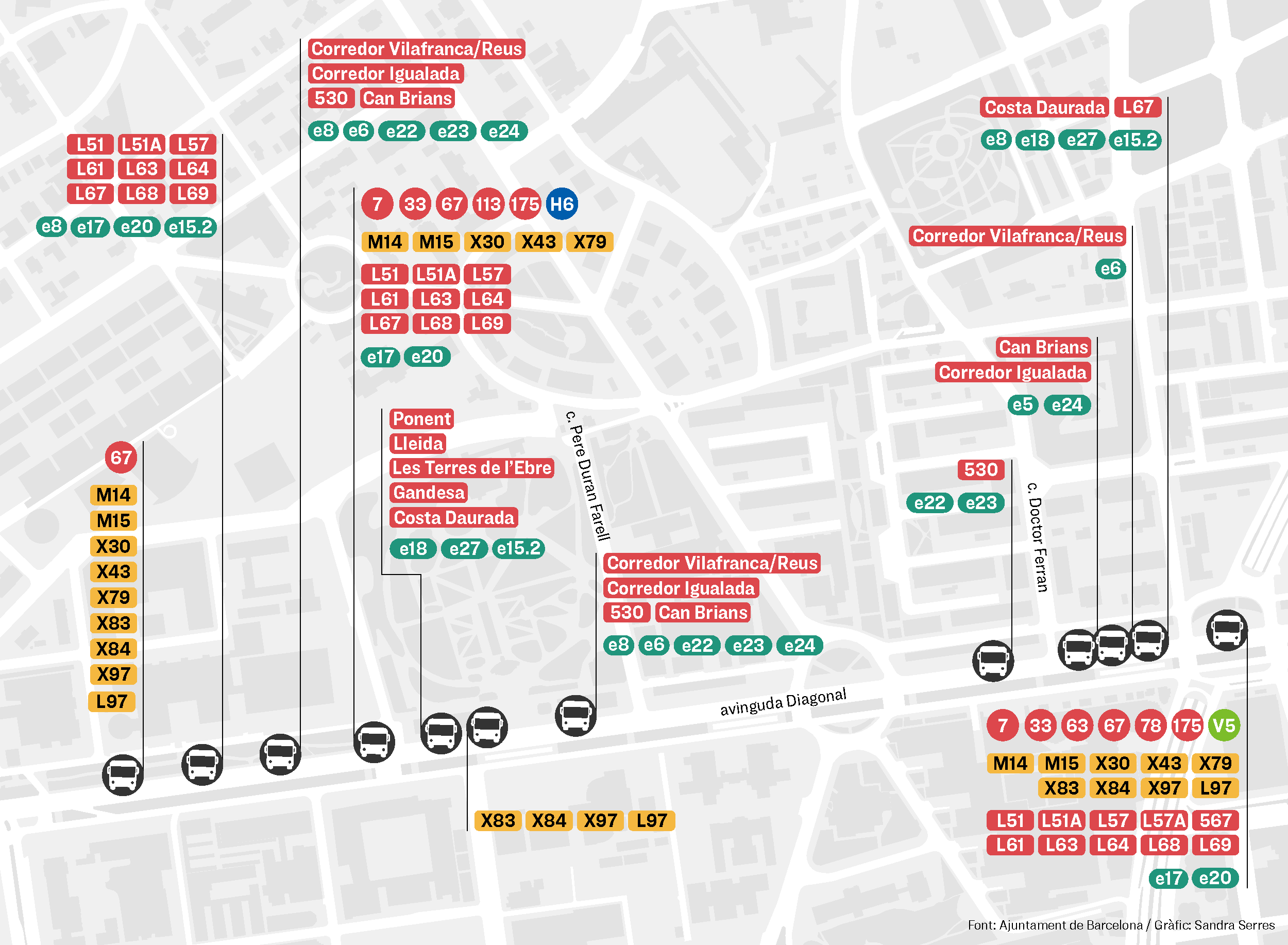
Starting Monday, July 27, 10 additional stops will be added, increasing from the current 13 to 23 on the stretch of Diagonal from Maria Cristina to Zona Universitària, on the mountain side, in the lane exiting the city. The objective is to reduce the number of buses at each stop and space out the stops to alleviate traffic and also the long queues that users suffered. In practice, users will only notice that their stop is relocated a few meters further along Diagonal. To inform them, the administration has filled the area with signs so that passengers can find their new stop.

- If you want to investigate the chart in more detail, open the high-resolution version in another tab.
Until now, some of these 13 stops accumulated up to 40 bus lines at a single point. Now, with the new distribution, each pole or shelter will have a maximum of 20 lines. Many of these new points will also be double stops, meaning they will allow simultaneous boarding of passengers in two vehicles at once, thus speeding up operations and shortening waiting times. Bonet has defined this change as the "phase zero" of a broader strategy.
This is the first attempt to sort out the mess accentuated by the transfer of users from train to bus. In the Maria Cristina, Palau Reial, and Zona Universitària area, 1,800 intercity buses stop every day. This means that, every minute of the day, several of these large vehicles coincided until now loading and unloading passengers (up to 30,000 per day).
200 buses at once during peak hour
The deputy mayor and head of Mobility, Laia Bonet, has admitted that interurban public transport has grown in demand in recent years and that, on the other hand, "the city's infrastructure is not up to par". In fact, many of these poles and shelters were installed years ago, in 2020, but were not operational because the reorganization did not go ahead at that time. The municipal spokesperson wanted to send a message of reassurance to users affected by the changes, and highlighted that the reorganization only involves moving the stops "a few meters", without drastic changes in routines. She also framed the measure within an 8-million-euro plan that foresees about twenty actions in other corridors such as Meridiana or Gran Via, planned for the next two years. "We really need to generate a competitive and attractive alternative for people to leave their cars at home," she stressed.
"During peak hours, we can have about 200 buses stopping [in these areas of Diagonal]; that means, approximately, about three buses per minute," argued the Director General of Transport and Mobility of the Generalitat, Susi López, who detailed that the reorganization has planned to distribute the stops into three groups along the Diagonal, depending on the final destinations, to make it more intuitive. The association for the Promotion of Public Transport (PTP), which has been calling for this reorganization for years, views the initiative positively: "It was needed, although it is very timid. Now we need to continue putting things in order, improve information for users and also waiting areas," assures Jordi Porta, spokesperson for the PTP.
A "low-cost" action
López also stressed that the action is "low cost". "We are talking about moving elements like information panels or bus stop poles: around 6,000 euros. And on the part of the City Council, it is simply a very economical painting action". The representative of Territori also defended that as long as the total reliability of the railway system is not recovered, it is "essential to maintain this double offer".
Both administrations have also agreed that this improvement is only a first step towards a more ambitious vision that includes the creation of large high-capacity interchanges at the four main entrances to the city in the long term.