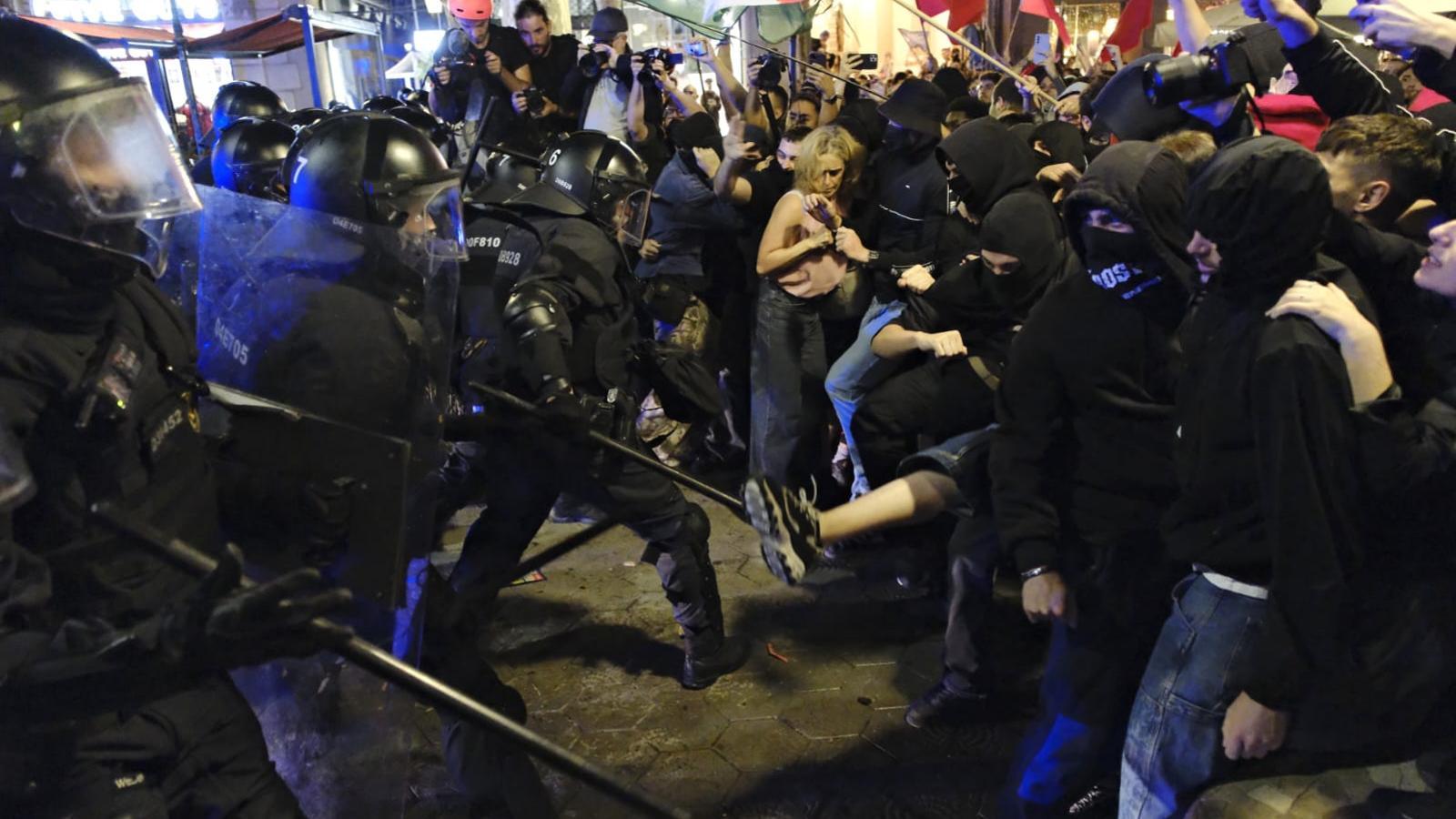
Barricades and police charges at the end of the demonstration for housing in Barcelona
A group of protesters has thrown rubble and bottles at the Mossos d'Esquadra, who have arrested 13 people
-
CAT -
CAST
BarcelonaOutbreak of tension at the end of the demonstration in defense of housing in the center of Barcelona. After a couple of hours of peaceful protests, the Mossos d'Esquadra charged against a large group of protesters – mostly made up of young people – who lit bonfires at the intersection of Gran Via and Passeig de Gràcia and threw stones, bottles, pyrotechnics, and street furniture at the officers. The operation, which featured a strong deployment of vans and Brimo agents, ended after midnight. The police carried out several identifications and arrested at least 13 people for public disorder, one of whom is a minor. Of all those arrested, eleven were brought before a judge this Tuesday morning and have already been released at the disposal of the courts whenever they are required. The minor was released at night.
Once the protest was formally called off, around 10 p.m., the Mossos d'Esquadra deployed a police cordon to contain the advance of some protesters, many of whom were hooded. Minutes earlier, at the height of Passeig de Gràcia and Diputació, a group had already tried to break the police line. From that moment on, tension escalated by the moment. At the roundabout of Passeig de Gràcia and Gran Via, a barrage of objects and pyrotechnics began against the officers and some shop windows, and the police responded with baton strikes. Bonfires were also lit, and while a column of people moved in the direction of Plaça Catalunya and another towards Tetuan, hundreds of people headed towards Plaça Catalunya.

In this central square –where the encampment in defense of housing is located– several centers of tension have been forming. Plaça Catalunya, Pelai, la Rambla, Balmes... The burning of dumpsters has reached the intersection between Roger de Llúria and Gran Via. Protesters have used fences, dumpsters, and construction rubble to build barricades and set them on fire. In the center of the Catalan capital, smoke has stained the air, while firefighters have rushed to extinguish the bonfires. Graffiti calling for a strike has also been made.
In parallel, the officers have attempted to encapsulate the group that was causing disturbances in Plaça Catalunya, but the protesters have taken advantage of this time to set up more barricades and accumulate material to throw at the police line. Some officers have fired foam projectiles in response to deter them.

One of the tensest moments took place in the Canaletes area: there, protesters obtained material from the construction works on La Rambla, and new episodes of throwing objects and police charges occurred. Finally, the Mossos pushed the activists towards the center of the square and surrounded them, positioning themselves at all entrances to the square. The Catalan police estimate that 28 barricades were set up throughout the night and the Fire Department extinguished 22 fires. In addition, there were 28 officers with minor injuries.
The Minister of Interior, Núria Parlon, updated the balance on the incidents of the demonstration this Tuesday morning on El món a RAC1 the balance regarding the incidents of the demonstration. Parlon highlighted that the majority of the 20,000 participants in the mobilization had behaved peacefully, although she specified that "a few" dedicated themselves to "perverting it." On the other hand, she explained that they will now look into whether the police can pull the thread, based on the recording of the events, and it will be checked if there is any other person directly involved and if more arrests are made. Parlon also vindicated the work of the Mossos d'Esquadra, which she highlighted is to guarantee the right to protest.
Thousands of protesters
This Monday at 7 p.m., unions and housing advocacy organizations held the demonstration that was postponed by Saturday's storm and which did take place in other major cities across the country. The housing crisis has turned everything upside down in just a few weeks, and tenants' unions warn that the early call for elections does not solve any problems nor does it change the plans for a general strike. This was confirmed by the thousands of protesters who took to the streets of Barcelona once again to flatly reject speculation and demand the right to housing. The protest gathered 20,000 people according to the Barcelona City Council, and 120,000 according to the organizers.
The demonstration began at Plaça Urquinaona and advanced along Ronda Sant Pere to the Arc de Triomf. When the front of the march reached this point, there were still protesters at the start who had not yet begun to move due to the large turnout. Chanting "No neighbor out of their neighborhood," "Rentiers are guilty, governments are responsible," and "It makes no sense, people without homes and homes without people," they advanced along Passeig de Sant Joan to Plaça Tetuan. The demonstration continued along Gran Via and ended at Passeig de Gràcia. The organizers called for participation in the encampment at Plaça Catalunya.

The call has reached people of all kinds and the profile of the protesters is quite diverse. Laia, Lucas, and Núria are students and still live at their parents' house, but they did not hesitate to take to the streets this Monday to demonstrate for the right to housing. "This way we will never be able to move out, it's our future," he explains. David, on the other hand, explains that he is a homeowner and that he has come in solidarity with all the people who cannot afford to buy an apartment. "The rents are impossible, and luckily I was able to buy an apartment. I am mortgaged for 30 years, mind you," he says. He wants to make it clear that he is one of the few in his group who has been able to buy.
Before the protesters began the march, ARA reported that there will be a general strike for housing before the Spanish elections on November 29th. The majority unions, CCOO and UGT, have announced that they support the stoppage proposed days ago by the tenants' unions, which on Sunday already had the support of the CGT union, according to sources familiar with the talks. The spokesperson for the Tenants' Union, Carme Arcarazo, welcomed the support and argued that broad consensus is needed to carry out this stoppage. "We want this strike to be a success: we are facing a very powerful enemy," she warned. And she added: "We have a month to organize the entire working class of the country."
The spokesperson for the Socialist Housing Union of Catalonia, Gisela Bermúdez, has harshly criticized all political leaders and said that "there is no party that really wants to put an end to the housing crisis" because "no party wants to break with the housing business." She also demanded "the expropriation of all apartments" from large landlords, banks, and vulture funds; lowering rent prices by half and applying indefinite contracts so that the working class "stops suffering from anxiety."
The Housing Union Confederation of Catalonia also wanted to point out the role of the Generalitat government in the housing crisis. According to its spokesperson, Marta Espriu, President Illa also has "responsibility" in managing the situation. And, from the PAH, Juanjo Ramón welcomed that "the streets have woken up," and believes it is "a window of opportunity" and "a framework of hope" for everyone who has lost their housing in recent years.
