What would the police have said if there were no images of the assault on the minor?

-
CAT -
CAST
Barcelona"We want to call you all to a permanent mobilization", said the then president of Òmnium, Jordi Cuixart, perched on the roof of a Civil Guard car on September 20, 2017. His words were incorporated into the police report that served as the basis for his imprisonment and that of Jordi Sànchez (ANC) a few weeks later. According to the police, the two of them controlled the thousands of people who were gathered in front of the Ministry of Economy to protest against the first arrests of the Procés and "never" used this control to call off the demonstration. The police report omitted that, moments later, perched on the same car and with the same megaphone in hand, Cuixart asked to end the demonstration: "We ask you, as far as possible, in a calm manner, to disperse this call in a few moments". The images, recorded by protesters, were shown during the trial at the Supreme Court.
As agents of authority, police officers enjoy a presumption of truthfulness. It is presumed that what their reports say is not biased nor does it respond to the interest of the agent or the corps to manipulate the facts so that they resemble more what they want to happen, such as a judicial conviction. Unfortunately – for society and also for the image of the police, whatever the corps may be – it is not difficult to find examples of malpractice in the drafting of reports, often in cases of police charges –also at the border of Ceuta and Melilla–, in which the agents' actions are especially subject to the criterion of proportionality. And this is where images can condition the outcome.
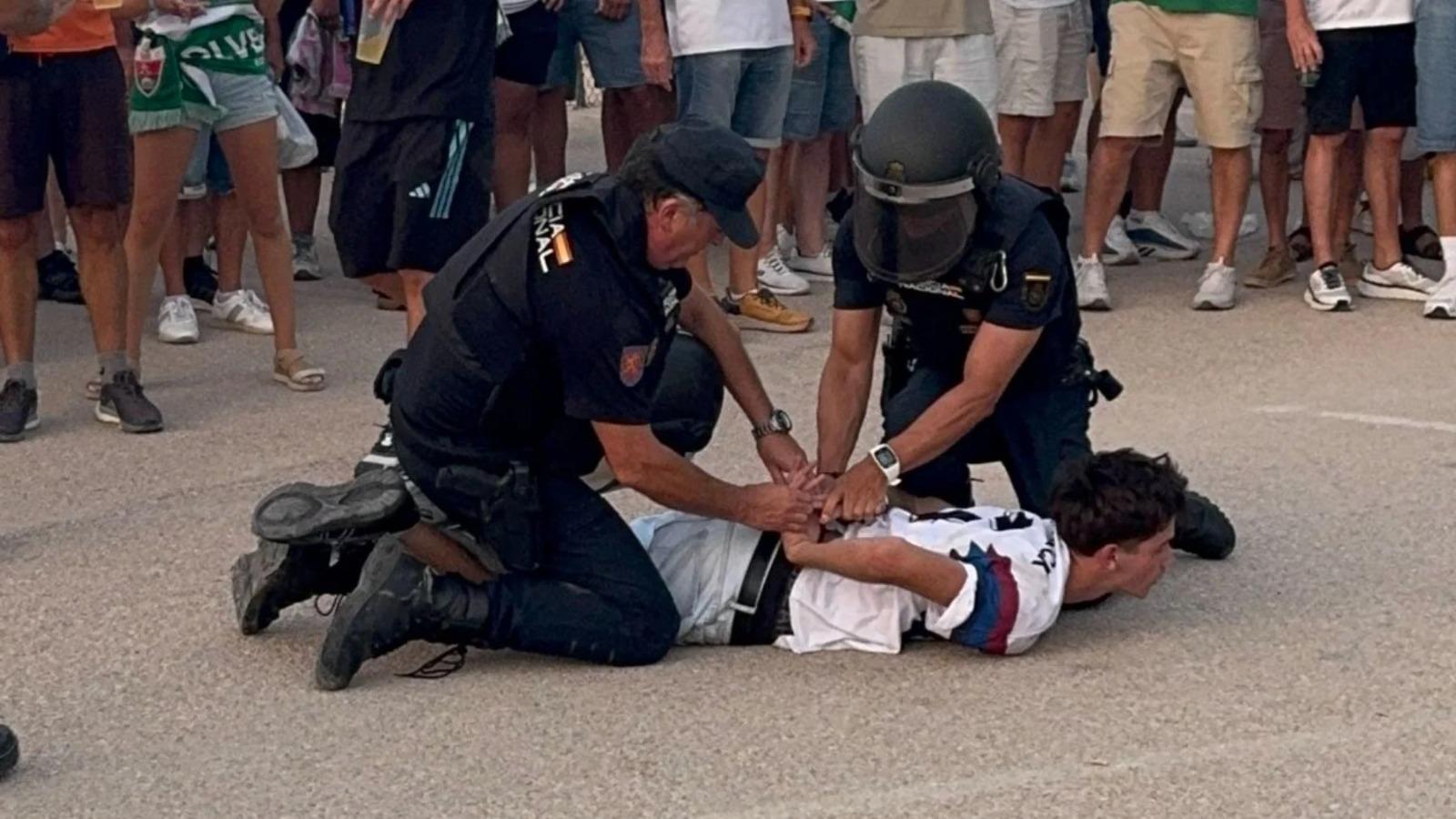
The proliferation of smartphones, all equipped with high-quality cameras, reduces the room for interpretation that reports can collect. Numerous videos have emerged from the assault by the National Police on a minor last Sunday in front of the Elche stadium that allow the events to be reconstructed. In one, it is seen how, before being assaulted, the Barça fan walks chanting Els segadors or chants of support for the team, next to a friend of his who is carrying an Estelada (Catalan flag). It is also seen how, from a distance, he shouts and makes gestures against the Elche fans, who also shout and make gestures against the Barça fans, without at any point either side generating moments of tension.
Later, police officers pull the young man out of the crowd and he accompanies them without confronting them. He receives two shoves to the back and at least two baton blows, before turning back to try to hit a police officer. It is then that other officers subdue him with baton blows. And, once on the ground, after one officer asks the rest to calm down, there is still one who gives him an elbow blow to the eye. When they take him away handcuffed without him resisting, he receives the impact of another punch to the face that would have knocked him down if several officers had not been holding him.
The entire pro-independence movement, as well as the commoners and the Government, have condemned the aggression against the minor. Even the Minister of the Interior, Fernando Grande-Marlaska, has not come out as in other occasions to defend the police action, and has emphasized that it will have to be determined if the action was proportional. But the main union of the National Police, the SUP, has come out to close ranks with the agents.
A spokesperson for the SUP assures that "the truth" of what happened is that "the individual" was arrested for using the estelada – which a colleague was carrying – "as an excuse to provoke, sow hatred, and utter racist chants". According to him, the police intervention was "exemplary" because, he says, the young man assaulted two police officers when asked for his documentation. What's more, even though the images refute this version, he adds that, from the ground, he proceeded to kick, spit at, and insult the officers who were restraining him. Another spokesperson for the SUP points out, moreover, that the Barça fan tried to assault a rival fan and also several police officers while he was within the group of blaugrana fans – something the images also deny – and that, "at all times", he offered "resistance". The estelada, this spokesperson also explains, was displayed "as a symbol of hatred".
If this is the version they give with numerous recordings of the events, what would they have said if there were no images of what happened? The National Police has an internal investigation open, as confirmed by the Minister of the Interior, and the events will probably end up in court. The unknown will be whether, before the judge, reality will be enough to end the presumption of veracity of the police officers.
