The Parliament rejects Illa's star proposal on housing
ERC and Comuns shield the president of the Generalitat from the reprovals of Junts, the PP and the CUP
-
CAT -
CAST
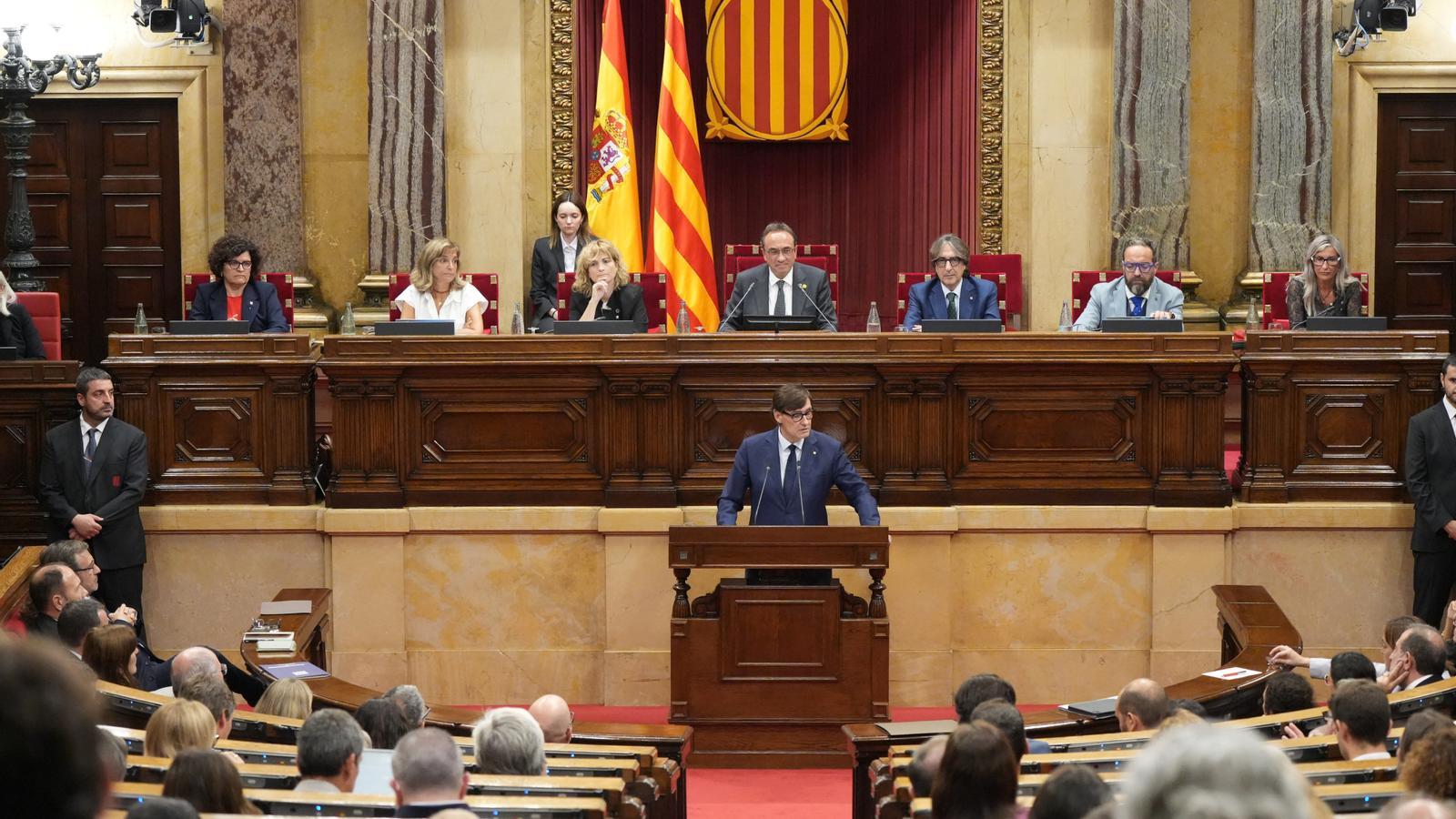
BarcelonaIn a week marked by housing across the country, Salvador Illa began the general policy debate on Tuesday with a set of measures to resolve the crisis that has been dragging on for years. The president announced a 25 million euro fund to prevent evictions similar to those of Maricarmen Abascal and also a program with which the Government will offer the option to Catalans over forty years old to share the ownership of their home – 50% of the home would remain with the public administration, which would cede ownership for forty or fifty years –. It is this last measure that has not received the endorsement of Parliament because the Comuns abstained. A setback for the executive, considering that the one who has derailed this resolution is one of the two investiture partners. ERC, on the other hand, voted in favor.
The group led by Jéssica Albiach has given a "warning" to the executive, party sources point out. They are not against the initiative, but they consider it "insufficient" and have intended their abstention to be a message to demand that the Government "comply with the pending agreements". Despite not receiving the endorsement of one of its partners or even a majority in Parliament, the Minister of Territory, Sílvia Paneque, has assured that the Government will move forward with this program because it has the "legitimacy" to do so and it does not require any legal modification. In contrast, both investiture partners have endorsed the plan to increase the public park of affordable housing by 50,000 apartments by 2030.
The Socialists abstained – and caused it to fall – from the Comuns' proposal that replicated one of the decrees that the Spanish government approved this week: the automatic renewal of rental contracts, which will also be rejected this Friday in Congress. The PSC also abstained from the resolution proposal from the Comuns that requested the launch of the anti-eviction unit, just as Illa promised, because "it is already out for tender". "We understood that it made no sense to do anything other than abstain," argued the parliamentary spokesperson for the Catalan Socialists, Elena Díaz, in a press conference.
Furthermore, there were various resolution proposals that contained part of the content of the main housing decree that the council of ministers approved on Tuesday and which now hangs by a thread due to the uncertainty regarding Junts' position. The Junts members, precisely, voted against one of the resolution proposals presented by ERC regarding the ban on evictions for vulnerable people. In contrast, Junts had presented a resolution of its own in which it made an explicit distinction for this ban between vulture funds and small property owners. The proposal received the support of the PSC and Comuns and was approved.
Although the PSOE and Sumar are standing together in Madrid on matters of taxation in the housing market, the PSC has avoided validating various resolution proposals on the subject. Specifically, the Catalan socialists abstained on the point of taxing speculative purchases, and of subsidizing or charging no tax at all on the purchase of a first home. In contrast, for Junts, whom the PSOE wanted to convince to give the green light to the Maricarmen decree and have it approved this Wednesday in the Spanish lower house, the PSC voted in favor of their proposals regarding taxation in the housing market.
The reprobation of Illa, rejected
On the other hand, the Parliament has rejected censuring the President of the Generalitat, Salvador Illa. The votes of Esquerra and Comuns, alongside those of the PSC, were key to ensuring that the resolution proposal presented by Junts did not move forward, and neither did the censure and the request for the dismissal of the Ministers of Education, Esther Niubó, and Interior, Núria Parlon. Also thanks to the votes of the Government's partners, the proposals to censure the management of the Catalan executive registered by the PP and the CUP were not validated.
A solution to the political conflict "endorsed"
For more than a decade, proposals regarding the political future of Catalonia have been voted on at the general policy debate. During the 'Procés', they were more detailed and concrete, and now, those that manage to get approved tend to be more generic and diffuse. This Thursday, for example, the ERC proposal was approved, which advocates for reaching a "broad consensus" to resolve the Catalan political conflict and for this solution to be "endorsed by the citizens of Catalonia". The proposal received support from the PSC, Junts, ERC, the Comuns, and the CUP. These are the same groups that have also voted in favor of establishing the national convention to resolve the political conflict that ERC and the PSC agreed upon for the investiture of Salvador Illa. In the resolution presented by the republicans, they added that this agreement, once established –it does not set a date for when that should be–, should present its conclusions within a year. Furthermore, Parliament has once again demanded the "total and immediate" application of the amnesty law, which received votes in favor from all groups except the PP and Vox.
Neither ERC nor the PSC brought any resolution proposal to request the implementation of the new financing for Catalonia, despite having agreed upon it –they did present one last year, when the agreement had not yet been finalized–. In contrast, the Comuns did write into one of their proposals to reflect this pact to change the regional financing model, which received the votes of socialists and republicans. Junts, for its part, had incorporated a proposal defending the economic agreement that only received support from ERC. In fact, the 'juntaires' are currently opposed to endorsing the model agreed upon between the socialists and Esquerra when it reaches Congress.
Finally, Junts presented a resolution proposal in which it points out that "Catalonia is a nation", which has exposed the two national blocs within Parliament: it was defeated by the opposing votes of the PSC and the Spanish nationalist right.
