Illa commits to buying apartments from vulnerable families to avoid cases like that of Maricarmen Abascal
The president of the Generalitat gives the official starting signal to the political year with the speech at the general policy debate in Parliament
-
CAT -
CAST
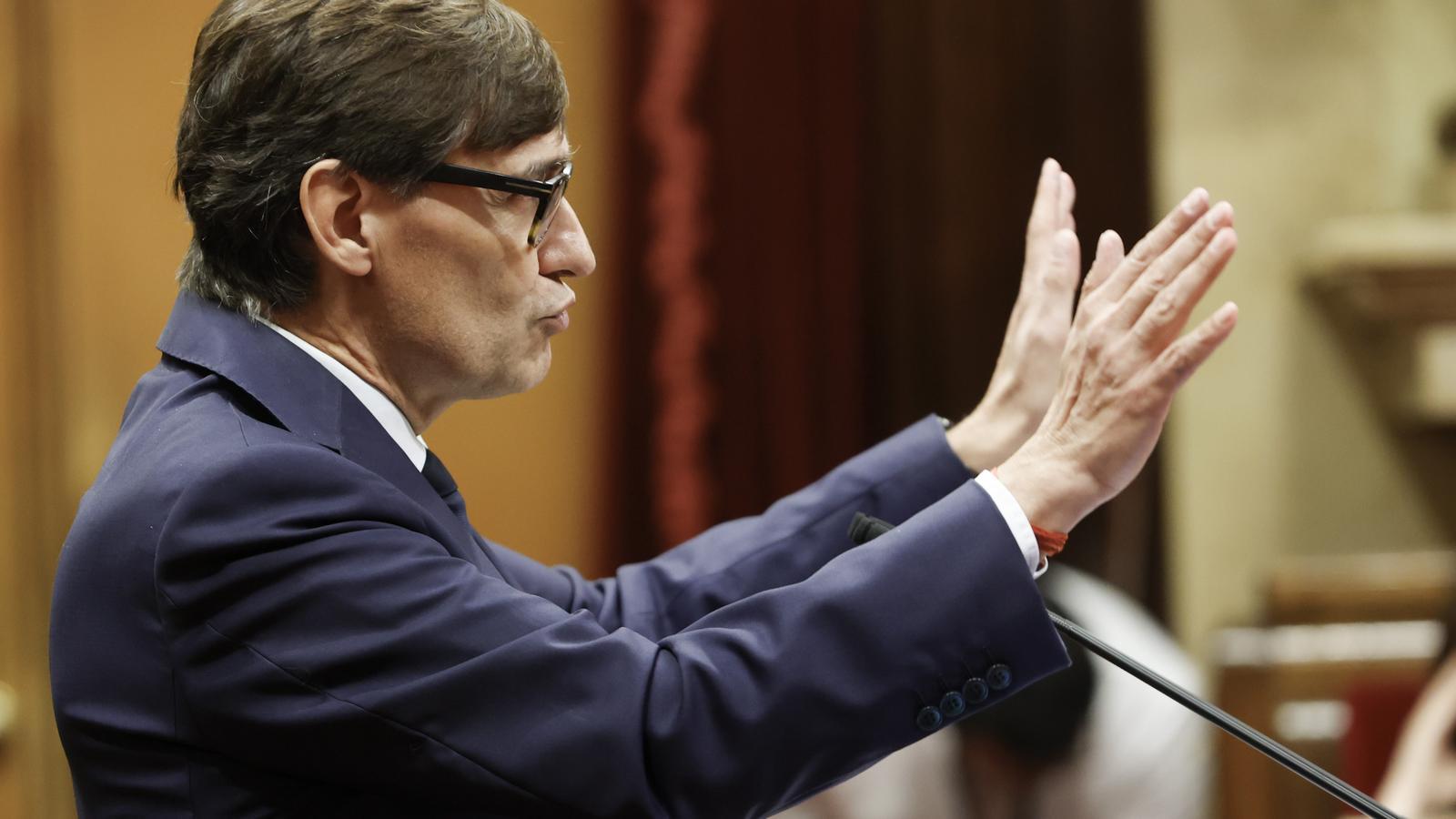
BarcelonaSalvador Illa officially kicks off the political year with new promises, especially in housing. The President of the Generalitat announced in the general policy debate in Parliament that the Government will promote an anti-eviction fund; shared and temporary purchases between administrations and citizens who cannot afford the down payment on an apartment, and the expansion of emancipation loans for young people.
The president pointed out that the goal is to avoid more cases like that of Maricarmen Abascal, who was evicted from her home in Madrid at 87 years old. "This is not the model of society we want," Illa remarked, even though Catalonia is the autonomous region with the most evictions in the State. "In Catalonia we have values and we put humanity before everything else," he asserted in contrast to the Madrid president, Isabel Díaz Ayuso. On the other hand, he took the opportunity to thank the processing of the Maricarmen decree promoted by the Spanish government, led by Pedro Sánchez.
It is in this context, that of the eviction of Maricarmen Abascal and once the debate on rental prices has been placed at the center of the political sphere, that Illa has launched the commitment to create a 25 million euro fund to prevent similar new evictions. As the president explained, it would only be activated as a "last resort" and to stop the evictions of "vulnerable" citizens. The amount of money the Generalitat is putting into it is "expandable" and Illa has invited other administrations – such as city councils, county councils, and provincial councils – to contribute more funding.
This, however, was not the only "unprecedented" measure that Illa has committed to carrying out. He also announced that the Government will offer the option to Catalans of "forty years old with stable incomes" – but who have "difficulties accessing a mortgage" – to share ownership with the Generalitat: 50% of the housing would remain with the public administration, which would cede the property for forty or fifty years. During this time the housing could be sold or rented and even inherited, but once the time has elapsed, the person would have to decide whether to pay the other half to the Generalitat or lose the apartment, which would be allocated to the social housing stock. This measure will have funding of 100 million euros.
Illa has also made an announcement on another of the most burning issues on the public agenda, such as education, and has proposed to the parliamentary groups to create a new regulation to "recognize the public authority" of teachers. However, he has not detailed how he intends to achieve this and has asked the rest of the political forces to get involved to analyze "the best way to do it".
On the other hand, the president has also announced that he will promote the holding in Catalonia of a conference of European regions that are "committed to democracy, the rule of law, and European values." The socialist leader, who has once again given a speech with references to current international affairs, has announced the launch of a Catalonia-Ukraine program to strengthen and facilitate the aid of Catalan administrations to Kyiv. "We want our commitment to have continuity, structure, and concrete results for mutual benefit," the president emphasized.
The application of the amnesty
On October 6th, a plenary session at the Parliament of Catalonia and another at the Constitutional Court will begin in parallel. In Madrid, the progressive wing of the Constitutional Court will validate the full amnesty for former minister Dolors Bassa and, by extension, for the rest of the October 1st leaders whom the Supreme Court had refused to amnesty. That day it will not yet be effective, but the President of the Generalitat trusts that in the next plenary session of the Parliament, scheduled for October 20th, Catalonia will be able to welcome the deputies who remain in exile. "I want us to have President Puigdemont with us in the next debate we hold in Parliament," he said.

The president has defended his government's work to improve people's lives and also to improve coexistence. And this is where the amnesty comes in, necessary to build a "more united, cohesive and prosperous" society. "The amnesty law has the endorsement of the Court of Justice of the European Union (CJEU) and the Constitutional Court. Its application is mandatory without further delay. And it will be so, as I have always defended," he insisted. Illa has vehemently defended the application of the amnesty since it was one of the agreements between the PSOE, ERC and Junts for the investiture of Pedro Sánchez in 2023. Before that, he, like the rest of the Socialist Party, had opposed this measure.
"Propaganda" and "lack of national ambition"
Criticism of the president's speech was not long in coming in the press conferences following the plenary session. This Wednesday he will face the spokespersons and he already knows that he will not find a bed of roses. From Junts, Salvador Vergés defined Illa's speech as "propaganda" and completely "predictable": "We are very worried that we have seen a president who lives in an imaginary Catalonia," he stressed. His "triumphalism," according to the Junts leader, contrasts with the fact that the president has shown himself to be "very far from the suffering of doctors, teachers, farmers, and fishermen."
From investment partners like ERC, Ester Capella regretted the "boring speech in form" and with a "lack of national ambition in substance." At the same time, she censured the scarcity of resources announced for housing: she stated that they are "a drop in the ocean." In turn, the leader of the Comuns in the chamber, Jéssica Albiach, pointed out that "Catalonia is not better" and that the speech against the extreme right does not work without measures: "We have seen triumphalism and 'come back in ten years'," she said, and added that he did not announce the "market intervention" of housing, but rather "giving money to investors." This diagnosis that "it falls short" was also shared by the CUP; its spokesperson, Xavi Pellicer, called the purchase aid a "rescue for kidnappers" because he believes it goes to vulture funds and reproached Illa for "juggling."
On the flank of the Spanish nationalist right, the PP spokesperson, Lorena Roldán, lashed out at Illa for his "very disappointing" intervention, which sounded like "a broken record," and the Vox spokesperson, Joan Garriga, pointed out that Illa "is far from the real Catalonia" and called the housing measures "ridiculous."
