The National Court finally applies the amnesty to the twelve CDRs of Operation Judas
The CJEU had concluded three months ago that archiving the case for terrorism did not clash with European law

-
CAT -
CAST
MadridThe list of people awaiting amnesty continues to shrink drop by drop. The latest court to take the step has been the National Court, which had been dragging its feet for three months to avoid applying the law to the twelve CDR members of Operation Judas accused of terrorism. After the approval of the regulation, the court tried to dodge it by asking the Court of Justice of the European Union (CJEU) if granting amnesty to the CDR members contravened European law. It was a way to boycott and delay the implementation of the amnesty. The Luxembourg ruling, which took two years to arrive, was finally issued in July, fully endorsing the law. Since then, the National Court had a clear path to make a move, but it needed three more months to make the judicial oblivion effective. Finally, 28 months after the law came into force, it has buried the case: “It must be understood that the facts that are the subject of this proceeding must be included [in the amnesty]”, concludes the four-page interlocutory order.
The resolution alludes to the literal wording of the amnesty, which includes within the perimeter of the law those cases investigated for terrorism that do not involve “serious human rights violations” in an “intentional manner”. It also refers to the CJEU ruling, which established that this does not compromise legal certainty, equal treatment, or non-discrimination. It was in November 2023, coinciding with the negotiations for the investiture of Pedro Sánchez, when the National Court sent the CDR members to the dock, a trial that never actually took place. They were arrested on September 23, 2019, because they were supposedly preparing violent actions coinciding with the anniversary of the 1-O referendum and the imminent publication of the Procés ruling.
The accused were facing heavy prison sentences. The popular accusations –led by the Catalan Association of Victims of Terrorist Organizations (ACVOT) and also composed of Vox, the Association of Victims of Terrorism, the Dignity and Justice Association and two Civil Guard associations– requested up to 33 years in prison for eight of them for the crimes of belonging to a terrorist organization, possession, storage and manufacture of explosives, and causing devastation. The Public Prosecutor's Office, which maintained that they formed a “parallel, clandestine and stable terrorist organization” within what were dubbed Tactical Response Teams, initially demanded up to 27 years in prison. However, following the entry into force of the amnesty, it was in favor of archiving the case.

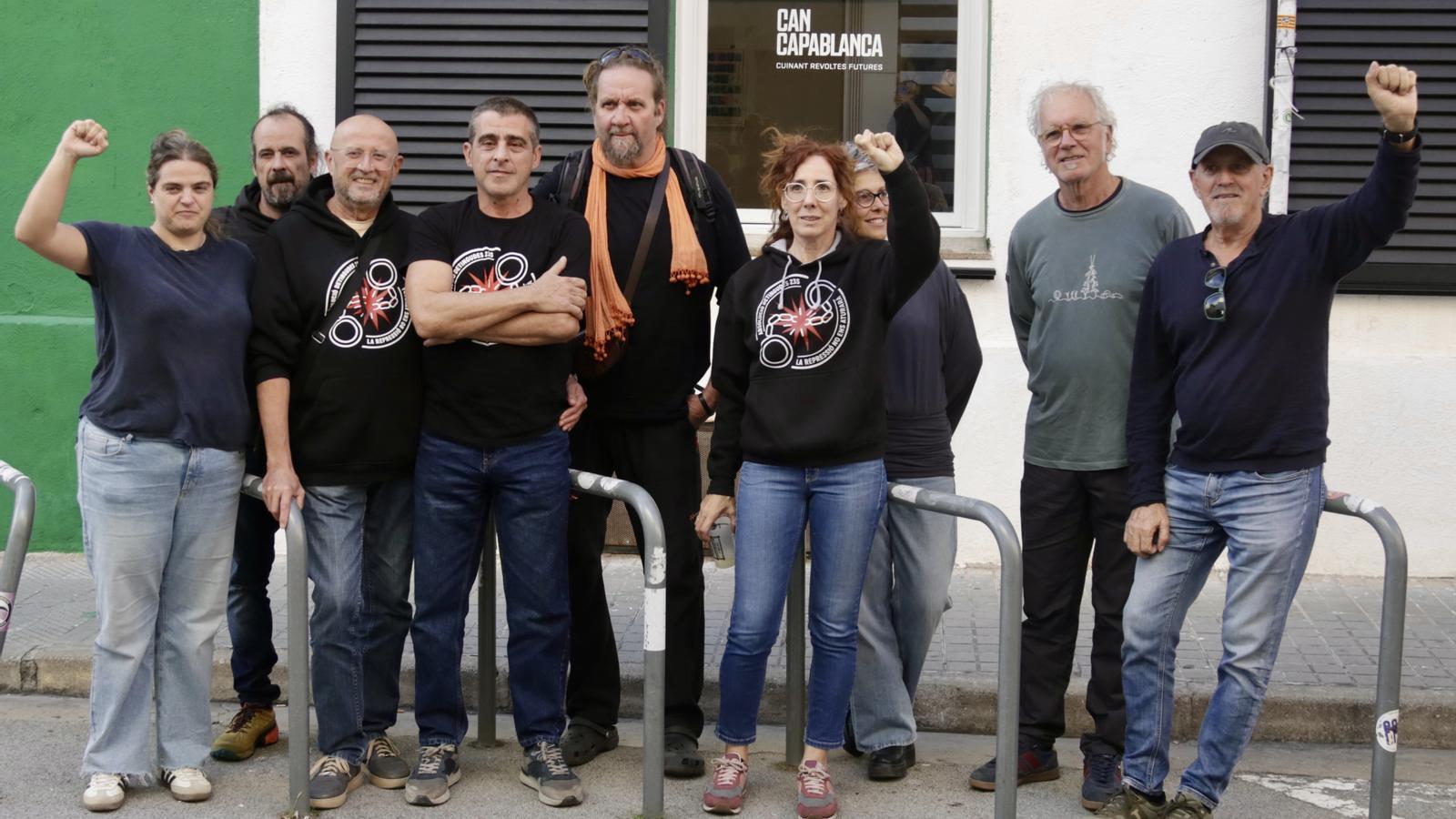
“The victory belongs to all of you who have fought and remain firm in the struggle,” claimed Alerta Solidària shortly after, which defended the twelve CDR members. In the afternoon, the amnestied individuals celebrated the news at Can Capablanca, the pro-independence and popular community center in Sabadell. “They have disrupted our lives and we cannot forget it. We are freed and at the same time angry,” acknowledged a visibly moved Edu Garzón, one of them. One of the lawyers from Alerta Solidària, Jordi Busquets, denounced that the journey had been too “long and painful” for the activists: “It has taken a part of their lives in a totally gratuitous manner.”
For his part, on social media, the leader of Junts, Carles Puigdemont, lamented that the amnesty comes after “unjust suffering,” an “obscene media lynching,” and a “flagrant violation of fundamental rights.” The president of ERC, Oriol Junqueras, expressed himself in the same vein: “Justice is making its way, but nothing will erase the suffering experienced,” he wrote.
The path does not end here
Despite this, the Spanish justice system has not yet had the final word. As ARA has learned, the popular accusations will file an appeal with the National Court itself against this decision. They have ten days to do so and could then still go to the Supreme Court to reverse the amnesty. In the last document they presented to prevent this, to which this newspaper also had access, they accused the CJEU of having issued the ruling for “reasons of political convenience” after “pressures” from Spain and argued that speaking of “serious human rights violations” is “implicit” in terrorism cases: “Is it legally admissible to grant amnesty when there has been an attempt to commit an attack in the name of a political ideology?”, they asked.
A delicate wording
The path to reaching the amnesty has been very tortuous. The inclusion of terrorism was one of the major obstacles in the negotiation and processing of the amnesty law. The final wording removed the reference to the Spanish Penal Code and referred directly to the European directive regarding the fight against terrorism. Previously, in the first version of the text that Junts blocked, it had been introduced that only terrorism that had “intentionally” caused “serious violations of human rights” would be excluded, and particularly those that appear in the European Convention on Human Rights.
The changes in versions were also conditioned by the progress of the Tsunami Democràtic case, in which Manuel García-Castellón was investigating Marta Rovira and the Supreme Court indicted Carles Puigdemont and Ruben Wagensberg. That case ended up derailing due to a judge's error when extending the investigation.
