The Crown of Aragon gathers again in Poblet 15 years later claiming Spain
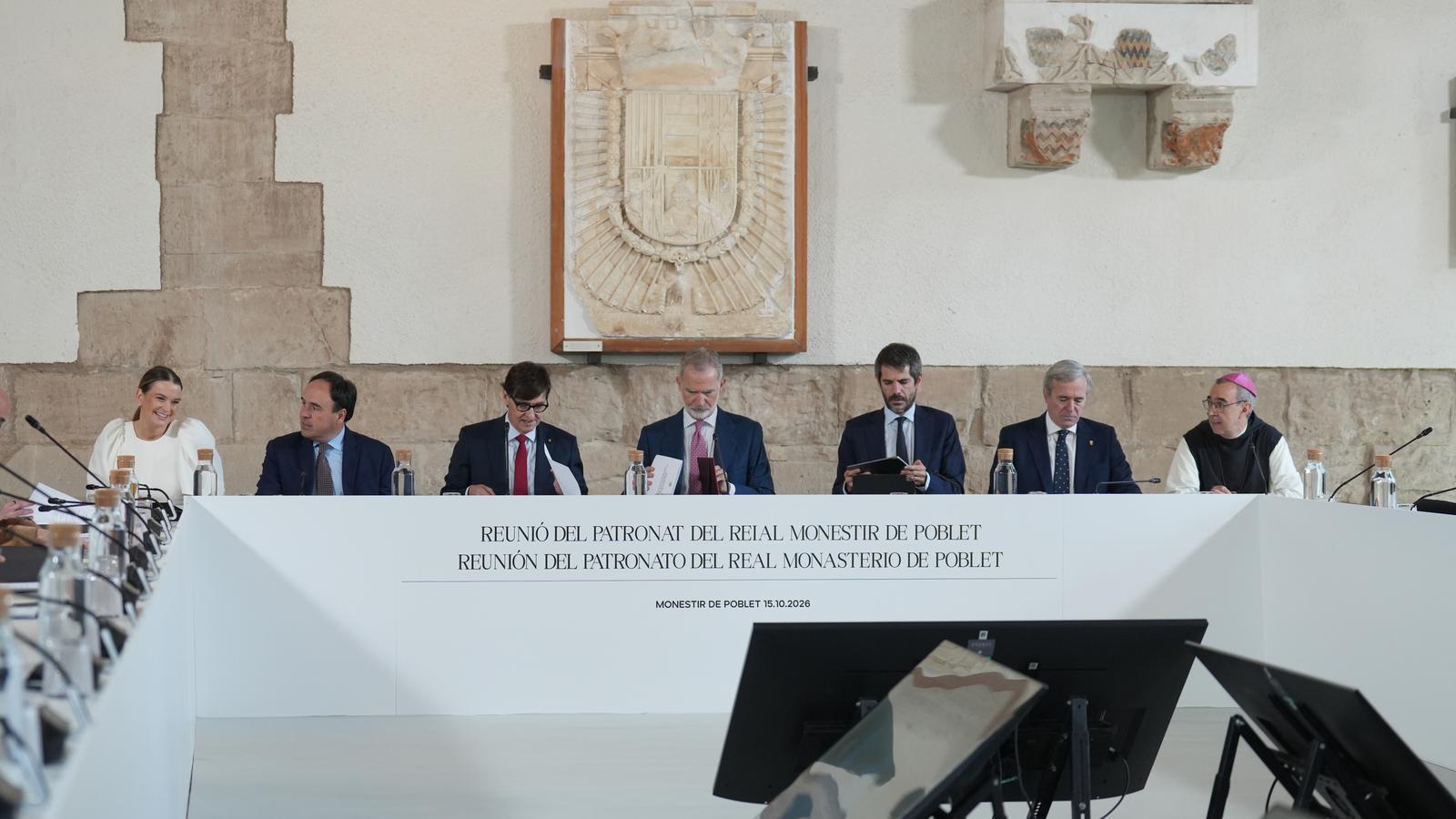
The Catalan, Valencian, Aragonese and Balearic presidents meet with the king at the monastery in the meeting of its board of trustees

-
CAT -
CAST
BarcelonaFifteen years have had to pass, with the 'Procés' in between, for the Crown of Aragon to be made visible once again: it happened at the meeting at the Royal Monastery of Santa Maria de Poblet. King Felipe VI presided this Thursday over the meeting of the Poblet Board of Trustees with the Catalan, Valencian, Balearic, and Aragonese presidents, in addition to the Minister of Culture, Ernest Urtasun. All together, beyond highlighting the shared history with the kings who are buried in the royal pantheon of this monastery founded in the 12th century, and which is reflected by the four common bars on the flags of the territories, they wanted to celebrate the common Spanish project.
Felipe VI, honorary president of the board, claimed "Aragon, Catalonia, the Valencian Community, and the Balearic Islands, gathered here and inseparable from the reality of Spain." The monarch, who expressed himself in Catalan very briefly, stressed that James I –buried in Poblet– "refers to an era when the territories of the Crown shared institutions, interests, and horizons of expansion." The monarch had a lapse when he wanted to remember him and only cited him as king of Valencia, Majorca, and Aragon, without mentioning that he was also Count of Barcelona.
For his part, President Salvador Illa, who is the effective president of the board, used Catalan for the most part in his speech and claimed Poblet as a "possible space for meeting between institutions to work together in favor of the common good." "I propose that the Poblet board meeting becomes a new Poblet forum in which our communities can debate and share projects in favor of the prosperity of Spain as a whole," said Illa, the only socialist regional president at the meeting. A proposal that those present accepted, especially the Aragonese Jorge Azcón, who suggested that the convocation be rotating and that next year it be held in his region. Illa, moreover, in his speech also returned to cite President Josep Tarradellas –who also has his archive in Poblet– and, modifying a well-known phrase of his about Catalonia, stated: "Spain is big enough for us all to fit in and too small for anyone to be left out."
"Germ of Spain"
The Valencian president, Juanfran Pérez Llorca, in his turn, has recognized the "common trajectory of the Crown of Aragon, a historical and political reality without which it is not possible to conceive the autonomous Spain of today." He highlighted "the historical continuity" of the monarchy and, in Catalan, assessed that, in the Spanish project, "the Valencian Community contributes with its own voice, with respect for its history, with pride in its autonomy, of our language and own identity."
It was the Aragonese president, Jorge Azcón, who brandished the most forceful Spanish nationalism, after highlighting the "tolerance, solidarity and understanding between the peoples of the Crown of Aragon." He even defined Poblet as the "capital of the dynastic memory of the Aragonese Royal House," although a good part of the members are from the House of Barcelona, and defined the four territories of the ancient crown as "tiles of a much broader mosaic called Spain"; "the undoubted germ of the Spanish nation."
The Balearic president, Marga Prohens, also valued "the belonging to the Crown of Aragon" and insisted on the circumstance that, "through dynastic union it gave rise to the Hispanic monarchy, antecedent of modern Spain," she said, also, in Catalan. The Minister of Culture, Ernest Urtasun, also used the language of the country, reiterating the will to "relaunch Poblet in the coming years." At the same time, the abbot of Poblet, Rafael Barrué, was the only one who expressed himself entirely in Catalan and made a plea: "We need your help."
Living history of Poblet
The Poblet board of trustees was created in 1930 under the presidency of Eduard Toda i Güell, following a process of abandonment of the monastery due to the Mendizábal confiscation. When the Principality recovered self-government, it gave rise to the current structure, in which the board is symbolically led by the king and effectively by the president of the Generalitat, and includes as members representatives from the Aragonese, Valencian, and Balearic governments, commemorating the ancient Crown of Aragon, as well as the delegate of the Spanish government in Catalonia and the archbishop of Tarragona. Poblet is state-owned, although the Generalitat maneuvered to seize its ownership in 2011.
