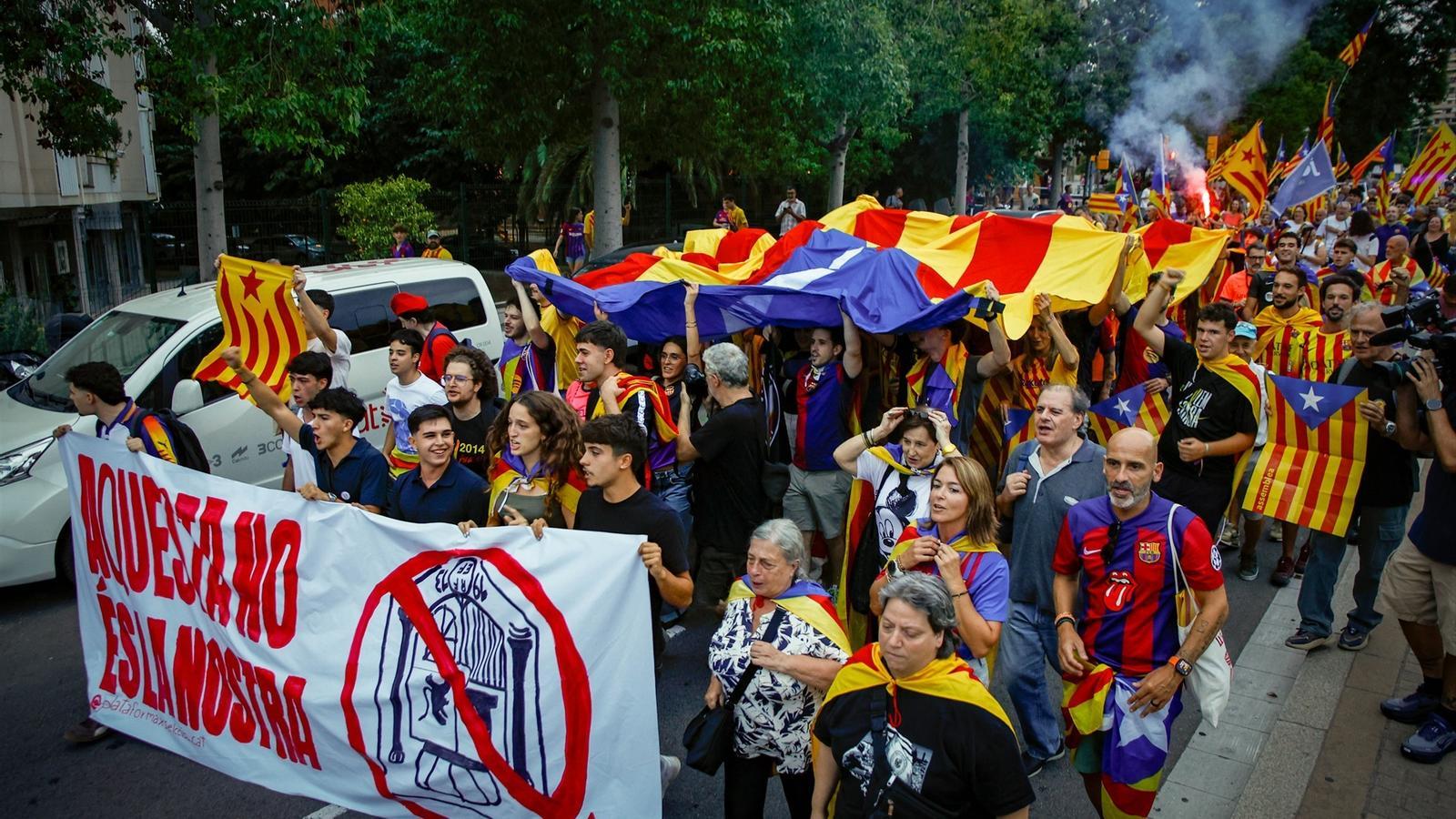
Is there anyone in Europe who demonstrates more than the Catalans?
From historical workers' movement to civic independence movement: we analyze with experts where the impulse to take to the streets comes from
-
CAT -
CAST
BarcelonaOne of the few times the city of Barcelona has come out of the mouth of a US president was in February 2003, with George W. Bush, in the midst of the Iraq War. "The security policy of the United States cannot depend on whether many or few people take to the streets of Barcelona," stated the then-former US president, in allusion to the capital of Catalonia flooded with people, peace symbols, and "No to war" signs. That image of an overflowing city that captured the attention of the entire world was not a mirage or an isolated event, but the reflection of a mobilizing DNA rooted in our home that has, in every September 11th, one of its benchmarks.
The explanation for this mobilizing inertia must be sought in the same history and social structure. Salvador Martí, professor of political science at Pompeu Fabra University, points out that there is a "quite important relationship between what we could call social capital, that is, interpersonal networks and associative density, and mobilization." In this sense, Catalonia has historically been a territory with "a notable associative density, through many movements, from the parochial sphere, the traditionally anarchist, the libertarian, and also, subsequently, the workerist," affirms Martí.
This industrial base was totally decisive. According to Jordi Mir, a professor at the Autonomous University of Barcelona (UAB), "places that tend to have an industrial base or industrialization also usually have significant mobilization that has to do with working and living conditions". Activism, in fact, feeds itself: "The culture of mobilization generates mobilizations", states Mir, who highlights that the fact of having a powerful labor and national movement favors by inertia the emergence of new struggles in the future.
The path towards pacifism and the middle classes
After the Transition, the energy of the Catalan streets was channeled towards new horizons. Martí highlights that in the eighties, fundamental movements emerged such as the pacifist, the anti-NATO, the environmentalist, the feminist, and the gay liberation movements. However, the purely civic and peaceful image of today's demonstrations has not always been this way. Mir recalls that "pacifism has not been a cause throughout history that has had the capacity to mobilize." Historically, from libertarian traditions, it was even thought that "in certain scenarios, armed violence can have a function in transforming society," the expert states, especially when citizens did not have guaranteed political rights. It is not until the marches against the Iraq War in 2003 that anti-militarism becomes a truly hegemonic phenomenon.
This civic nature distances us enormously from the European context, especially from the neighboring country. Martí underlines that "France has a very robust and, above all, very confrontational political culture of protest." The expert ensures that "things that happen in France would be unthinkable to happen in the Spanish state," since there, mobilization days can end "with 50 burned cars" and with much harsher levels of violence against street furniture.
All this social density culminated, during the last decade, in the independence process, in which the mobilization "has been very robust, very high, and for a period with great capacity and a lot of muscle." For Martí, the differential factor of this movement with respect to previous worker waves is that "possibly another sector that historically did not mobilize as much, which was the middle classes, entered it."
But how is this appeal to citizens unaccustomed to street protest explained? Mir points to the power of socialization: "Political ideas also become fashionable." According to the UAB professor, "at a certain moment what was seen in one way comes to be seen in another," facilitating that large masses of the population modify their perception, find new arguments, and join a mobilizing current fully.
The submerged whale
The current stage, in which the sovereignty cycle is experiencing a marked ebb, does not equate to the end of activism. Mir illustrates this with an image: "Mobilizations are like a whale. There are moments when the whale emerges and they are very spectacular. And then it disappears and it is as if the whale submerged." The people are still there, but the energy is moving towards other urgencies, such as the Platform for People Affected by Mortgages (PAH), the Tenants' Union, or the recent educational mobilizations.
Finally, the exceptionality of Catalonia today must be nuanced. As Martí warns, "today Catalonia, in terms of mobilization, is not so different from other places in the State." Phenomena such as the 15-M outburst or the defense of education have shown that "the Madrilenian mobilizes from time to time, especially regarding public policy issues." Be that as it may, this Friday's Diada shows us that protest is our oldest heartbeat. The street continues to be that great whale that never stops swimming from the depths.
