Ceuta: colony or Spanish territory?
Neither international law nor the population of Ceuta and Melilla support the Moroccan claim, but migration has become the bargaining chip of a conflict that goes back centuries
16/08/2026 - 14:03 h
-
CAT -
CAST
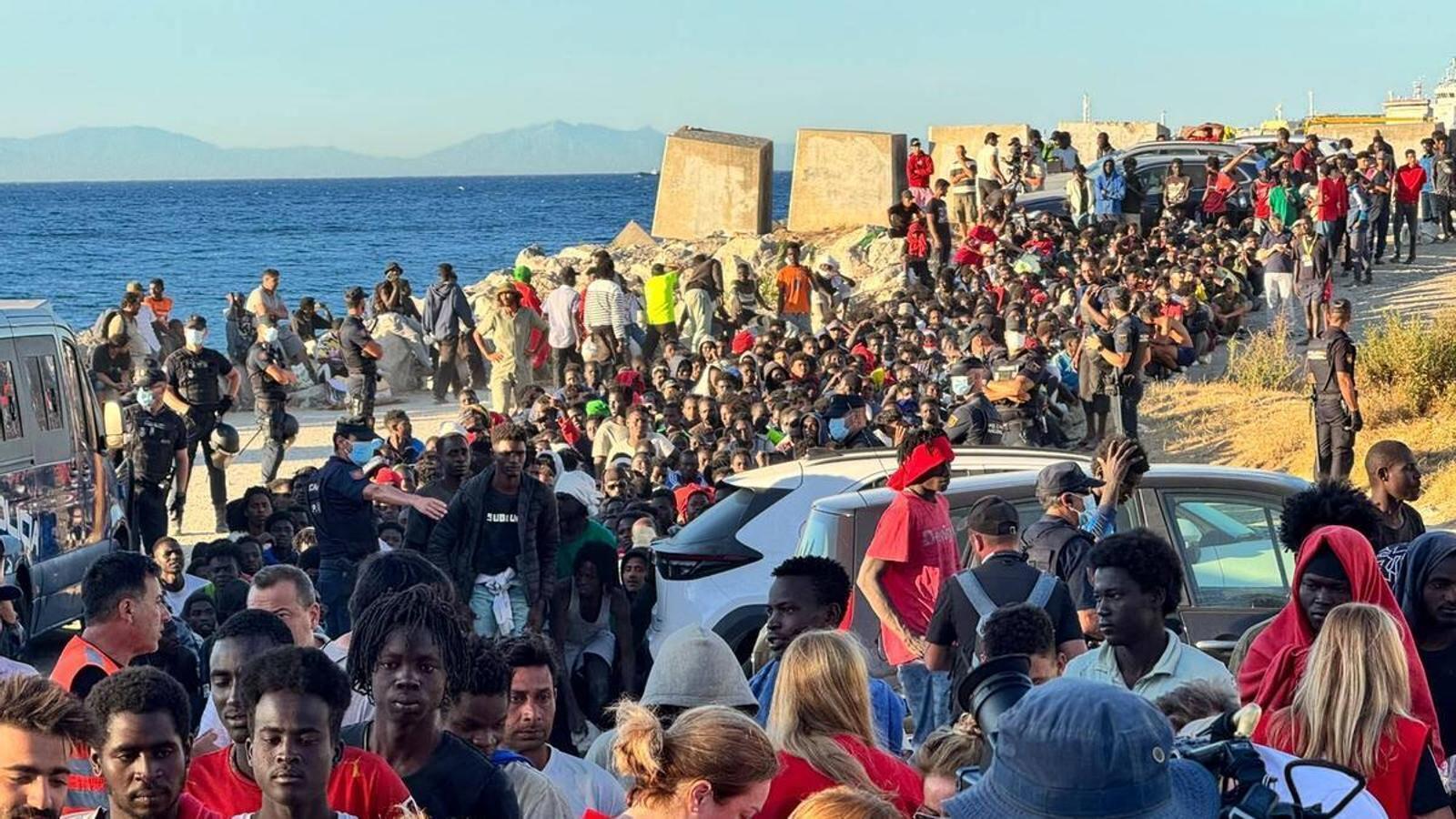
BarcelonaThis summer's migration crisis has once again placed Ceuta and Melilla at the center of the political debate between Spain and Morocco. In an interview with the Arab television channel Asharq News, the Moroccan Minister of Justice, Abdellatif Ouahbi, acknowledged on Wednesday that the claim of sovereignty over both cities "remains on the table," although he called for "calm" and a long-term solution through dialogue. "Inside Ceuta there are Moroccans and there are Spaniards, and we continue to hold onto our territories," Ouahbi stated.
The Spanish government's response was not long in coming. During a visit to Ceuta the same day, the Minister of Defense, Margarita Robles, stated: "Ceuta and Melilla are not Spanish, they are extremely Spanish. Therefore, neither Ceuta nor Melilla are to be touched." Thus, her words reopen a question that is rarely explained calmly: what really are Ceuta and Melilla and why do they continue to be, almost four centuries later, the most sensitive points in the relationship between the two countries.
Ceuta and Melilla: are they colonies?
Melilla has been under the sovereignty of the Crown of Castile since its conquest in 1497. Ceuta has been since the Treaty of Lisbon of 1668, when Portugal became independent from Spain and the city – which had already been under Portuguese rule for two and a half centuries – passed into Spanish hands. Both integrations are, therefore, much earlier than the existence of Morocco as a modern unified state, which did not take the form we know today until 1956. This chronological order is the core of the Spanish argument: one cannot speak of colonization of a territory over a political entity that did not yet exist.
Chronology
This argument, however, only explains the origin of sovereignty, not the extent that both cities have today. Moroccan journalist and historian Ali Lmrabet adds a relevant nuance: the original presidios of the 15th and 16th centuries were only small forts where prisoners were sent, and the current area of Ceuta and Melilla is the result of the African War of 1859-1860 and, in the case of Melilla, also of the Margallo war of 1893, when Spain imposed by treaty a much larger territorial cession. Josep Pich Mitjana, professor at Pompeu Fabra University, summarizes it with a rather graphic image: "The new territory was demarcated by firing a cannon and marking the new border where the ball fell".
Lmrabet adds that the same argument "should also apply to the Chafarinas Islands, Perejil Island, Vélez de la Gomera rock, and Alhucemas rock occupied by Spain in similar circumstances and which Morocco, on the other hand, never claims". In fact, the dispute over Perejil Island is not merely theoretical: in 2002, a group of Moroccan gendarmes occupied this islet – Spanish since 1668 – and caused one of the worst diplomatic crises between both countries. The Popular Party government of José María Aznar recovered it with a military operation six days later, with mediation from the United States.
International law, in any case, remains outside this nuance. The UN decolonization committee maintains a list of seventeen non-self-governing territories pending decolonization – Western Sahara and Gibraltar are included – but Ceuta and Melilla have never been included. Morocco has formally claimed it on several occasions since its independence in 1956, presenting the two cities as "colonial enclaves", just as it claimed and obtained the retrocession (return) of Ifni in 1969 – a territory that until then belonged to Spain–. But the petition for the two autonomous cities has never prospered: the UN does not consider that there is a pending decolonization process because the basic requirement – a colonized people with its own identity subjugated by an external power – does not apply as it does to other African territories invaded during the colonial partition of the 20th century.
This lack of international recognition is also reflected within Ceutan society itself. No political party with representation – neither the formations close to the Muslim population of Ceuta, mostly Arabic-speaking, nor those of the Rif and Amazigh population of Melilla – supports the thesis of Moroccan annexation today. This is highlighted by Mohamed Mustafa, a deputy in the Assembly of Ceuta and a political scientist: "In the city of Ceuta, the claims [of Moroccan sovereignty] have no standing whatsoever, they are neither in civil society nor in political entities".
This sentiment was evident last week, during Robles' visit to Ceuta. A resident stopped her in tears, asking her "not to abandon" the city after saying that they were "more Spanish than anywhere else." This is a relevant fact: the debate over whether Ceuta and Melilla "should be" Moroccan is intensely discussed in Rabat and, consequently, in Madrid, but it practically does not exist as a real political position among its inhabitants, regardless of their religion or origin, who do have a real fear of being left alone and integrated into Morocco.
Ceuta is only fourteen kilometers from the Peninsula, precisely at the Strait of Gibraltar, one of the busiest maritime passages in the world: whoever controls its shore actually controls the access between the Atlantic and the Mediterranean. Furthermore, they are the only territories of the European Union on the African continent, which makes them a point of permanent friction in migratory policy and a key – and sensitive – piece in the Madrid-Rabat relationship. From the Spanish perspective, Pich Mitjana leaves no room for doubt: "Economically it is a disaster, nothing is gained from it. But geopolitically, Ceuta is very important; Melilla is debatable." Ceuta, he says, "is to Spain the equivalent of what Gibraltar is to the United Kingdom, the other gateway to the strait".
Lmrabet disagrees from the Moroccan perspective. In his opinion, control of this strait is not as essential as it once was. He justifies this with the construction of the large port of Tangier, near Ceuta, which, he says, "has absorbed the commercial traffic that used to pass through there." Consequently, "today Ceuta and Melilla no longer represent real economic weight for Morocco." His claim, he concludes, is "above all historical, not practical, an argument of territorial continuity and a grievance from the 19th-century War of Africa, rather than a current strategic calculation".
Morocco's "super weapon"
Despite skepticism about its economic or commercial value, there is an area where, according to experts, Ceuta and Melilla do function today as a key strategic piece for Morocco: migration. Do they really act as a migratory "containment dike" for Spain and the EU? Political scientist Mohamed Mustafa answers without mincing words: in his opinion, the Spanish government's state policy towards Morocco has been "practically indistinguishable" regardless of the party in power. It has been based, Mustafa maintains, on "externalizing the border and turning Morocco into the southern control that contains the flows before they reach European soil." In the same vein, the Moroccan Minister of Justice remarked that Morocco "wants to collaborate with the EU," but that they cannot be "the guardians of the Europeans": "We want to cooperate with them, but we don't want to work for them," he stated.
Journalist Ali Lmrabet and professor Josep Pich agree, each from their side of the strait, on an even more direct interpretation. "Obviously, this is a weapon. It's a superweapon that Morocco has, which is immigration," assures Lmrabet, adding that the longer the current situation lasts, "the more it interests" the regime of Mohamed VI: "Morocco knows that Spain will not hand over Ceuta, nor Melilla, nor a rock. For him, the longer the situation lasts, the better: he can pressure and get what interests him."
However, Pich finds a precedent that helps to interpret this summer's episode: he compares it to the Green March that Morocco organized in 1975 in Western Sahara, when it took advantage of the weakness of a Spain in full transition. "What Morocco is replicating is what they did with the Sahara," he maintains, and recalls that Pedro Sánchez's government "abandoned the Sahrawis" and that, since then, "every time Morocco wants to pressure Spain, it resorts to a massive influx of people towards Ceuta and Melilla."
This modus operandi has already borne fruit before: following the 2021 migratory crisis, triggered by Spain's reception of the Polisario Front leader, Brahim Ghali, Pedro Sánchez's government ended up supporting the Moroccan plan on Western Sahara in 2022, which did not include the self-determination referendum, and broke the historical Spanish position on the conflict as part of a bilateral agreement with the Moroccan commitment to "control" irregular immigration. The Moroccan government, however, flatly denies this. The Minister of Justice, Abdellatif Ouahbi, assured on Wednesday that they have "never" used migrants as a bargaining chip. However, the facts call this into question.
