"I am an independentist, but I go with 'the red'"
The sociological concept of "banal nationalism" explains how football acts as a reminder of a state identity
-
CAT -
CAST
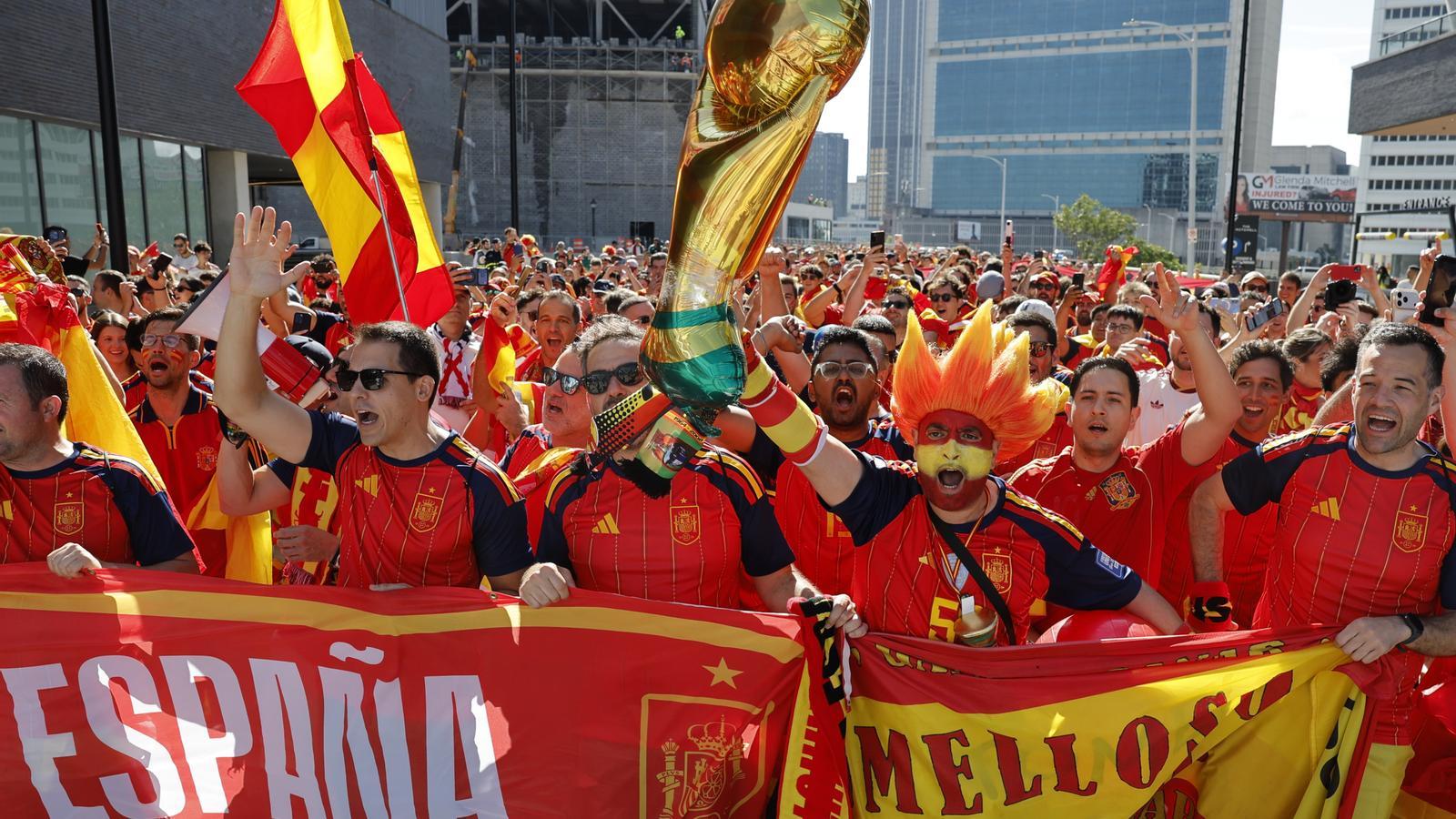
Barcelona"I am an independentist, but when Spain plays I want them to win for the Barça players and for Catalans". This phrase often echoes on our terraces from friends, acquaintances, or even some political party members. There are also those who say: "I don't feel Spanish, but I like their football". This Sunday, in the Spain - Saudi Arabia match on the second day of the World Cup, many Catalans will once again experience this apparent contradiction: separating their disaffection towards the State from the euphoria for the goals of Luis de la Fuente's team. The ball seems to have the ability to blur strongly defined ideological lines in ninety minutes.
But, what national implications does cheering for the Spanish team really have? Academia has long been studying this crossroads under the umbrella of "banal nationalism", a concept coined by social psychologist Michael Billig in 1997. The main idea of this concept is to describe an "invisible and semi-unconscious form" of identification with the nation, present especially in those countries or regions where theoretically it is no longer necessary to wave flags or proclaim national status because it has already been successfully assumed. According to Ferran Archilés, a historian at the University of Valencia, the profound success of this mechanism is that it "naturalizes the nation", that is, it makes citizens feel it is completely natural to be part of that country without the need for great stridency or permanent demands.
However, the popular excuse of "I don't feel Spanish, but I support the Roja" presents certain fundamental nuances for specialists. Alejandro Quiroga, director of the master's degree in nationalism studies at the Complutense University of Madrid, points out that these "feelings of national identification are prior" to passionate adherence to the football team. That is to say, if one is moved to the core by Spain's victories, it is likely that a latent identity already exists in the background, and the mass sporting event simply comes into play and acts as a "reminder" of this belonging. Along the same lines, Archilés adds that cheering for the national team solely because you like the football spectacle or because of ties with the players from your local club "is not banal nationalism because you are not identifying yourself with the Spanish nation, which is what the team promotes." This identity mechanism genuinely acts only when the person connects with it unreflectively or without having previously thought about whether to "feel like a nationalist or a Spanish nationalist".
Football and the status quo'
The great triumph of these tournaments lies in the ability to cloak themselves in supposed political neutrality. Many followers cling to the idea that football is a simple sport alien to politics, a belief that Quiroga considers "completely false." The expert emphatically states that "by defending a national football team, one is at least defending the statu quo", which inevitably implies weaving a clear "emotional bond with that nation." The historian from Madrid summarizes this by unmasking the true intention of those who ask to separate sport from the State: "Anyone who tells you that you shouldn't mix football with politics is clearly telling you that you should defend the establishment," thereby preventing any impulse for change.
In the propagation of this identity, experts say that the role of the media is key in shoring up indelible "mental frameworks." During the television broadcast of the match against Saudi Arabia, the continuous use of language through expressions like "We played well" will act as a boundary between a "we and an they," constantly reminding us – and imperceptibly – to which community we belong. It is a type of everyday nationalism that "is so present that you no longer see it." After all, in the Spanish state "the power of football and the national team is extraordinary, and so is the capacity to disseminate a national imaginary," states Archilés. The euphoria of the terraces, therefore, always goes far beyond what the ball does: it transforms a subtle assumed identity into an authentic "hot nationalism." A top-corner goal before we even start.
