The world and the earth, fire and fury

-
CAT -
CAST
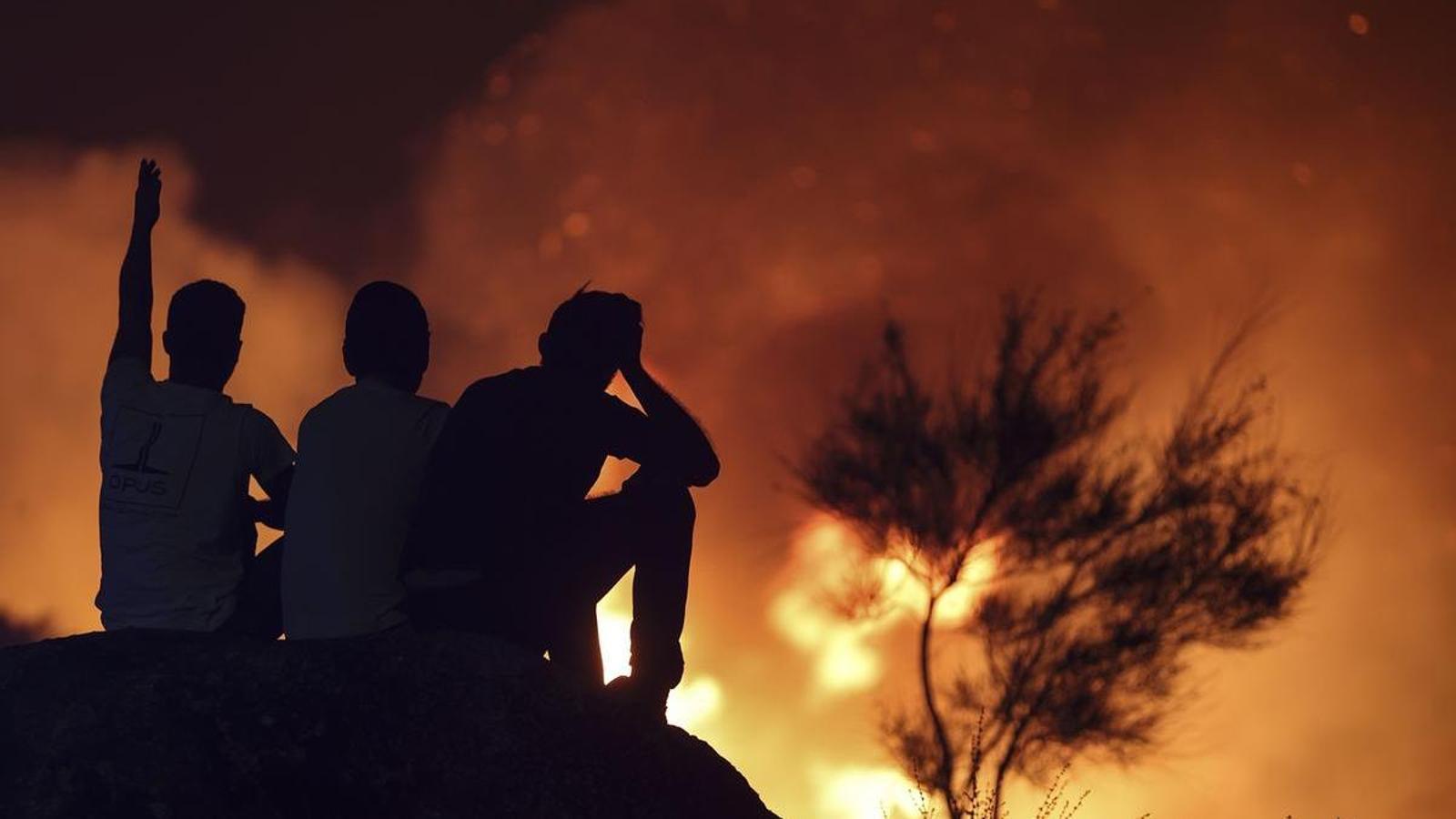
This summer has already left a series of human tragedies and on the landscape that invite us to think about the material conditions of our time. Thermodynamic and geological phenomena – such as high temperatures that force us to re-adapt to the environment, or the spiral of fires across the sub-European territory – and social dramas such as the massive flows of migrants arriving from Africa – and xenophobic reactions, this summer in Ceuta, last summer in Torre Pacheco – overlap in space and time. It is the time of heat and scarcity of the Earth.
I write it in capital letters – Earth – to name what we have always called World. In a chapter of the book Where am I? A Guide to Inhabiting the Planet, "The world and the earth", the French philosopher Bruno Latour subtly points out that perhaps it is not a coincidence that earth is a feminine noun and that universe (or world) is a masculine noun. Through the sinuosity of metaphor, for Latour the universe is the result caused by humans on what was once Earth. And when Latour speaks of the result of human actions, he refers to a history of civilizations in which 99% of the protagonists were men.
The Earth is an uncontrollable reality: it groups together the soil, the sea, and living beings, all of them actors in motion. In relation to it and its current state – at its limit –, we need a less extractivist and more humble bond, less frivolous and more careful. We do not speak from abstraction, but by listening to the lessons of both the infernal temperatures that end in devastating fires and the reasons – not only geopolitical – for the massive arrivals from south to north of migrating people. We may think that these phenomena have nothing to do with each other, but they are different expressions of the circumstance that determines our world: the condition of limit.
The ultimate problem of our civilization is to accept the conditions of the territory, the limits of natural resources, the material reality of the Earth. The consequences – irreparable if there is no change of modus operandi– lead to the destruction of our landscape and, ultimately, of our way of life.
From rural areas, we cannot deny what we do not see from the unstoppable rhythm of life in cities and from the blindness of virtual work. The territory and the landscape show us that our problem is not so much sustainability as balance. Sustainability leads us to think about the world's resources in an individual way: eating in a way that is more respectful of animal life and proximity, using renewable energies, not polluting. From the ethics of the self. Balance, on the other hand, requires common elements, relationships, and consensus. Balance is, for example, that way of life between village and city from which family memory – of two, three, or four generations back – allows us to learn.
More lessons from nature. The fires that in recent weeks have burned Catalonia, part of Castile, the Valencian Country, and France – as in the past they affected Greece, Portugal, and Galicia – speak to us of an unresolved relationship between nature and property. We throw our hands up in the air when we see our forests burning, but we do not face our share of responsibility in the fact that more than 75% of the forest area in Catalonia belongs to private owners and not to public administration.
Who takes care of nature, then? When some of us moved away, in the past, from our origins for work or educational reasons, we were not aware that, in some way, we were collaborating in abandoning the territory. The truth is that the urbanized society of our time is incapable of sustaining the conditions of balance that nature and the territory demand. It is not just about preventive management.
The scorching temperatures and the migratory flows we have seen through Ceuta also remind us of the Earth's material limitations. The square kilometers of land compared to the sea are increasingly smaller and manual labor is increasingly less necessary, while the world's population, especially that of the Global South, continues to grow – unlike the European first world, which continues to decline. Violence and desperation appear when the imbalance between an undignified life and hope is unbearable: no geographical contiguity relationship is as economically unequal as the one that unites Morocco and Spain, with 10 to 15 times less income per person in the African country.
The opposite is true for temperature. Europe continues to be the region in the world where the temperature is rising most sharply – twice as much as in the rest of the world – in recent decades. The concentration of population and economic-industrial activity in a region of very small dimensions in relation to the whole world is the cause.
Europe is currently the main victim of its own climate crisis. Creator of the most praiseworthy – and at the same time most detestable – imaginaries about the human condition, Europe is materially a small enclave on the verge of social and material implosion. The citizens of this first world need a new humility in two directions: more empathetic with our own land and more open to the rest of the world. The ghetto is not the solution, because mobility dynamics are unstoppable. If we want to guarantee quality in our lives, we will have to understand that the Earth is much larger than our land. And to inhabit it again.
