Orbital line: what model of country do we want?

-
CAT -
CAST
"Since they improved the [Rodalies] service, it takes 20 minutes less, and without having to go through Barcelona". This is one of the phrases heard in the presentation video of the Metropolitan Commitment 2030, the strategic plan for the metropolitan region of Barcelona approved three years ago, explaining what the metropolis should be like at the turn of the decade. A phrase that condenses a dream for many people: to be able to move between the main cities of the so-called metropolitan arc without Barcelona being mandatory on any journey.
Whoever lives in Terrassa and works in Granollers, whoever studies in Sabadell and goes to Mataró for sports, or whoever leaves Vilafranca and has to reach Martorell to visit a relative knows perfectly well what I'm talking about. The radial model is, today, the burdensome daily reality for tens of thousands of people.
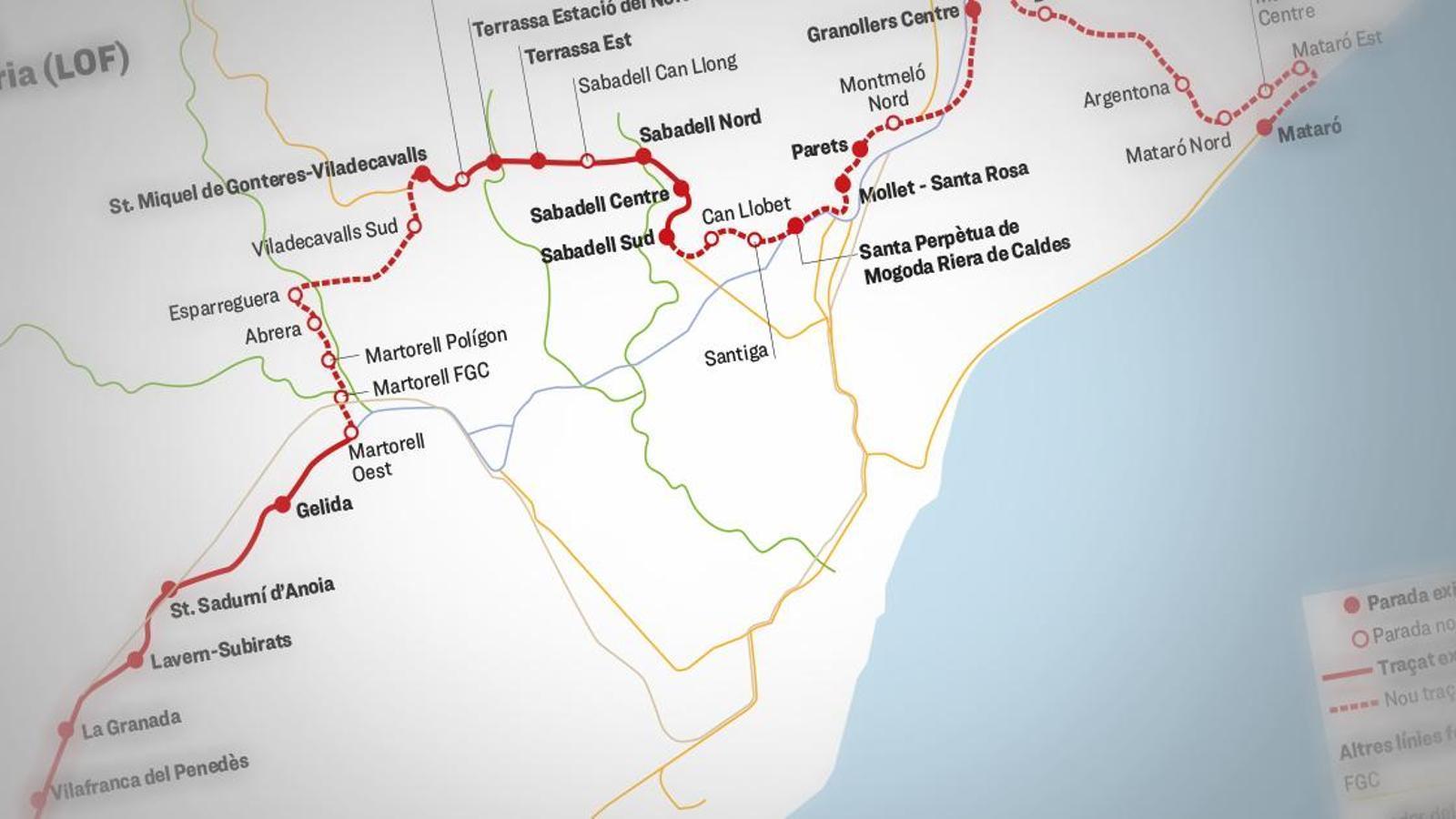
This week, the desire has begun to take political shape. President Salvador Illa and the leader of ERC, Oriol Junqueras, have formalized the agreement to promote the orbital railway line, which should connect Vilanova i la Geltrú with Mataró passing through Vilafranca del Penedès, Martorell, Terrassa, Sabadell, and Granollers. The project, which has more than two decades of studies, plans, and official documents that have never translated into works, has re-emerged as the key piece of a political negotiation to achieve the approval of the much-desired Generalitat budgets.
The opportunity is evident: for the first time in many years, the orbital line has a clear political commitment and a timetable, albeit uncertain, on the table. The project foresees 120 kilometers of tracks, 68 of new construction, with a completion horizon around 2040 and a total investment of 5.2 billion euros. "It is a central and decisive commitment for the whole country. More than a train line, it is the will to change the country's model," said Junqueras. I completely agree with this assessment.
However, what seems to be still unclear is what kind of country model we are heading towards, pending an essential review of the General Territorial Plan of Catalonia that has just begun and whose duration is unknown. Because it is not enough to connect these cities and wait for "things to happen." It must be clearly decided whether we are opting for a country model that strengthens its urban network of intermediate cities as a backbone or if we simply want to contribute to decongesting Barcelona and its immediate surroundings, as the adjective orbital itself suggests. If it is the former, much more investment will be needed, both in economic activity and services, to achieve it.
For years, and setting aside high-speed rail, in terms of rail transport, which is fundamental for this territorial structuring and the generation of new centralities, all the plans and investments on the table are aimed at urgent care. The 8,037 million committed in the update of the Rodalies Plan until 2030 are destined to renew obsolete tracks, catenaries and electrical systems to put an end to continuous breakdowns. That is, to fix what we already have. In this context, making the orbital train a future bet while the existing lines continue to fail every day (more than 8,500 incidents in the first nine months of 2024, 31 daily) does not necessarily have to be contradictory, but it does require a great effort of accountability on the improvements being achieved that allows us to believe in future bets.
One way would be to advance alternatives, even if temporary, that work in the short and medium term. Such as strengthening the R8 Rodalies line, considered the seed of the orbital, which already runs transversally through Martorell, the UAB campus, Mollet and Granollers. Improving its frequency, reliability and interchanges, as territorial entities have been demanding for a long time, would cost a fraction of the orbital and would provide a real transversal service well before 2040. The second, less glamorous, but which has proven highly effective in other areas, is the express interurban bus on reserved lanes, such as a high-frequency service taking advantage of the B-30/AP-7 axis. Or simply increasing the frequency of buses that connect at least the comarca capitals of this arc.
However, I insist, mobility solutions aside, the comprehensive vision of the territory in a longer horizon, possibly by 2050, is essential to understand who and for what these connections should serve. Therefore, this infrastructure, like any other of similar dimensions, cannot be explained by itself without helping to explain a certain model of country. Because the objective of not passing through Barcelona is useless if the connected cities do not offer affordable housing, jobs, quality services and, ultimately, opportunities for progress.
