The Pope, God's architect and the sky of Barcelona
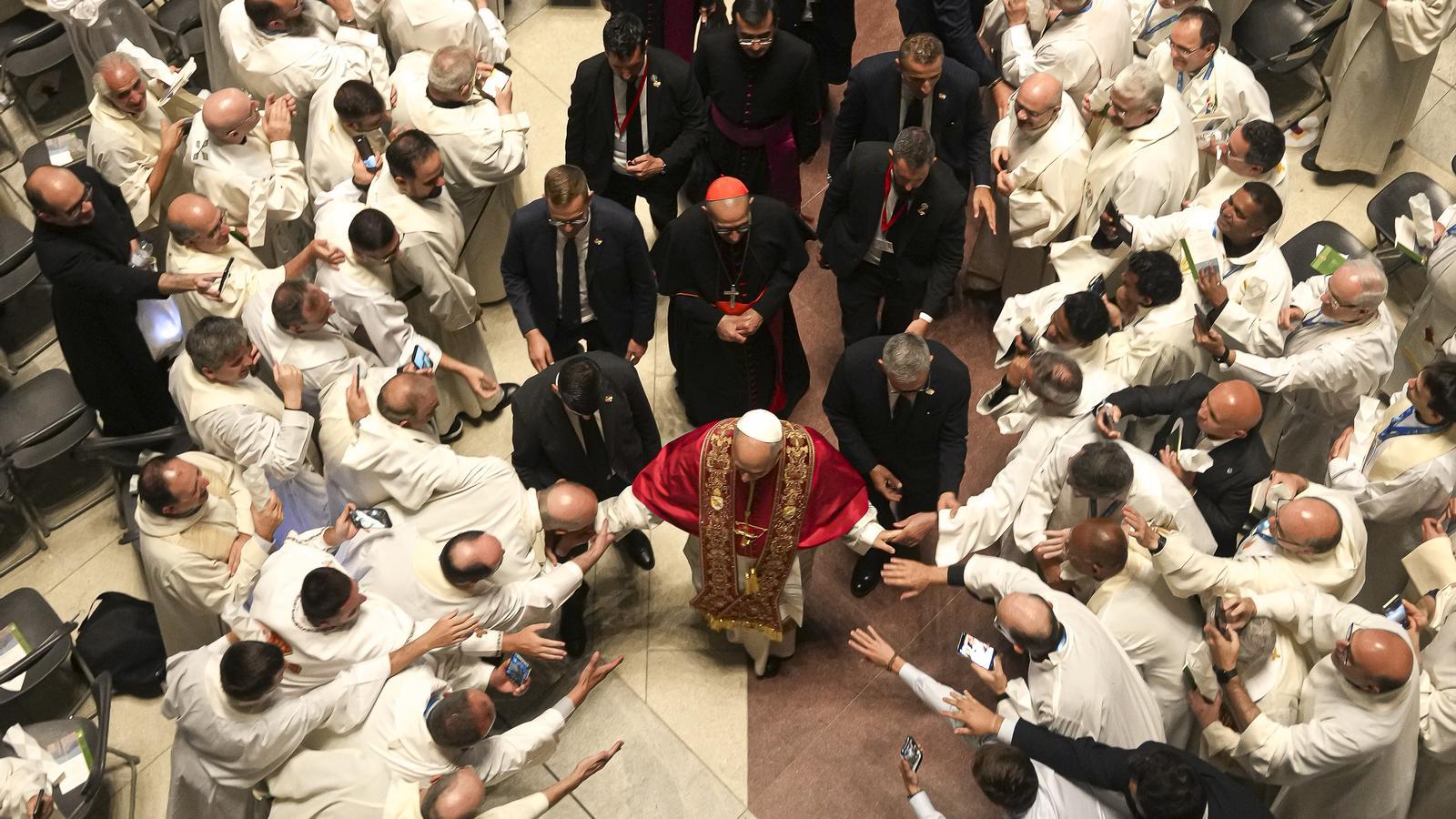
BarcelonaIt cannot be said of Antoni Gaudí that he would have imagined in his dreams that, a century after his death, the Pope would come expressly from Rome to bless the tallest tower of the Sagrada Família. Because if Gaudí had one thing, it was that he dreamed big. Very big, the biggest, what they told him seemed impossible, to be exact. As in the first reading, Gaudí saw "a new heaven and a new earth." Today there is no temple in the contemporary world that can be compared to the Sagrada Família. And for this reason, today, at the foot of his tomb, all the authorities have gathered, the Catalan, the Spanish, and the Roman ones, led by the Holy Father who kneels there and lights a lamp. It has been a hundred years since he was buried under the title of the architect of God.
Upstairs, a mixture of mitres, priests with albs and stoles, parish parishioners, civil and military society, and everyone who paints or pays for something in this country awaits impatiently; everyone playing like at a end-of-year festival, while the spidercam flies over the nave from top to bottom, ready to transmit the best plays, hoping that Barcelona will once again become the city of wonders.
The singers filling the choirs, the trumpets heard in Westminster, the magnitude of the basilica, the angelic voice of the choirboy from Montserrat, the “I believe in one God”, the Our Father or the Virolai which shine solemnly and firmly in the voice of the thousands of faithful who sing them with all their might, all this raises the bar again for the eternal examination that Barcelona is undergoing and which is measured by the demand when the expectations are at a urbi et orbi level. Now yes, we are in a historic moment, spectacular, grandiose, because as the Pope will say in Catalan in his sermon, the Sagrada Família "is an eloquent catechesis made of stones, colors, and light".
Meanwhile, what must Pedro Sánchez be thinking, who this morning was sparring with Feijóo in Congress and is now sitting calmly in the front row with his wife, both dressed in dark, not far from the King and Queen of Spain, in the presbytery? Neither the Holy Father can disarm him with political language, Catalan, Spanish, and universal.
With the controlled exception of the evening at the Montjuïc Stadium, Pope Leo XIV's visit to Catalonia has been more religious and less crowded than his visit to Madrid, but the staging and liturgy, as well as the "made in Barcelona" designs, have lent the events a very Catalan elegance and restraint, almost forgotten after the clamor of so many political battles and the blows of the Procés. The wound is not closed and the Pope has not referred to it at any time. Robert Prevost has acknowledged Catalonia and its language, but has raised his gaze and looked elsewhere when he could have provided context. The Pope's words are written between Rome and Madrid, under the watchful eye of the ecclesiastical governors of the province.
The moment arrives for the blessing of the Sagrada Familia tower, the television highlight and the reason for the papal visit, which after the linguistic controversy over the program initially in Spanish has acquired the status of the final scene of the season's last episode. The flame of the lamp that Leo XIV left a couple of hours ago on Antoni Gaudí's tomb trembles ("Antonio", in the Spanish version of the booklet we attendees received). How is it possible that no one corrects such a big mistake as the basilica itself? Or why has someone in charge believed they have the right to disrespect the memory of God's architect? Especially when an American pope, a perfect Spanish speaker, refers to Gaudí by his first name.
The blessing was bilingual. The pressures of Catalan Christians had their effect. Was it necessary to alarm and disturb the conscience of so many people when it is already 2026? But the great winners of the papal visit are the children of the Escolania de Montserrat, their voices, and the lights of the small lanterns suspending time before the Nativity facade. And Antoni Gaudí, who today has seen his dream shine, just as if they were a new heaven and a new earth. A deafening applause erupted in the basilica, with lights, drones, and fireworks. Vibrations of 1992. What are they waiting for to beatify him?
