Second night of violence in Belfast as victim's family condemns attacks on immigrants
Minority communities have alerted the police to the existence of a blacklist with addresses of their homes, susceptible to being targets of attacks
-
CAT -
CAST
LondonViolence has shaken Belfast for the second consecutive night despite the victim's family's plea for The clashes have concentrated at the Sandyknowes roundabout, a predominantly unionist and Protestant area located about 13 kilometers northwest of the center of Belfast, near the M2 motorway and the Chimney Corner hotel, where, according to various local groups, asylum seekers are being housed. The Police Service of Northern Ireland (PSNI) has established a large deployment with armored vans, riot squads, and water cannons to prevent protesters from reaching the establishment.
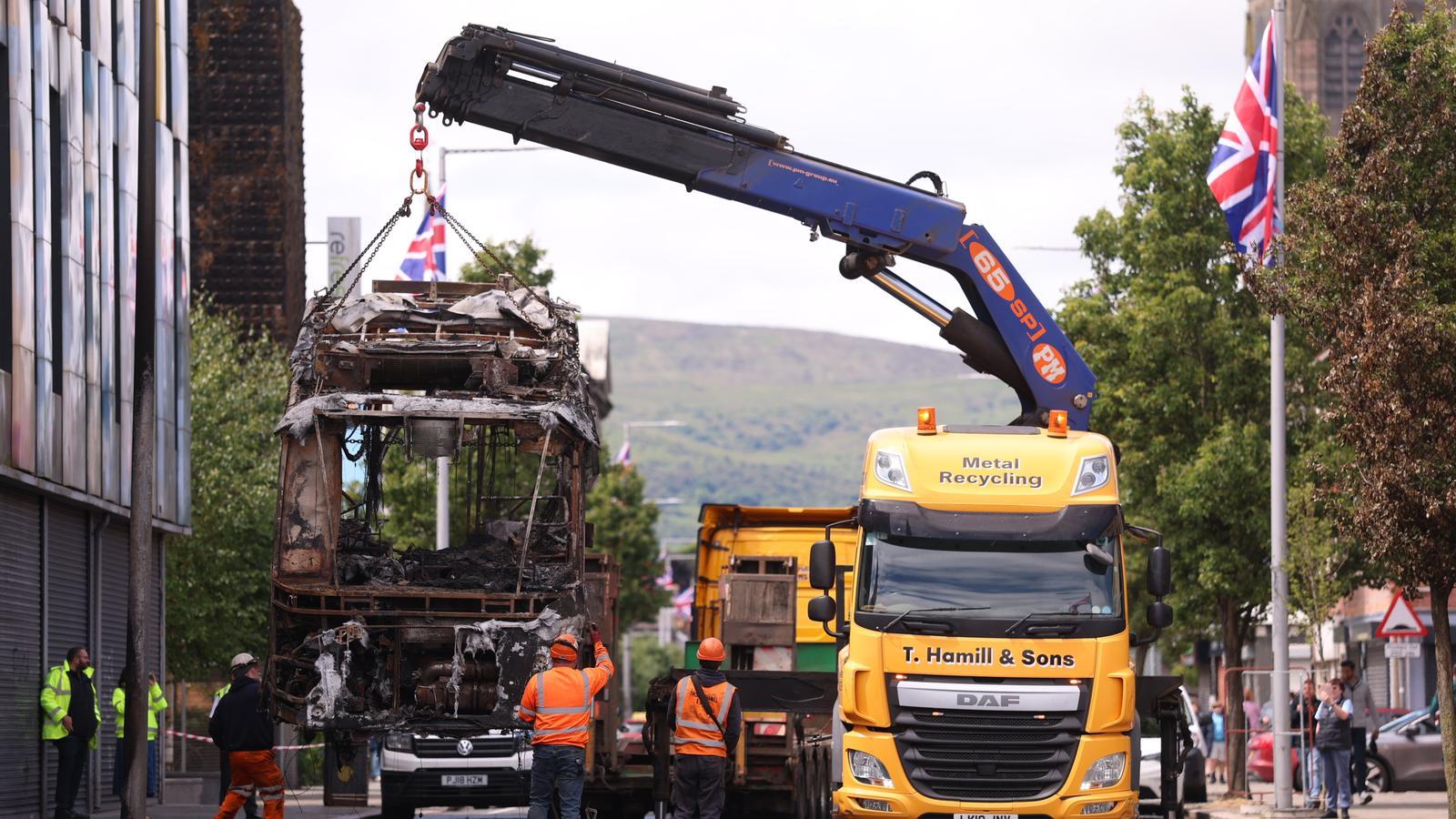
During the riots, protesters set fire to a truck from the Department of Infrastructure – a sewer cleaning vehicle – and piled up bricks to throw at security forces. Aerial images provided by British television channels showed officers repelling attacks while the demonstrators retreated under the pressure of water cannons.
The new episodes of violence have occurred after a first night of xenophobic riots that left homes, businesses, and vehicles burned in Belfast after a Sudanese refugee, Hadi Alodid, was accused of the attempted murder of Stephen Ogilvie, 44. The man remains hospitalized in critical condition and in a coma, and lost his left eye in Monday's attack.
Given the risk of further incidents, the PSNI had mobilized about 200 additional officers and had warned about the circulation on social media of an alleged "black list" with addresses of homes occupied by immigrants. According to the police, several families have contacted the authorities in a state of great anguish after seeing their homes included in this document.
Meanwhile, protests have also been called in other towns in the province. In Coleraine, to the north, more than a hundred people gathered outside multi-occupancy dwellings near the university campus, while some participants demanded the expulsion of immigrants. Despite the hostile atmosphere, the gathering proceeded peacefully under police surveillance.
In Stormont, seat of the Northern Irish autonomous government, another protest brought together about 140 people. Some participants criticized the violence of the previous night and stated that the riots had diverted attention from the immigration debate.
At midday this Wednesday, the victim's family had condemned the attacks against members of immigrant minorities. In their statement, they explicitly praised the contribution of these to Northern Irish society, stating: "The riots are not welcome. Peaceful protests are the only way forward. We have many migrants who make a very valuable contribution to our country. We do not want this terrible tragedy to be used to divide people or fuel hostility." The migrant minority population in Northern Ireland accounts for only 3.5% of the population; in England, it reaches 18%.
The fires and assaults on private homes, and the burning of vehicles and containers have transported the streets of the Northern Irish capital to a time tunnel, evoking the harshest years of the Troubles, the sectarian violence between members of the Protestant and Catholic communities.
Pending the balance that can be given on Thursday morning, so far up to eight families and twenty-seven people have lost their homes due to the first night of violence.
Northern Ireland's police have arrested and charged two people with involvement in riots and criminal damage for Tuesday's incidents. In Glasgow, where there were also incidents, although not as serious, three protesters have also been charged with participating in riots that social media continually fuels.
that was falsely linked to radical IslamismAs has been said, the accused of the attempted murder is Hadi Alodid, a thirty-year-old Sudanese refugee, legally established in the province since 2023. He appeared this Wednesday before the Laganside Magistrates' Court in Belfast. He faces charges of attempted murder, possession of a bladed weapon, and death threats against a radiographer from the British public health system (NHS), an episode that took place on the same day as the attack on Ogilvie. The judge has ordered his remand in custody and he will have to reappear on July 8.
after the assassination of teenager Henry Nowakhurling" stick – the national sport of Ireland – until the police arrived. The attack triggered the serious riots mentioned earlier on Tuesday night, during which masked groups attacked migrant homes and businesses and set fire to buses and police vehicles.
A pattern of agitation
The Belfast riots are part of an increasingly common pattern of violence fueled by social media and algorithms that prioritize the most emotional and extremist content. A BBC investigation has shown that they tend to follow a similar sequence: a violent incident generates strong public outcry, images go viral quickly, and the suspect's identity – whether correct or not – becomes the focus of debate. This happened, for example, two years ago in Southport, when the murder of three girls attending a summer workshop dedicated to Taylor Swift was followed by misinformation on social media about the perpetrator's identity and affiliation, which was falsely linked to radical Islamism.
two years ago in Southport, when the murder of three girls attending a summer workshop dedicated to Taylor Swift was followed by misinformation on social media about the perpetrator's identity and affiliation, which was falsely linked to radical Islamism.
In the case of Belfast, the massive dissemination of the attack video was followed by intense activity on the X network. Anti-immigration profiles with high visibility amplified messages linking the incident to the government's immigration policy. These posts have been reinforced by recommendation algorithms and, in some cases, by interventions from influential figures such as Elon Musk or the far-right activist Tommy Robinson, who contributed to increasing indignation and social tension.
This mechanism has already been observed after the riots triggered in Southport, as well as following false accusations of gang rape in Epsom and after the murder of teenager Henry Nowak and the dissemination of police images of his arrest while, in fact, he was dying from another knife attack. Although the cases present relevant differences, the same pattern is recognizable: the accelerated spread of content that appeals to rage and fear, and which ends up directing hostility towards immigrant communities that often have no relation to the investigated events.
In response to the riots, the British government will announce next week a reform of the Online Safety Act to oblige social media platforms to remove illegal content more quickly during crisis situations. The Minister of Science, Innovation and Technology, Liz Kendall, has defended the measure, arguing that it seeks to prevent the spread of messages that incite violence and public disorder.
