"God is dead", the question on the PAU philosophy exam coinciding with the Pope's visit
The role of women, trade unions, 23-F and the emigration of Andalusians to Catalonia marks the history test

-
CAT -
CAST
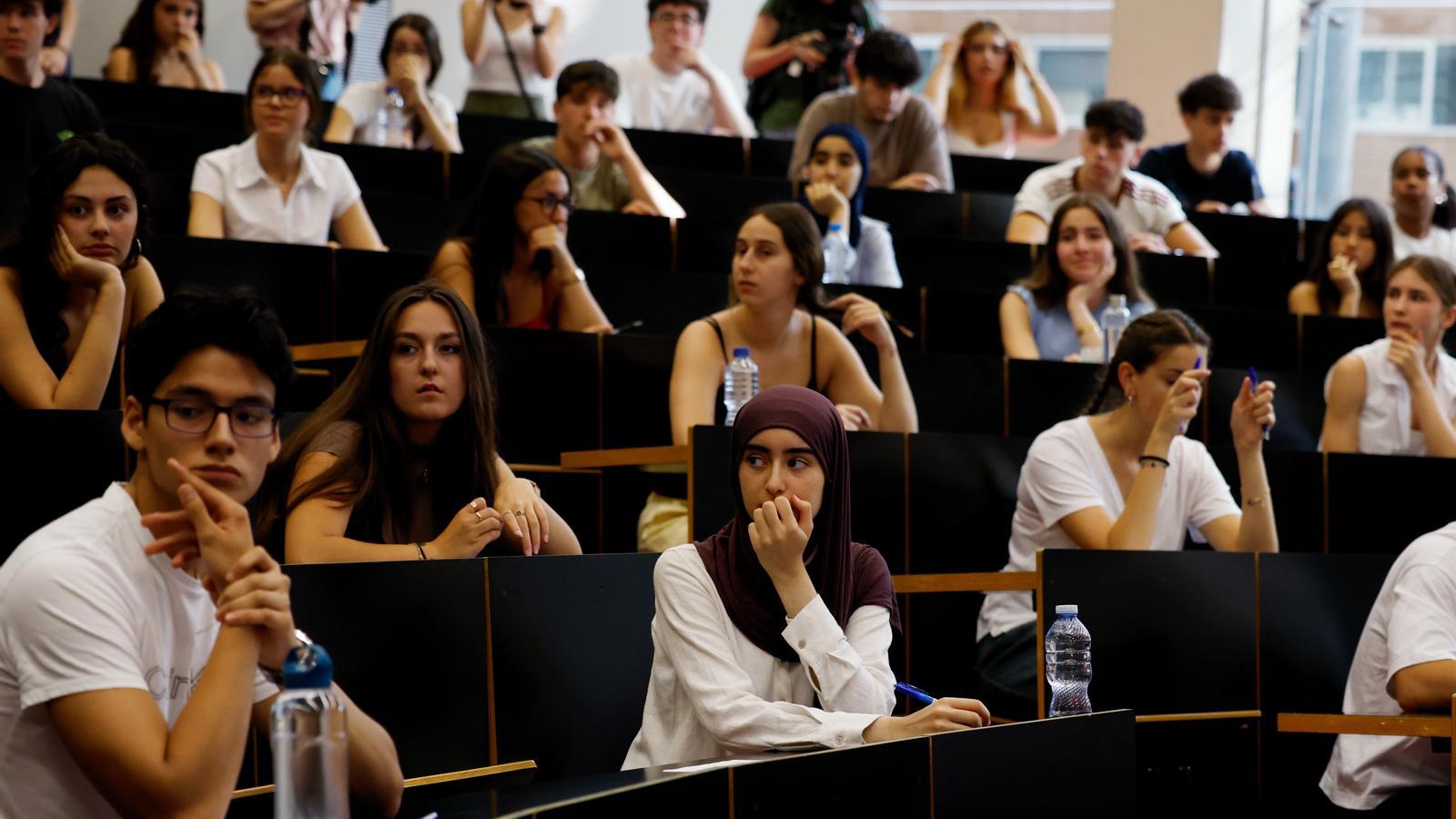
BarcelonaReligion and God are not only marking this Wednesday's news with the visit of Pope Leo XIV, but they have also made an appearance in this year's PAU philosophy exam. Students who chose this subject – the history test was also held first thing – had to analyze how the statement "God is dead" would be evaluated from the perspective of two prominent Western philosophy authors. "It was an easy question because we had all worked on it," admitted a student from the Premià de Mar institute when leaving the test at UPF.
Beyond this exercise, the test included a fragment from The Republic by Plato and another from Creating Capabilities by Martha C. Nussbaum, the only female philosopher on the PAU syllabus. In fact, last year was the first time a woman appeared on the philosophy exam for the university entrance exam in Catalonia.. In this exercise, many of the adolescents celebrated Plato's inclusion because they said he is the author "who is studied the most".
"We must let men sort out the complications"

"We must let men resolve the complications"
On the other hand, the role of women, trade unions, and the emigration of Andalusians to Catalonia have been the main themes of this year's university entrance exam in history. In the first exercise, students had to explain the role of women during the Second Republic and Francoism based on two texts, also written by women: a speech by Clara Campoamor and one by Pilar Primo de Rivera. In the first, Campoamor argued how women had also fought for the Republic and asked: "How can it be said that women have not fought and need an era, long years of the Republic, to demonstrate their capacity?".
In contrast, in the second speech, Pilar Primo de Rivera stated: "We must only attend to what corresponds to us, and we must let men, because it is up to them, resolve all the complications that the government of the nation entails." And she adds: "The women's sections must have, with respect to the leaders, an attitude of absolute obedience and subordination. Because this is always the role that corresponds to women in life, submission to men."
Trade unions and 23-F
In the second exercise, students could choose between writing a report for the CNT on what social struggles in Spain have meant from the First World War to Primo de Rivera's coup d'état, or putting themselves in the shoes of a girl working for a bourgeois family in Barcelona at the end of the 19th century and describing the social classes of the early years of the Restoration.
Regarding the "knowledge" exercises —which are answered with multiple-choice questions—, students have had to imagine they were journalists for a Spanish television and had to interview a family that emigrated from Andalusia to Barcelona in the sixties and answer questions about shantytowns or the lack of housing due to the massive arrival of immigrants.
On the other hand, they have also had to put themselves in the shoes of a Congressman who lived through February 23rd —precisely this year that Tejero has died— and the coup d'état documents have been declassified. In this section, one of the questions is about the name of the coup d'état dismantled in 1978 and among the answers the option "Operation Darth Vader" has appeared.
Although many of the students explained that the history exam was "easy", they also criticized that the Civil War and Francoism "hardly" appeared, when "normally it always does".
Disappointed with math
At 12 noon it was the turn of the optional subjects of musical analysis, technical drawing applied to plastic arts and design, general sciences, Latin language and culture, and mathematics. It was in this last subject where, as is already usual, there have been more disappointments. In fact, some of the students who took the selectivity exam at UPF left the test crying and assured that it was "very difficult". On the other hand, some of the teachers who accompanied them explained that it wasn't that the exam was very complicated, but it was a bit more difficult to understand in terms of reading comprehension.
In the afternoon, the tests for Catalan literature, biology, design, business operations and business model design, and technology and engineering will be held.
