What are we and where do we come from? A Catalan study rewrites the history of complex life
Researchers from IRB and BSC reconstruct the origin of eukaryotes and suggest they are the result of microbial genetic donations from millions of years ago

-
CAT -
CAST
BarcelonaThat you, reader, are now reading this article or that, while you read it, there are beings as fantastic as whales crossing the Mediterranean or tritons splashing in streams of Montseny surrounded by beeches, firs, holm oaks and oaks is thanks to a history of microbial promiscuity forged over millions of years, including viral infections.
This has been discovered by a team of researchers from the Institute for Research in Biomedicine of Barcelona (IRB) and the Barcelona Supercomputing Center (BSC-CNS) led by the Icrea Toni Gabaldón. For five years and with the help of the MareNostrum supercomputer, they have scoured the public genomic data of all Earth's biodiversity to reconstruct the genetic origin of the last common ancestor of all eukaryotes – organisms that have cells with a nucleus – known as LECA (for last eukaryotic common ancestor).
This is the cellular lineage to which humans and the rest of animals, plants, fungi, and protists belong. It is characterized by having cells with DNA contained in a nucleus and specialized organelles that perform different functions. For example, there are mitochondria, which are true power plants.

The conclusions of the new work by Catalan scientists, who now publish in Nature, turn upside down the most accepted thesis in biology to date: that cellular complexity – i.e., eukaryotic cells – arose from the punctual interaction between two much simpler prokaryotic beings, with cells lacking a nucleus and organelles.
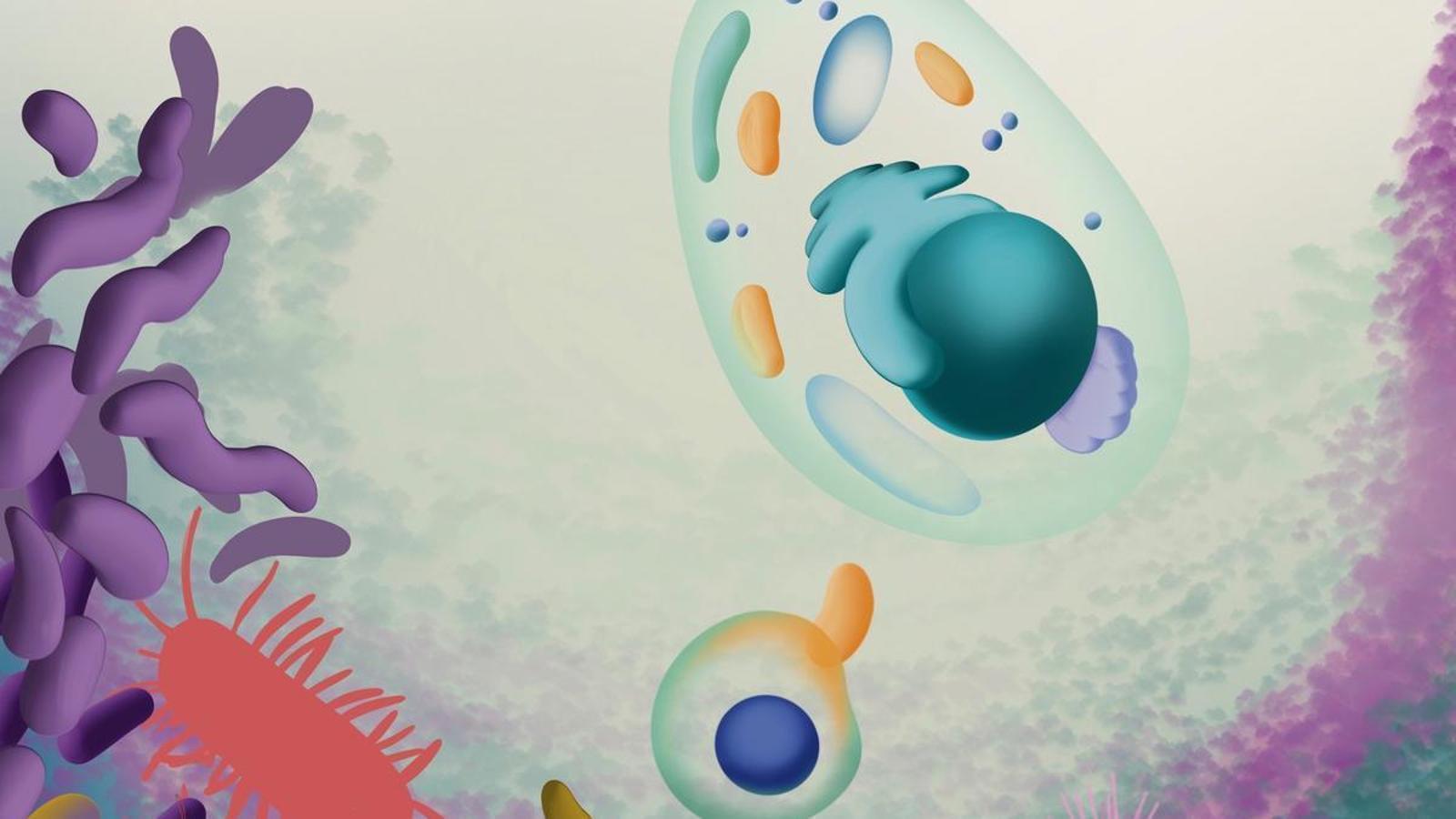
The Catalan researchers question this narrative and argue that it was more of a gradual and repeated ménage à trois over hundreds of millions of years, with interactions between microorganisms that coexisted in the same ecosystem, and with the intervention of giant viruses. All of this led to the development of eukaryotic cells.
"Until now, textbooks spoke of the interaction between a bacterium – which over time became the mitochondrion – and an archaeon [another simple unicellular microorganism]. But our results show us that the story they told us is incomplete and much more complex than we thought," Gabaldón stated in a briefing organized by the Science Media Centre (SMC) Spain.
The big question of biology
Unlike what happens with dinosaurs, the origin of eukaryotes cannot be reconstructed from visible bones or fossils. The most accepted theory about the origin of life on Earth suggests that it evolved from inert matter at some point between 3.9 and 3.5 billion years ago, when the first primitive organisms appeared. However, how, about 2 billion years ago, life transitioned from such simple cells to complex ones like eukaryotes remained an enigma. And this is despite it being the most important evolutionary leap in the history of life on our planet, without which the evolution of multicellular organisms, such as plants, animals, or humans, would not have been possible.
To shed light on this episode, Gabaldón and her team started with genetic sequence data from bacterial and archaeal diversity, as well as from eukaryotes and viruses, and applied mathematical models to group them into families and see how they were evolutionarily related. They thus found that two specific groups of bacteria interacted for a long time, myxobacteria and planctomycetes, and generated genes in the ancestor of eukaryotes.
Furthermore, surprisingly, they found sequences of giant viruses, which infect eukaryotic microorganisms and are capable of integrating into the genome. The Catalan scientists suggest that genes were likely transferred, not only from bacteria to eukaryotes, but also between eukaryotes.
Thanks to all those genetic donations, a more autonomous and complex organism was generated. And, probably, the acquisition of the mitochondrion was the cherry on top that allowed that ancestor of ours to conquer other environments and diversify. "All genomes preserve traces of their history, which speak to us of ancient alliances between microorganisms. Understanding them helps us answer a very profound question: what we are and where we come from," considers Gabaldón.
The project has been mainly funded by the Gordon and Betty Moore Foundation, has had computational resources from the Spanish Supercomputing Network (RES) provided by the BSC at MareNostrum 5, and with the support of the Ministry of Science.
