An innocent anthropologist in the Àneu Valleys
Nigel Barley, educated at Oxford, spent two years in Cameroon doing fieldwork. The experience resulted in a hilarious self-critical chronicle, The Innocent Anthropologist. The Dowayos took him for a ride. And he ended up playing along. The work has become a classic.
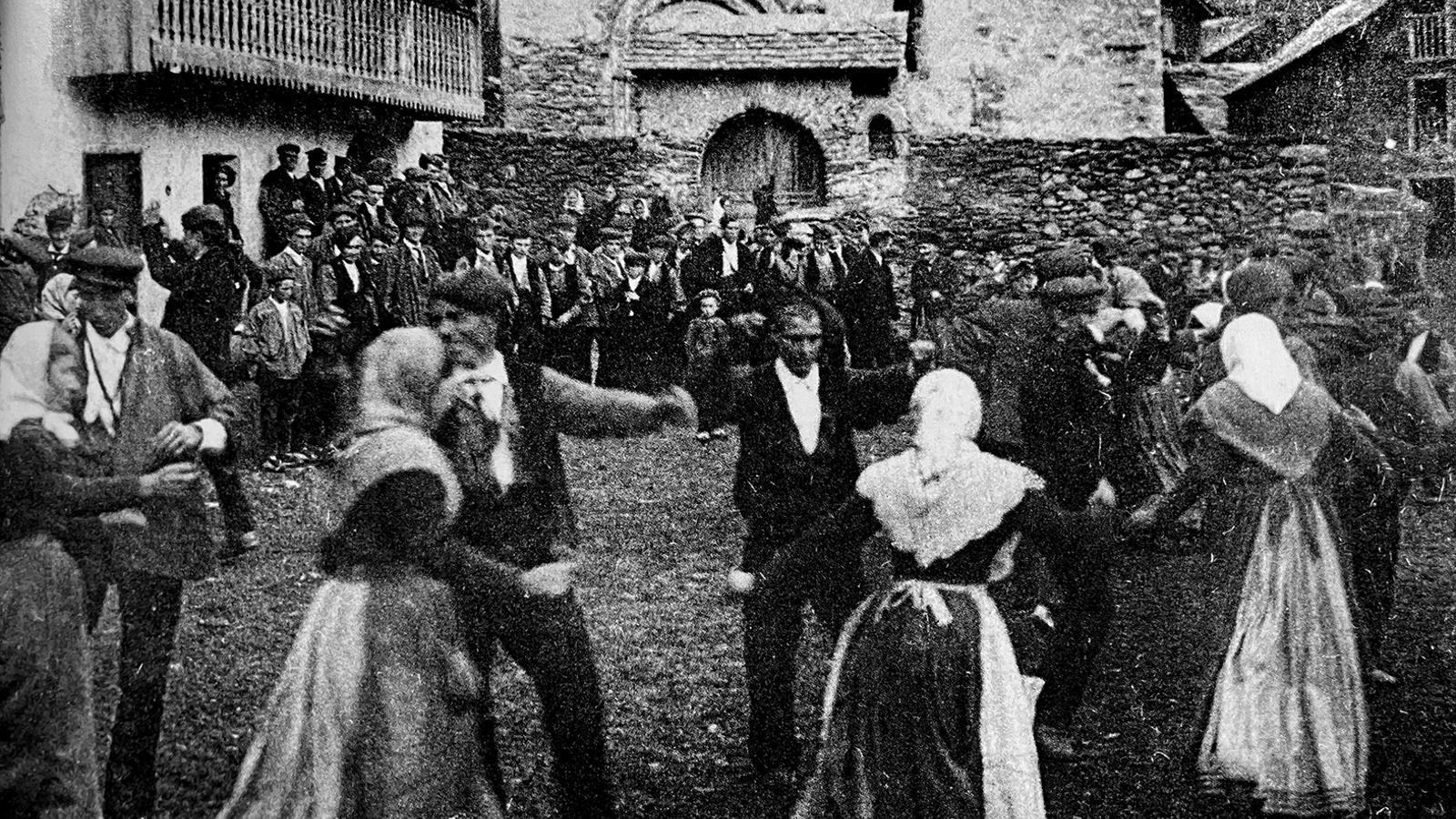
This was in the late 1970s. A few years later, Toni Anyó, a disciple of one of the fathers of Catalan anthropology, the forgotten Claudi Esteve Fabregat, instead of going to Oxford, where he might have met Barley – and where he had been offered further training – settled in Son, the second highest village in the Valls d’Àneu, and dedicated himself to collecting filmed testimonies of the lives of its inhabitants (1982-1985), most of them still farmers. The people of Son took it well, without the cunning of the Dowayos. In this case, innocence was shared and symbiotic. Those images have a strong evocative power, as well as being valuable documents.
The collected material – many hours of filming – which was initially intended for a TV3 documentary that the public broadcaster did not end up making, constitutes the swan song of a society that for centuries lived from the land and for the land. Today the images can be viewed at the Pyrenean Documentation Centre, a small museum-archive in the village of Son itself, supported by Anyó and a group of members of the non-profit association he heads. The museum opened its doors a decade ago. It does not receive public funding.
Anyó is a passionate scientist who has lived on the fringes of academia. Son is his adopted world. He is also the one who, in practice, takes care of the church's Gothic paintings, an altarpiece from the 15th century preserved in situ, by Pere d’Espallargues. It is the only one in the Valls d’Àneu that remains in its original location. It is perfectly restored. The stone fonts for oil and baptism are also admirable.
Another essential character for understanding Pallaresa life is the writer Ferran Rella, from Esterri d'Àneu, the cultural soul of the valleys, who this year celebrate the 35th anniversary of Dansàneu. Without him, culture would not have flourished as it has in this corner of the Pyrenees. Among his latest initiatives is the graphic book Les Valls d’Àneu desaparegudes (Efadós), where, as Martí Domínguez says in the prologue, "Ferran Rella re-plows, tills memory anew" with that essential touch of nostalgia and affection. The images, once again, like those collected by Anyó, are evocative of a 20th century that experienced the transition from the rural world to electrical and tourist modernity.
The Valls d’Àneu, a Pyrenean cul-de-sac for centuries, from 1924 onwards, with the opening of the Bonaigua pass, which connected them by road with Aran, and in the 50s with the hydroelectric power plants that harnessed the water of the winding Noguera Pallaresa, left behind a mountainous closed-off life, encapsulated in time. The last peak moment was the business that Pallaresa farmhouses did during World War II selling herds of hoofed animals to the allies: mares, mules, donkeys... In Son, some made a lot of money.

The ancient world from which the Pallaresos came has somehow been fixed at Casa Gassia in Esterri, which houses the Ecomuseum of the Vall d'Àneu, also promoted by Ferran Rella and inaugurated in 1994. By the standards of the time, it was a rich house. By today's standards, it is one of fierce austerity. They must have been terribly cold, or perhaps not so much, at least until the 14th century, when what is known as the Little Ice Age (1300-1850) began in Europe.
The large number of Romanesque churches scattered throughout these valleys, of a rustic beauty, in which Lombard influence predominates, are a reminder of the secular religious dominion: in the valley, more than a hundred priests served at the same time. In the village of Son alone, there were eleven, distributed in three temples, one of which has since disappeared. The Church was a very earthly spiritual power.
Religion colored everything, from the calendar to aesthetics. Anyó notes the exceptional Romanesque seraphim in the paintings of Pallars. The seraphim were the highest angels, closest to God, with their six wings with all-seeing eyes: the pharmacist Joaquim Morelló, who died 100 years ago, was the one who discovered to Domènech i Montaner, Gudiol and Pijoan the mural paintings of Santa Maria d'Àneu with the marvelous seraphim. Anyó also notes a peculiarity of the Madonnas, such as that of the monastery of Sant Pere del Burgal, figures that in Romanesque times held a chalice or lamp in one hand, an early connection with the myth of the Holy Grail – perhaps due to Cathar influence?–. They disappear with the Gothic. Women lost power.
Anyó, Rella and, with them, many other scholars and activists have dedicated the last decades to continuing the pioneering work of the ethnographer Ramon Violant i Simorra (1903-1956), originally from Pallars Sobirà. Or to the testimony that Josep Maria Espinàs left in 1959, first in the magazine Destino and later in book format, about the livestock fair in Salàs, which would disappear a few years later after six centuries of continuity. Today, in Salàs, there is another interesting period museum, the Botigues museum.
This year, a lush spring has once again dyed the Vall d'Àneu a brilliant green. Go to Àneu to walk and read a revived past.
