How should Germany defend its democracy?

-
CAT -
CAST
Far-right nationalist populist parties are leading the way everywhere, from Washington to Warsaw. Why, then, be so alarmed by the small electoral victories of one of these parties, Alternative for Germany (AfD)? “Because it’s Germany!” is the almost instinctive answer in many heads around the world.
But this “Because it’s Germany!” needs to be taken apart like the segments of an orange. Yes, because of Adolf Hitler, because of two dictatorships (Nazi Germany until 1945 and Communist East Germany until 1989), and because of two world wars. And yes, part of the AfD's language sends a shiver down the spine of anyone who knows Nazi rhetoric.
There is also the fact that Germany is Europe's central power. The AfD's national co-leader, Alice Weidel, says that when she comes to power after the federal elections scheduled for 2029, Germany will leave the euro and exit the Schengen area. What would then remain of the European Union?
The great German liberal Ralf Dahrendorf, who died in 2009, told me more than once that he would only truly trust in the solidity of German democracy once it had passed the test of a major economic crisis. Well, the country is close to that.
The last segment of the “Because it’s Germany!” is perhaps the most interesting. The entire constitutional, political, and educational system of the Federal Republic is designed to avoid anything like the collapse of the Weimar Republic into Hitler's dictatorship in 1933. The Federal Republic must be a wehrhafte Demokratie: a democracy capable of defending itself.
That is why the way Germany will now defend its democracy is a matter of not only European but global transcendence. Of all the responses being frantically debated in Berlin, the formula that seems most convincing to me is this: neither ban the AfD nor embrace it, but rather limit it legally and combat it politically.
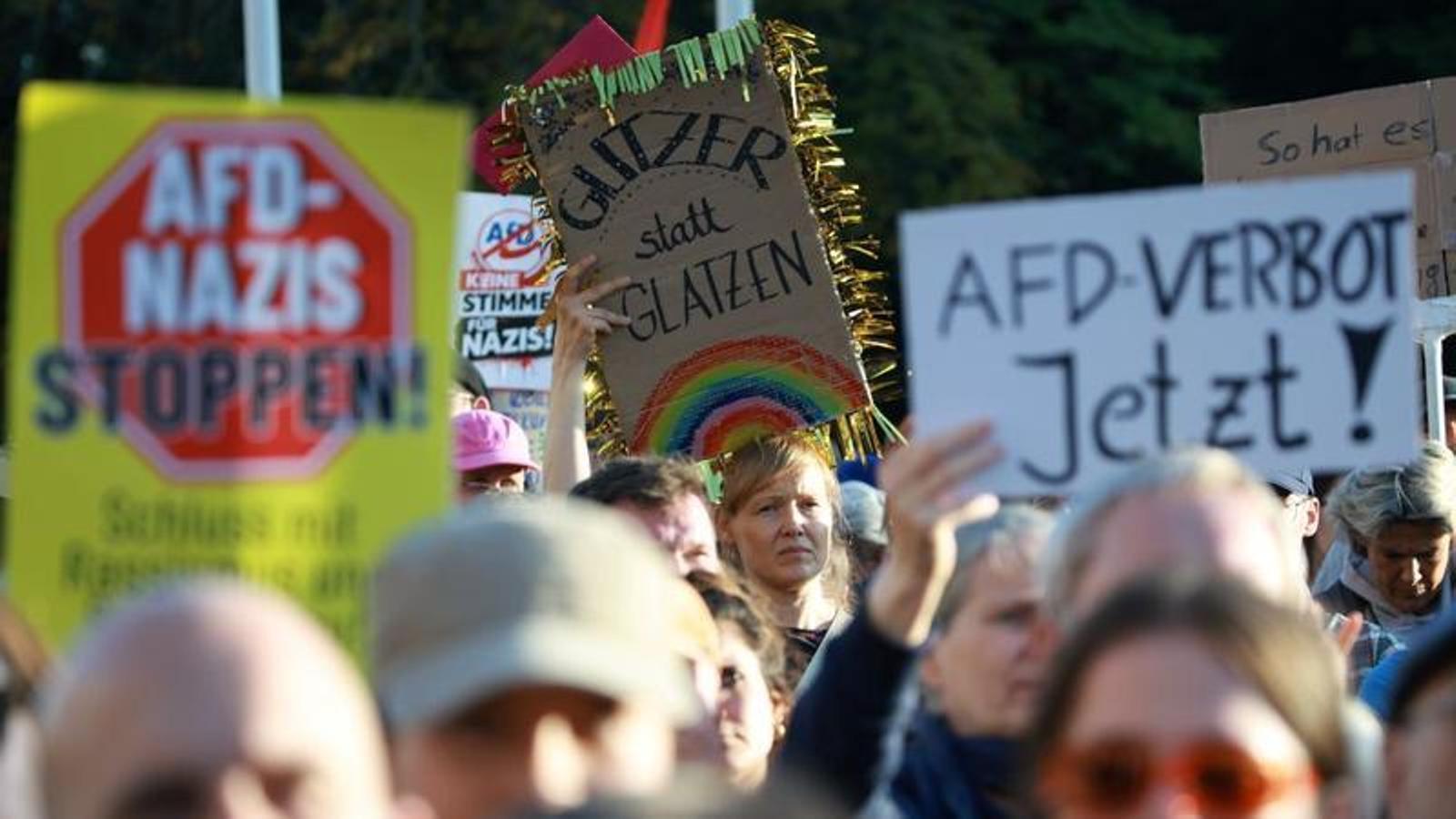
The German Constitution provides for the banning of political parties that are "hostile" to the country's fundamental liberal democratic principles. Some top-level German political leaders have called for an application to be filed with the Constitutional Court to ban the AfD, or at least its most extremist parts, for these reasons. But it is already too late. The AfD has been a major force in the Bundestag since its success in the 2017 general election, a result of the migration crisis, and, like Reform UK in Great Britain, it leads many national polls. To suddenly tell so many citizens "you cannot vote for the party you support!" would, in itself, be an attack on democracy.
But here we are not talking about democracy as the tyranny of the majority (“The people have spoken: off with their heads!”). We are talking about liberal democracy. This means that the result of any popular vote is limited by the rule of law, by human and minority rights, and by pluralistic and anti-majoritarian institutions. Today, the real threats to German democracy resemble less Weimar in 1933 than Budapest in 2010 (when Viktor Orbán took power) and Washington in 2026. Apparently, the mini-Trumps of the AfD have been discreetly exploring Trumpian executive and administrative mechanisms that they could use to consolidate their control. The Federal Republic has the right, the power, and the duty to stop them.
Article 37 of the German Constitution, which allows federal authorities to override the unconstitutional conduct of the federal states, has never been applied in the 77 years of the republic's history. If the AfD forms the government of the federal states, it will be necessary to use all powers wherever required, including Article 37. For example, it must be prevented that intelligence information regarding Russia's growing aggression is shared with the pro-Russian branch of the AfD. They will also have to guarantee the independence of judges and prosecutors, and the neutrality of the police and the civil service. I would add that any extreme politicization of public education and public broadcasting must be prevented. The AfD politicians will say, of course, that it is foul play. Too bad. If, as they say, they want “another republic,” they should go live in Russia.
However, even more important than these legal and administrative limitations is the political response. At the opposite extreme from those who call for banning the party, there are Christian Democrats who demand abandoning the so-called "firewall" and welcoming AfD politicians as a normal part of the political game. The argument is that letting them assume responsibilities in a regional government will expose their inconsistency, their incompetence, and their lack of real political answers. It is also argued that talking to them and working with them will end up moderating them, as seems to have happened with Giorgia Meloni's Brothers of Italy. I myself have felt tempted by these arguments. But data collected by political scientists indicate that it is just as likely that an inclusion strategy will give more momentum to the far right. The AfD activists themselves warn of the danger of Melonisierung (Melonization).
Thus, the Christian Democrats should not fall into the temptation of half-getting into bed with the AfD, like a middle-aged man nervously embarking on an extramarital affair. On the contrary, they should fight it politically with greater effectiveness. Instead of defining Christian democracy by what it opposes (the AfD and the far-left Die Linke), they should say what it defends. To renew the German social market economy, they should implement all the reforms agreed upon this summer with their social democratic coalition partners, and go even further. Faced with enormous external challenges, from Russian aggression to American and Chinese AI, the Christian Democrats should courageously defend responses on a European scale. Historically, they are the party of Europe, and only these responses will give any European country the strength to stand up to the giants.
But, in addition to AI, traditional German parties urgently need EI (emotional intelligence). The key to the success of Ulrich Siegmund, from the AfD, in Saxony-Anhalt, as in the case of Trump and Nigel Farage, is a kind of emotional communication. I am here with you; I listen to you and I see you; I share your anger. With me you can say what you really think and be yourself, because, whether I am a millionaire or not, deep down I am a normal guy like you. So let's all have a beer and move forward towards an imaginary past.
It is fascinating to reread the fundamental article by the exiled German political scientist Karl Loewenstein on "militant democracy", from 1937. Loewenstein insists that democracy cannot "devise emotional formulas capable of competing with the fascist Pied Pipers of Hamelin". Hence the emphasis on constitutional limitations. But our information environment has been transformed and rewards attention, drama, and passion. In this environment, democracy cannot be defended only with legal limitations and rational policies. Democrats everywhere must compete with the Pied Pipers of Hamelin of today also on emotional ground. Both constant presence on social media and physical presence on the ground are essential. The Hungarian Péter Magyar and, in a way, the new British prime minister, Andy Burnham, have shown how it can be done. Now it will depend a lot on whether German democrats, and especially the Christian Democrats, show that they are also capable of it.

