To feign illness to avoid having to go home
The Convalescence House of the Hospital de la Santa Creu, jewel of the Baroque

-
CAT -
CAST
It makes perfect sense to dedicate a chapter ofA country of science at the Casa de Convalescència of the Hospital de la Santa Creu, located in the Raval, a stone's throw from the headquarters of ARA. It is the headquarters of the Institut d’Estudis Catalans (IEC), whose Section of Sciences is very powerful. Catalans associate the IEC, our national academy, especially, with Catalan and its normative dictionary, the DIEC. But under the shelter of this more than centenarian entity (it was founded in 1907 by Enric Prat de la Riba), very diverse scientific research has been carried out on topics as varied as the biogenome, the Romanesque Pyrenees or migrations and diversity.
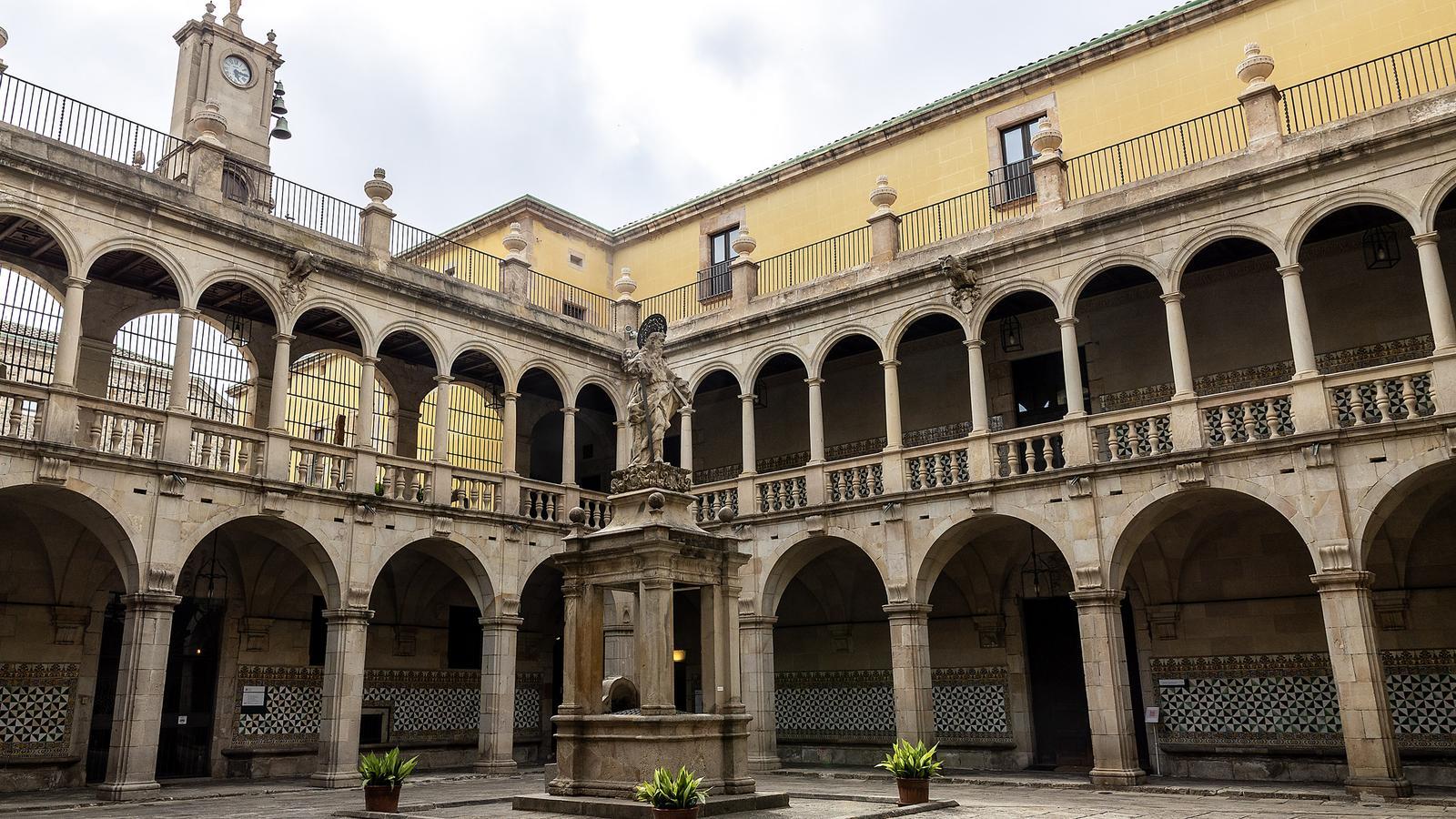
Furthermore, the Casa de Convalescència represented a very important advance in patient care: some of those who were discharged from the adjacent Hospital de la Santa Creu (now the site of the Library of Catalonia) stayed there to recover and prevent a relapse. I am visiting this space accompanied by Fàtima Duarte, who knows a great deal about its history. She has led numerous guided tours and had to research to provide good and engaging explanations. The first stop is already an exceptional place: the beautiful cloister, one of the most painted in Catalonia (this has an explanation: it is close to the Escola Massana, and students from this art center often came here for practicals). In the center of the cloistered courtyard stands a sculpture of Saint Paul, by Lluís Bonifaç. Bearded, he holds a sword in one hand and a book in the other. These are two tools of power, but the latter is – or should be – more powerful.The merchant Pau Ferran was housed at the Hospital de la Santa Creu. Legend has it that he went bankrupt, fell ill, and was attended to. When he recovered, he decided to dedicate his fortune to the construction of the Casa de Convalescència (on the condition that Saint Paul had a prominent role there). The sculpture of Saint Paul, made of Montjuïc stone, is above the well from which water was drawn in abundance for daily use. "If they suspected the water was contaminated, they gave wine to the patients," comments Fàtima. "Here the convalescents were well cared for. They ate meat and dessert every day!" Some pretended to be sick so they wouldn't have to leave. We go up some stairs to the first floor, where the cloister is. I ascend slowly because the railings, with drawings of fruits, among other motifs, catch my attention. The tiles that line the walls are a common feature in this center. The handrail of the stairs is made of copper. "It helps with disinfection," Fàtima emphasizes. "This way, relatives who went to visit a sick person disinfected their hands," she adds. All this happened centuries before covid arrived. We are now in the chapel, dedicated to Saint Paul, esclar. On the pilasters there are some painted horseshoes, symbolizing Pau Ferran. What a contrast between the austerity of the cloister and the richness of this chapel, where there is a very elaborate painting by Antoni Viladomat, one of the great masters of the Baroque!The chapel is the link between the men's dormitory and the women's. The convalescents could hear mass from their beds, and if they had the spirit or strength to get up, they would attend. Besides praying, coming to the chapel had an additional attraction: it was the only place where men and women, boys and girls could "see each other's faces". Whether they were husband and wife, father and daughter, friends or more-than-friends. They all slept separately, and they also had breakfast, lunch, and dinner separately... Just in case.
In the Convalescence House there is also a garden, which curiously is on the first floor. In reality, they are a series of flowerbeds with plants that appear in the narratives of Mercè Rodoreda. The garden is a tribute to this great writer and visual artist (she did drawing, painting, and collages, which is little known). Furthermore, there is a space that reviews her life and work.
"Where does this bridge go?", I ask Fàtima. It connects the elevated garden, crossing Egipcíaques street, with another scientific building: the headquarters of the CSIC, the Spanish research center. "I've never seen anyone cross it", says Fàtima. And yet there are scholars who have the dual status of being a member of one center and the other: the CSIC and the IEC. A kind of double scientific nationality.We end the visit in a space dedicated to Pompeu Fabra, where original publications by him are shown, such as the Complete Works, the Grammar of the Catalan Language, the General Dictionary of the Catalan Language... It should be noted that Fabra was one of the founders of the Philological Section of the IEC, which he presided over for many years, until his death. There is also a beautiful drawing exhibited – an enlarged reproduction – of him as a young man, in black and white, made by Ramon Casas.
Fifty years of constructionThe Casa de Convalescència is a construction after the Hospital de la Santa Creu (inaugurated in 1401). The works began in 1629, but were carried out slowly due to the scarcity of money. The building was made with patronage and, of course, the income arrived drop by drop. There were more obstacles, including a major fire. The construction lasted five decades. It was not until 1680 that it was inaugurated.

