Are there, still, distinguished sick people?
The Pere Mata Institute, a modernist gem by Domènech i Montaner, continues to be a health center
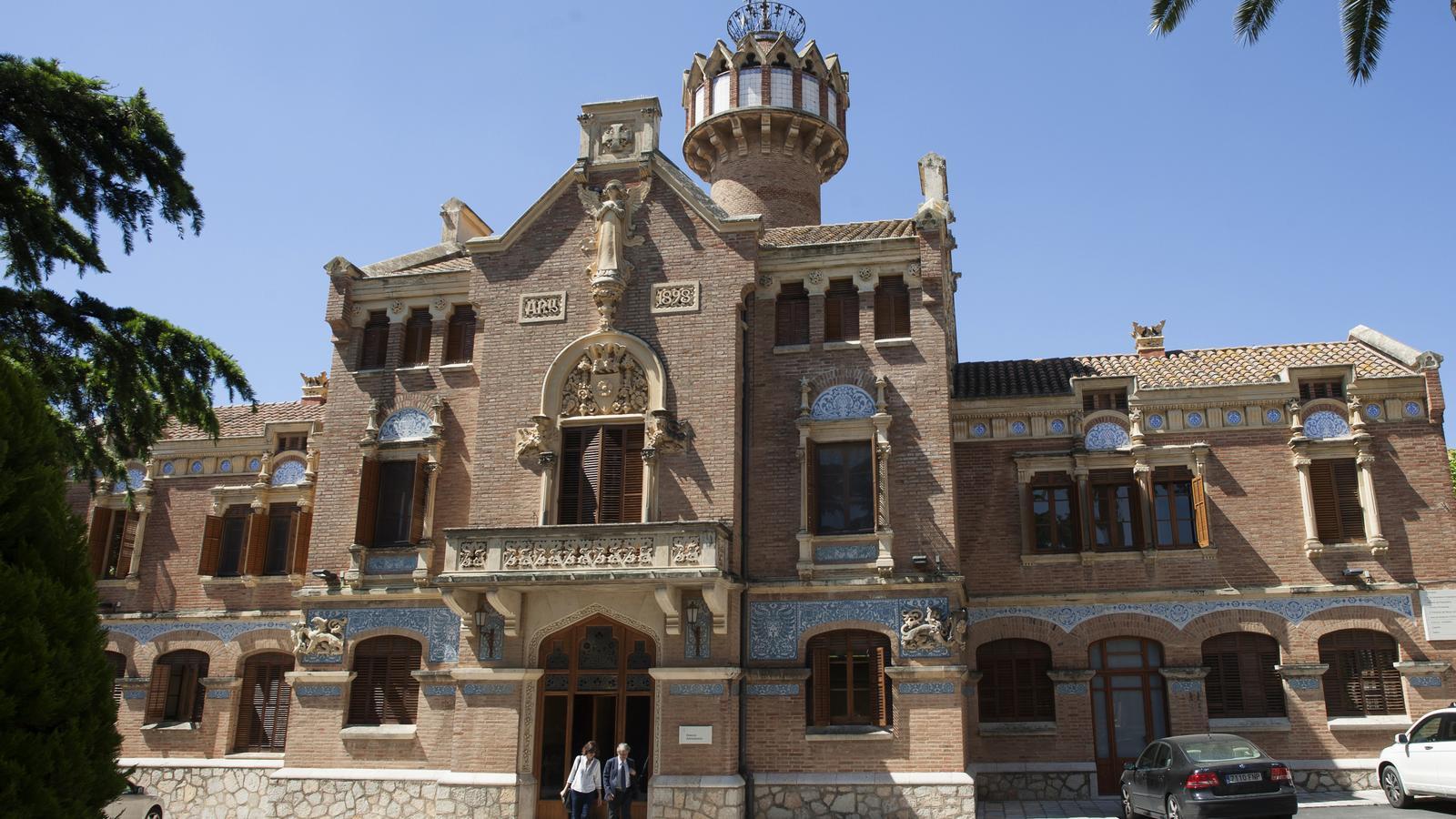

Good doctors treat everyone equally. However, from time to time they receive comments from relatives who use their social status to request special attention. Are there still, distinguished patients? Well yes, at least there are those who consider themselves so. I think about it when I am in one of the "distinguished patients" rooms at the mental health center named after Pere Mata (doctor, politician, professor of forensic medicine... and writer). Mata was the mayor of Reus and held positions of responsibility in Barcelona and Madrid, from which he promoted laws that, years after his death, made it possible to open centers like the one I am visiting today. The room is located on the first floor of the Pere Mata Institute, built in a clearly modernist style by Lluís Domènech i Montaner. It is a large room for a single person, and well decorated (walls, ceiling, and floor included). It has not been used for a long time; it is only visited. The rest of the facilities, on the other hand, are not open to the general public: they continue to be a health center.In this room for distinguished patients, what strikes me most is a blurry mirror: it is made on purpose. This way they could not see their faces and did not "collapse". Next to this room, there is another one, "smaller": much smaller and without windows. It was for the night caretakers. Although, exceptionally, some distinguished patients had their own service, there were "third class" patients who performed service tasks for the "first class" or distinguished ones. And they received remuneration (by the way, the Pere Mata Institute had its own currency). Next door there is a room with a single piece of furniture: a bathtub. Quite a luxury! "Hygiene and hydrotherapy were essential here. Electrotherapy was also practiced. Furthermore, light, ventilation, and contact with nature were considered elements of care," remarks Maria Adzerias, from Còdol Educació, a company that for years has been bringing the heritage of the Tarragona regions closer to citizens. Everything was designed for the emotional well-being of the patients. "Emotional well-being, which contributes to physical well-being, is very important. They were truly advanced here," says my wife, Elisabet, a doctor, who accompanies me.Maria reminds us that one of Pere Mata's illustrious patients was the painter Joaquim Mir. "On a trip to Mallorca with a group of painters, among whom was Picasso, Mir fell off a cliff. When he returned, he hadn't fully recovered. That's why his parents decided to admit him," explains Maria. Elisabet, a painting enthusiast, immediately searches on her mobile for paintings by Mir made when he was here. There are some very beautiful landscapes.Maria tells us all about this during a guided, theatrical tour. She plays the role of a housekeeper who, throughout the entire performance, introduces the Pere Mata Institute project to potential collaborators, and sings its praises, while waiting for Doctor Briansó, the Institute's promoter, to arrive. "Briansó achieved the objective of creating a quality, cheerful, and spacious center, far from the asylum of the painting Casa de locos, by Goya," says Maria. Elisabet immediately searches for it on her mobile and shows it to me – the madmen are crowded and with little light – while Maria reads from a document some words that Briansó pronounced about Pere Mata's project: "Does it not represent a lot, a great deal, in the moral order, the relief that we propose for the most unfortunate beings of humanity?". These are expressions that would now be nuanced, but they denote a way of thinking. Have we improved? "}The excellent guided theatrical tour places the public at the beginning of the 20th century, when the first cars, electricity, the telephone arrived... A time when progress accelerated. The visit has a final musical surprise, recalling the importance given to music therapy: on Sunday afternoons, patients, medical staff, and sometimes some relatives attended the concert.On the upper floor, behind an iron railing covered with colored glass cylinders – a solution that Domènech i Montaner himself would later develop at the Palau de la Música Catalana – a singer, accompanied by a pianist, performs pieces from the era. As I listen to the dancing notes, I notice a chestnut tree – a symbol of strength – etched on the wall. Vegetation is a recurring element in this center. Roses are abundant here, a flower that is also found on the coat of arms of the city of Reus."Domènech i Montaner –who also gave his all in another building in Reus: Casa Navàs–, was the conductor of a group of artisans, who made the furniture, the stained glass windows, the lamps...", emphasizes Maria Adzerias.The prestigious modernist architect designed this complex with pavilions. It is a precedent for the model he would later develop at the Hospital de Sant Pau. The project – unfinished – provided for pavilions differentiated by sex, social class, type of illness... In the interior spaces, he ensured that the furniture and many other elements had rounded shapes; this reduced the risk of bumps or injuries. Furthermore, the main staircase has no railing, so that patients could not grab it and injure themselves, nor a well in the staircase, to avoid the temptation to jump.As with Casa Navàs –Reus's other Modernist jewel, also by Domènech i Montaner–, construction costs were high: the architect had no budget limits. "Domènech i Montaner erects buildings with the same speed as he demolishes fortunes," it was said.We finish the visit to the garden, which is a little elevated. The stone wall surrounding the enclosure seems easy to cross. But if we approach it, a notable drop appears. It is known as the “lob's leap”. In this way, the patients did not have the feeling of being locked up, even though they were. After the visit, the actress shows me documentation that she used to create the script for the theatrical visit. There is a poster with the image of the Institut Pere Mata that says: Manicomio de Reus. Instituto Pere Mata, and then Casa de curación de padecimientos mentales y nerviosos. The two main names are the doctor Emili Briansó and the priest. One healed the body and the other the soul, and everything was sorted. The word asylum has fallen into disuse. This center no longer houses "madmen" or "lunatics", but rather people with mental illnesses. At least in name we have improved.A 14th of April with two kingsKing Alfonso XIII visited the Pere Mata Institute in 1904 and wanted to greet the patients. One of them claimed to be the "king of Spain". When he was presented to the monarch, the patient told him: "With whom does the king of Spain have the honor of speaking?". Alfonso XIII, despite being surprised, improvised: "With another king". "And where are you king of?". Then Alfonso XIII renounced his homeland: "I am the king of England", he let him know. La Vanguardia –monarchist newspaper– collected the anecdote, and not precisely applauding it. Perhaps the fact that there were Catalan flags displeased the chronicler of that act on April 14th... the day that, a few years later, the Republic would be proclaimed.

