Víctor Resco de Dios: "The fires of now are like a trailer for the movie of the future"
Professor of forest engineering and global change at the UdL

-
CAT -
CAST
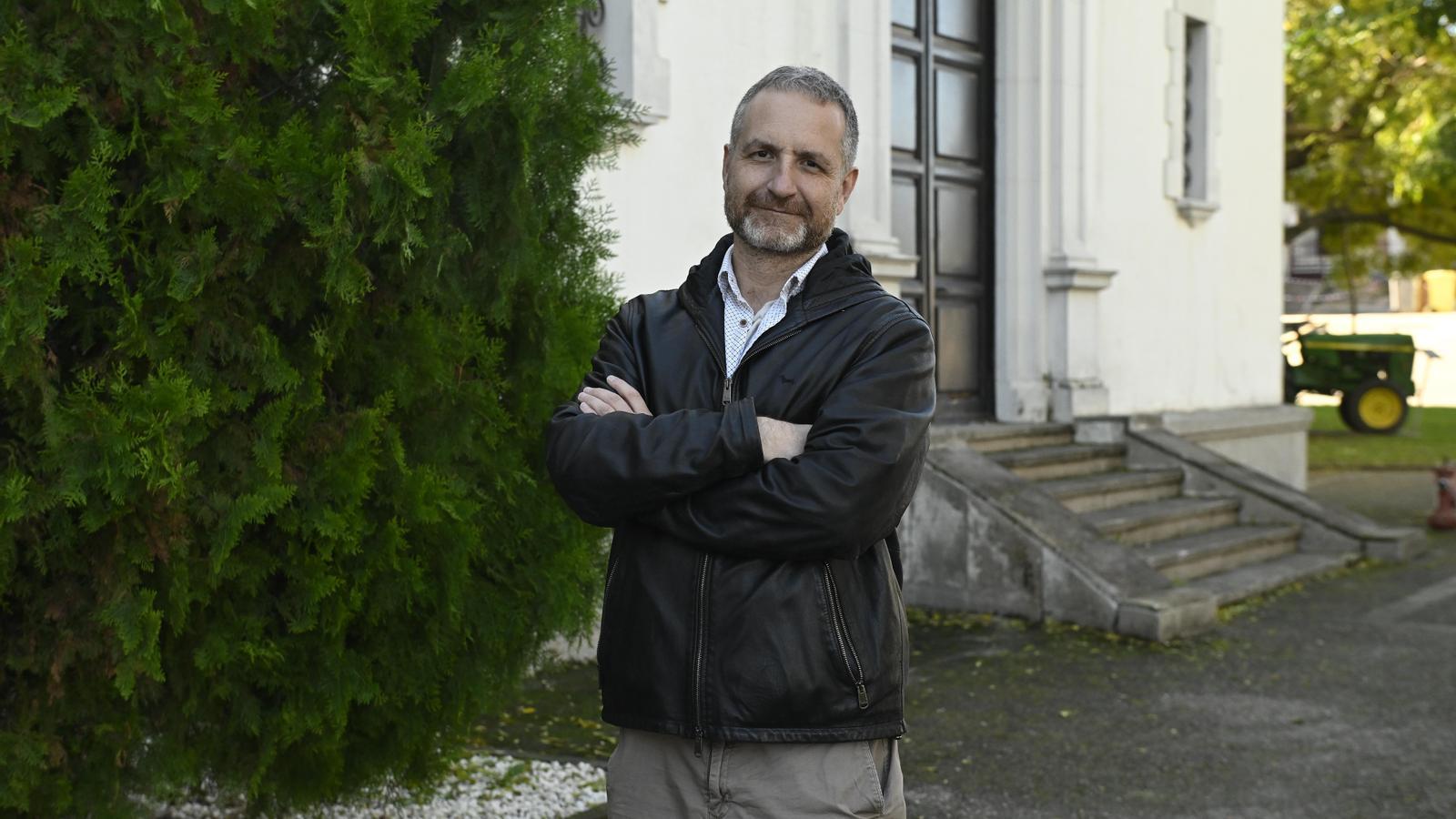
LleidaThe Professor of Forest Engineering and Global Change at the University of Lleida (UdL) Víctor Resco de Dios (Barakaldo, 1979) has recently been appointed a member of the Royal Academy of Exact, Physical and Natural Sciences of Spain (RAC), founded in 1847. He is the first professor from the UdL to be admitted.
What does it mean to become a member of the Royal Academy of Sciences? What role can this institution play in political decisions and public opinion?
— One of the main functions of the Academy is advising the various governments, whether they request it or the academies themselves consider that there are relevant issues. Another function is scientific dissemination: bringing knowledge to the citizenry and contributing to their scientific literacy. Especially in this era, in which there is so much disinformation and so many myths, one of the main tasks is to help the citizenry distinguish the wheat from the chaff.
Isn't this battle against disinformation already lost?
— In my field, which is that of wildfires, I believe that in recent years we have made a great deal of progress. I believe that society now understands that the wildfire problem is not a lack of resources, nor is it about planting pines or eucalyptus, nor is it about arsonists. It is a land management problem. We have abandoned it, fires are spreading more and more, and those who want to manage it often face many bureaucratic and legislative obstacles.
And climate change… Does this reality cause disaffection?
— Some leaders have used climate change as a shield behind which to take cover: “It is climate change, there is nothing we can do about it”. But the public is increasingly aware that this cannot be an excuse for inaction. On the contrary: precisely because we are immersed in climate change, adaptation, which involves managing the territory and fuel, is even more urgent. This is a marathon. There are many people who for many years have tried to explain it. I do not mean that the battle is won, because there are still significant portions of society that continue with the usual narrative. But I believe that, little by little, we are managing to get administrations to listen more and place emphasis on prevention plans.
Politics, however, works with very different timelines than those of science.
— Politics is lagging far behind. If you read the literature on wildfires in the United States, by the sixties people were already talking about the extinction paradox: if you invest a lot of resources in extinguishing fires but do not manage the land, you are creating a mirage. At first the burned area decreases, but, since the fuel continues to grow, even if you are very good at putting out fires, they become larger and larger.
Are we late? Have we reached a point of no return or are we still in time to reverse the situation?
— We must act as soon as possible. The longer we wait, the more aggressive the intervention will have to be. But this is not like food that expires and we throw in the trash. The earth and nature do not work like that. They do not have an expiration date: they are our world. The longer we wait, the more economic losses we will suffer. We must act soon to avoid losses that are preventable.
Are large fires now inevitable?
— Fires will become increasingly larger, but the future is not written. Fires need a lot of fuel and in Catalonia we have a lot of it, and more and more each time. Abandonment means that the available water must be shared among more trees. It is not the same to have a glass of water for one person as it is to have to share it among five. The same happens with vegetation.
Nature warns us continuously.
— What we have seen so far is like the trailer of the future that awaits us if we continue as we have been. A fire like the one that devastated 80,000 hectares on the outskirts of Madrid could happen here in Barcelona, in Collserola, and cause a catastrophe. We could also have a major fire in the Pyrenees. The good news is that everything is in our hands. The key is how we manage fuel and the territory. We can minimize the probability of catastrophic mega-fires. With abandonment, what we are doing is maximizing it.
You argue that the environmental crisis is at the same time an opportunity to remake the way we live.
— When major catastrophes occur, an immediate political reaction is produced. Now the goal is for wildfires to be talked about throughout the year; so that it is not just a way to get by, but rather that it forms part of the work of the different administrations.
In your book Ecomitos you questioned some very widespread ideas about the environment. For example, plastic recycling. Is less recycled than we think?
— Global studies indicate that only 10% of all plastic has been recycled. And if we talk about the plastic that has been recycled more than once, it is 10% of that 10%. Obviously, a significant fraction is still in use. This does not mean that everything ends up in the environment, but a significant part does end up in the sea and generates problems derived from microplastics. We need a global treaty to regulate its use, although it is becoming increasingly difficult. Plastic is a very useful and cheap material. We must rethink how we manage it.
The environmental crisis also has humanitarian consequences.
On a global scale, if we look at climate exiles, there are parts of the world that are poor and that have become even poorer as a result of climate change and the lack of water. But it is also important how we approach the green transition, because the way we do it in the global north can exacerbate the problems of the south. For example, electric cars. They are very quiet and do not pollute, but where do the batteries come from? They need lithium… The second main cause of exiles, after wars and conflicts, is nature conservation. When national parks are created, the people who live there are often expelled. We are talking about subsistence economies, about peoples who are often hunter-gatherers. To protect nature, they are driven out. Plantations are also made to offset emissions and people are displaced from their homes to be able to plant trees. This adaptation to climate change can aggravate social injustice. Some measures to improve biodiversity or compensatory plantations can end up having a component of green colonialism. It is colonialism disguised as environmental policies, but it remains the same old colonialism as always.
In Catalonia, a large part of the forests are privately owned. Does this hinder their management and the prevention of forest fires?
— Ownership is one of the factors involved, but we also see this problem in public forests managed by the Generalitat. It must be solved by placing fire prevention as a matter of national interest, a priority for all administrations.
What measures could be taken immediately to improve it?
— The first would be a regulatory relaxation and a bureaucratic streamlining. One of the main problems we have is abandonment. There are many people who still live in the territory and it is becoming increasingly difficult for them. People who live in the villages are already aware of the need to protect nature. They are, furthermore, the most affected, because they are the ones who see their houses burn down. Let's take advantage of the fact that they are already aware. We must also abandon this environmental taxation we have, because there is a presumption of guilt regarding any action that involves cutting down trees or carrying out prescribed burns.
