Science stops at the micro-villages
An IBB-UAB project travels to nine Catalan locations, five of which are in the Terres de Lleida, to bring biomedical research and scientific dissemination to rural areas

-
CAT -
CAST
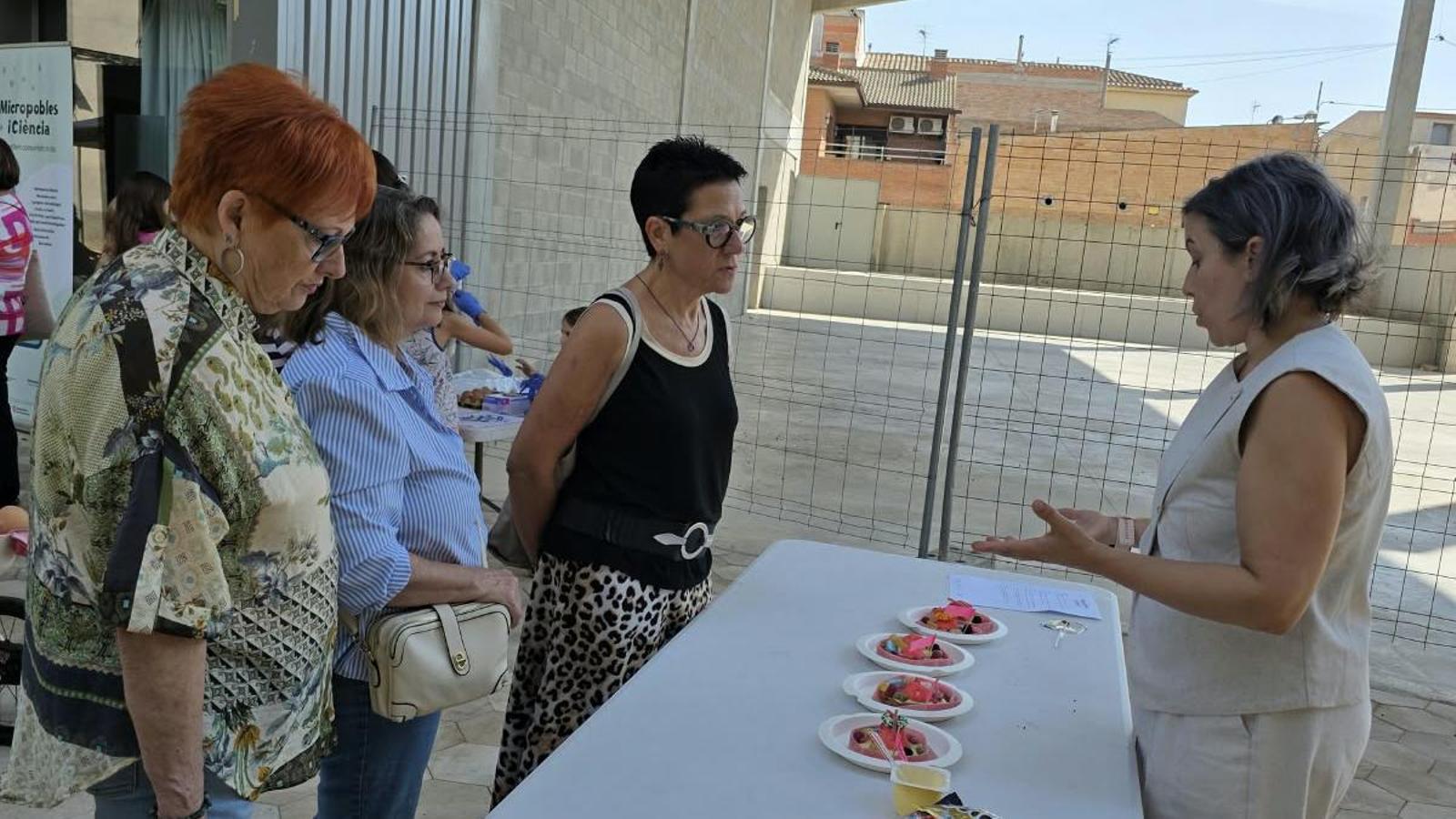
The TormsScience also travels along secondary roads. It is not only explained in university classrooms, at specialized congresses, or in laboratories. It can also reach a rural school, a municipal hall, or a town square in a small village, far from the main urban centers. With this premise, the Micropobles i Ciència (Microtowns and Science) project has toured nine Catalan locations this year to bring scientific knowledge closer to the rural population. The journey ended last Saturday in Els Torms, in Les Garrigues.
The initiative, promoted by the Institute of Biotechnology and Biomedicine of the Autonomous University of Barcelona (IBB-UAB) and the Association of Microtowns of Catalonia, was born from a simple question: does everyone have the same opportunities to access scientific information? "I come from an isolated area, with many difficulties in accessing it," replies Dr. Tamara Fernández, a postdoctoral researcher at the IBB-UAB and the person primarily responsible for the project. She is originally from Almendral de la Cañada, a small village of 300 inhabitants in the province of Toledo, where years ago she had observed that scientific initiatives were sporadic. This led her to wonder if this reality was also being reproduced in Catalonia, where she now works. Consulting the Association of Microtowns confirmed that it made sense to try a formula to reduce this inequality.
The project was conceived as a way to take science out of its usual spaces and bring it directly to where people live. It was not simply a matter of organizing itinerant conferences, but of building a proposal adapted to the characteristics of each municipality, with practical workshops, participatory activities, and talks open to the citizenry. The initiative obtained funding from the Agency for Management of University and Research Grants (AGAUR) and was deployed with the collaboration of town councils and, when appropriate, in rural school zones.
Five stops in the Terres de Lleida
The route has connected nine municipalities from different parts of the country (la Granadella, Brunyola, Maials, Bassella, Lluçà, Bot, el Poal, Carme, and els Torms). Five of these locations are in the Lleida demarcation, while two are in Girona, one in Tarragona, and another in Barcelona. The selection of the sites, made by the Association of Micro-towns, responded to territorial and demographic criteria, with special attention to municipalities with fewer than a thousand inhabitants, far from large urban centers and with difficulties accessing public transport.
Jordi Tarragó, a member of the board of the Association of Micro-towns and councilor of Almatret (Segrià), has been one of those involved in the project and explains that the organization always throws itself into it when there is an initiative to bring knowledge closer to the rural world. Despite everything, he admits that the local councils have difficulties mobilizing in this regard, "even when maximum facilities are provided." The fact that there have been five municipalities from our region is explained "because they are the ones that have been most receptive, although we have had to leave some others out," adds Tarragó. The head of the association justifies that the Micro-towns and Science project covers a priority service, such as culture and knowledge, "because this opens eyes and provides training to people." For this reason, Tarragó recalls that the association has a sector exclusively dedicated to this subject.
From tomato DNA to Lego pieces and sweets
The content of all the sessions has been structured around three areas: cancer, neurodegenerative diseases, and infectious diseases. These are topics of biomedical research with direct repercussions on daily life, but they are often presented with technical language that is difficult to understand for those without scientific training. The UAB team's challenge has been to convert these concepts into understandable experiences, without renouncing rigor.
"There is a practical part that is absolutely fundamental," emphasizes Fernández. Therefore, the activities are not limited to listening to explanations, but invite participants to experiment, observe, and test what they learn.
In the workshops on cancer and neurodegenerative diseases, for example, the extraction of DNA from a tomato has served to introduce the role of genetic material and explain how DNA alterations can be related to these diseases. Lego pieces have also become a tool to represent mutations and understand how they can modify proteins and interfere with cellular function. Candies, for their part, have served to represent the different phases of cell division. There has even been practice with the observation of brain tissues under a microscope.
Other workshops have sought for participants to understand the daily difficulties faced by people with neurodegenerative diseases, especially those affecting movement. Participants have tried writing with a device that causes vibrations in the hand or have buttoned a coat with thick gloves. Exercises have also been done with weights on the wrists and ankles to experience physical limitations.

The goal has not been just to simulate a patient's experience, but to make it easier for participants to better understand the difficulties that certain symptoms entail. Outreach thus becomes a tool for transmitting knowledge, but also for fostering understanding for the sick.
Activities on infectious diseases have followed a similar logic. Participants have compared what happens when they place their hands on culture plates under different hygiene conditions or have observed how the transmission of particles can be reduced with physical and distance barriers.
In addition to the workshops, talks have been organized to provide a broader perspective. In the case of infections, there has been talk of the importance of vaccines and the need to verify false messages or contrary discourses. In the sessions on cancer, it is explained how the disease originates, what treatments exist, and to what extent research has advanced. In those dedicated to neurodegenerative diseases, however, the team has placed the emphasis on prevention and therapies to alleviate the symptoms, without giving false hopes for their cure.
The team has been adjusting the explanations based on direct observation, questions from the public, and satisfaction questionnaires that are handed out at the end of the activities. "We have been learning little by little, in an almost self-taught way," acknowledges Fernández. In total, fifteen people from the institute have participated, with specialists from different fields who have been incorporated into the various stages of the journey.
Fernández defines the initiative as a pilot project that has allowed for testing how scientific outreach works in rural environments and what adaptations it requires. "We have a very clear will to continue, because it has been a very enriching experience for everyone," she states. The main difficulty now is finding resources to maintain it. The current funding ends in March 2027 and, therefore, it will be necessary to seek new ways to allow for its continuity.
