One of the concerns that may arise when traveling in a camper van is finding a place to spend the night. Legislation varies by country, and for example, in Spain, you can stay overnight almost anywhere where there are no express prohibitions. However, regulations prohibit deploying objects outside the vehicle, such as awnings or chairs. Before setting off on a trip, you should check the regulations of the countries you plan to visit.When it comes to finding a place to stay overnight, there are apps that make it easy. The most used is Park4night, which works particularly well in Europe. The app has a map showing different places where overnight stays are permitted and allows you to filter them according to their characteristics: with drinking water, free, surrounded by nature, paved, with grey water disposal, etc. The most interesting thing is that there is a section with comments from people who have recently been to each of the places. Other alternatives are CaraMaps, which is very similar to the previous one, and iOverlander, which also has information about the wildlife in each location.
A van that is a dwelling: when life passes on wheels
Discovering the world from a camper van is an increasingly popular option, especially among the younger generation
-
CAT -
CAST
BarcelonaIn 2017, Blanca and Òscar set off with two bicycles to travel the world. They cycled to Athens, where they took a flight towards Cape Town. In South Africa, the second part of the adventure began: crossing the African continent by bicycle. "At the end of this trip, we had been cycling for a year and a half, living with the bare minimum, and I started to need a stable place that was a home, but at the same time I wanted to keep traveling, and the only possibility I saw was to convert a van," explains Blanca. With Òscar, they have Vivirenruta, an Instagram profile and a blog where they share their day-to-day lives, which since 2017 has been based on traveling around the world, living a nomadic life.
They bought a van from '85 with which they have spent three years traveling around Europe. "We started a different type of trip where we had conveniences like electricity, water, and a place to work," says Blanca. After this time, they realized that the van had become too small for them: "Since we live with a large greyhound dog, we saw that we needed more space, and last year we decided to sell it and buy a truck to build our new home, as our life project is to live traveling," states Òscar. Since December, they have been working to convert the truck with the help of Vancraft, a company from Móra la Nova specializing in vehicle conversion.
Blanca and Òscar converted the van themselves, using material from social media. "It was crazy. It's really another trip before the trip, and in the end you always end up taking longer than you thought; you have to be patient," Òscar points out. They spent nine months working on the project every day, and after the experience, they recommend that, whenever possible, you should hire professionals. "It will always turn out better, they have the knowledge, the right tools, and the space to do it," he maintains. However, it all depends on the intended use and the dimensions of the vehicle in question: "There are people who travel with a van that is a minicamper with a mattress and a few other things, and that is easier to do yourself," says Blanca.
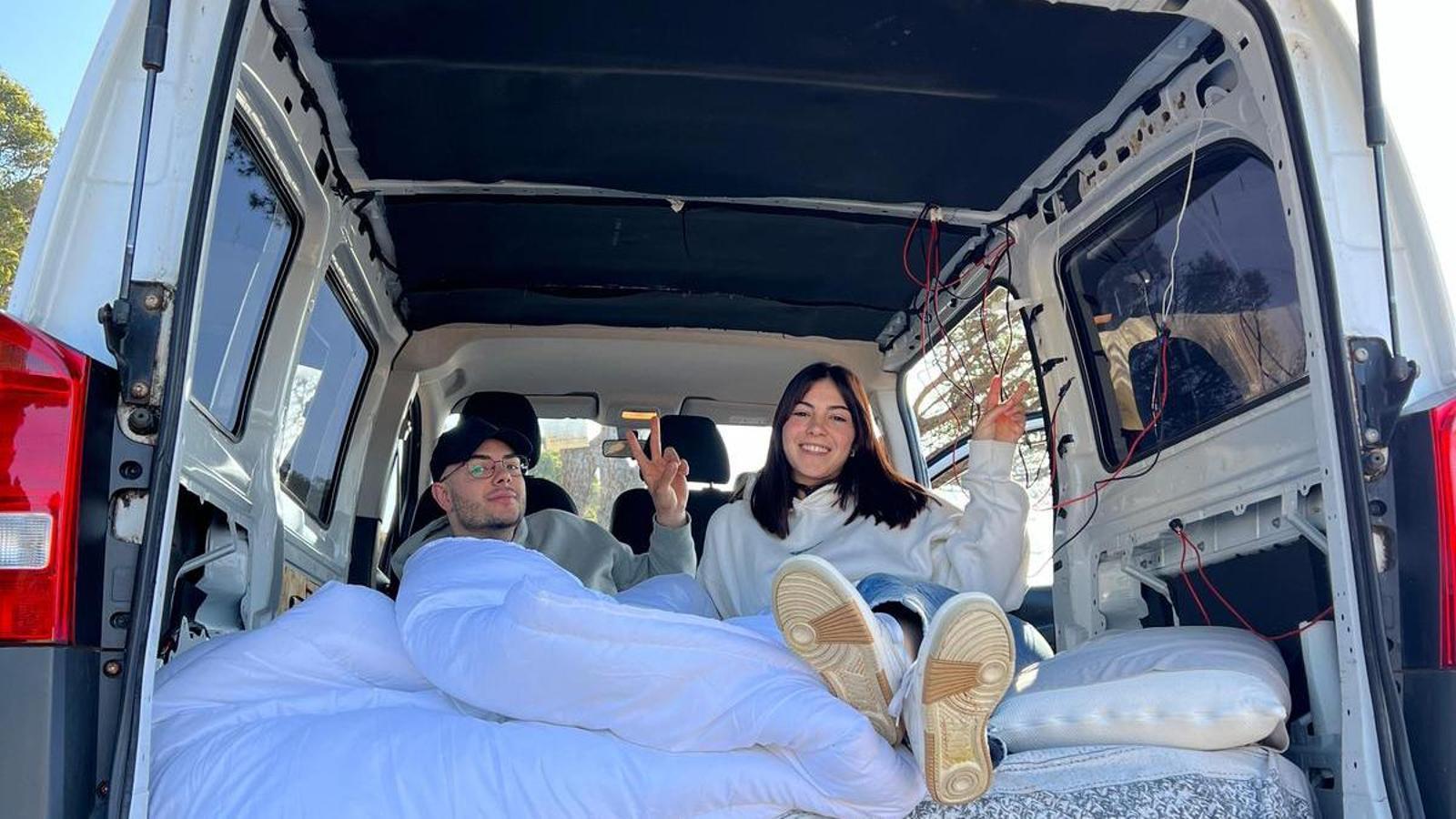
This is the case of Lydia Pérez and her partner. The two young people started converting a van so they could travel and go on getaways from time to time. In their case, they are doing everything themselves, using content from YouTube, Instagram, TikTok, and with the help of a friend who works in a camper conversion workshop. Even so, they will go to professionals to install a skylight: "We prefer to do it in a specialized workshop because you have to make a hole in the roof and everything has to be well connected to avoid rain water leaks," Pérez emphasizes.
What will you need on a daily basis?
If you are one of those who want to convert a van into a small mobile home, before you start it is important to ask yourself what you will need in your day-to-day life in the camper to be clear about what is worth investing more in. According to Blanca and Oscar, there are three essential elements that take more or less importance depending on each person's needs: light, water, and gas. For example, if you have an online job and during the trip you want to telework, you will need light and a good electrical connection: "The best option, and the one that gives more autonomy when traveling, is solar panels with a battery to charge your phone and a plug that can support your laptop," assures Oscar. You can also travel without solar panels, especially if the idea is to take short trips or weekend trips and not live in the van. If you want to take a long trip, it is advisable, according to Blanca, to invest "in a bigger van where you can stand up". Òscar points out that the most important thing is water, which runs out very quickly, and recommends having a tank to be able to shower and cook. "Around 60 liters would be fine, although we are making a custom one for the truck that will hold 700 liters," he emphasizes.And as for the shower, it doesn't need to be installed inside the vehicle: "We have bought a portable shower with a 25-liter tank. You connect it to the trunk, fill the tank, and you can shower," explains Pérez. MT Campers, a company dedicated, among other things, to camperization and vehicle homologation, recommends that larger vehicles opt for a tank "of at least 80 liters so as not to be short, but smaller ones with a 50 or even 20-liter tank are fine."
Camperizing a large vehicle like a truck is not the same as a van or a large car and does not require the same knowledge: "For a truck, everything has to be done artesanally, with large proportions, and a lot of knowledge and skills are needed that only professional workshops have," explains Òscar. In these cases, it is better to turn to professionals. Marc from MT Campers adds that trucks are easy to camperize "because the space is square and there is no danger of cutting any nerves, as could happen with vans due to their shapes."If a DIY camper conversion is done, it is important to be patient and prepared to face all the unforeseen events that may arise and that will prolong the process. "When it's something you do yourself, especially if it's something you've never done before, you have to start slowly to see, first, if you are capable of doing it, and second, if it will really be practical," points out Pérez. From his experience, he also recommends choosing suitable and quality materials: "For example, if you make a bed frame, buy wood that is resistant and can bear weight; otherwise, it is likely to break," he states. Marc from MT Campers adds that, if it is a small vehicle, you don't need to rack your brains too much: "Mainly, you need a second battery to connect the light, the small fridge, and the mobile phone when the engine is not running, a sofa bed or a wooden module to sleep in, and, above all, thermal and acoustic insulation."
