The rice restaurant in Barcelona that never closes and has served more than 1.5 million rice dishes in 25 years
At the Arrosseria Xàtiva there are rice dishes of all kinds, such as the authentic Valencian paella and the baked rice
-
CAT -
CAST
This began with Maria Antònia Ribera, a housewife with ambition, and with Aunt Nievecitas and her expertise in making Valencian rice dishes. Without these two women, we would not be here, 25 years later and with more than a million and a half rice dishes served. We are at the Arrosseria Xàtiva located in Les Corts, one of the three that Àlex López, son of the founder, has in Barcelona. The others are found in Gràcia and Sant Antoni. This year is a celebratory one because the rice restaurant that his mother founded a quarter of a century ago is marking its anniversary.
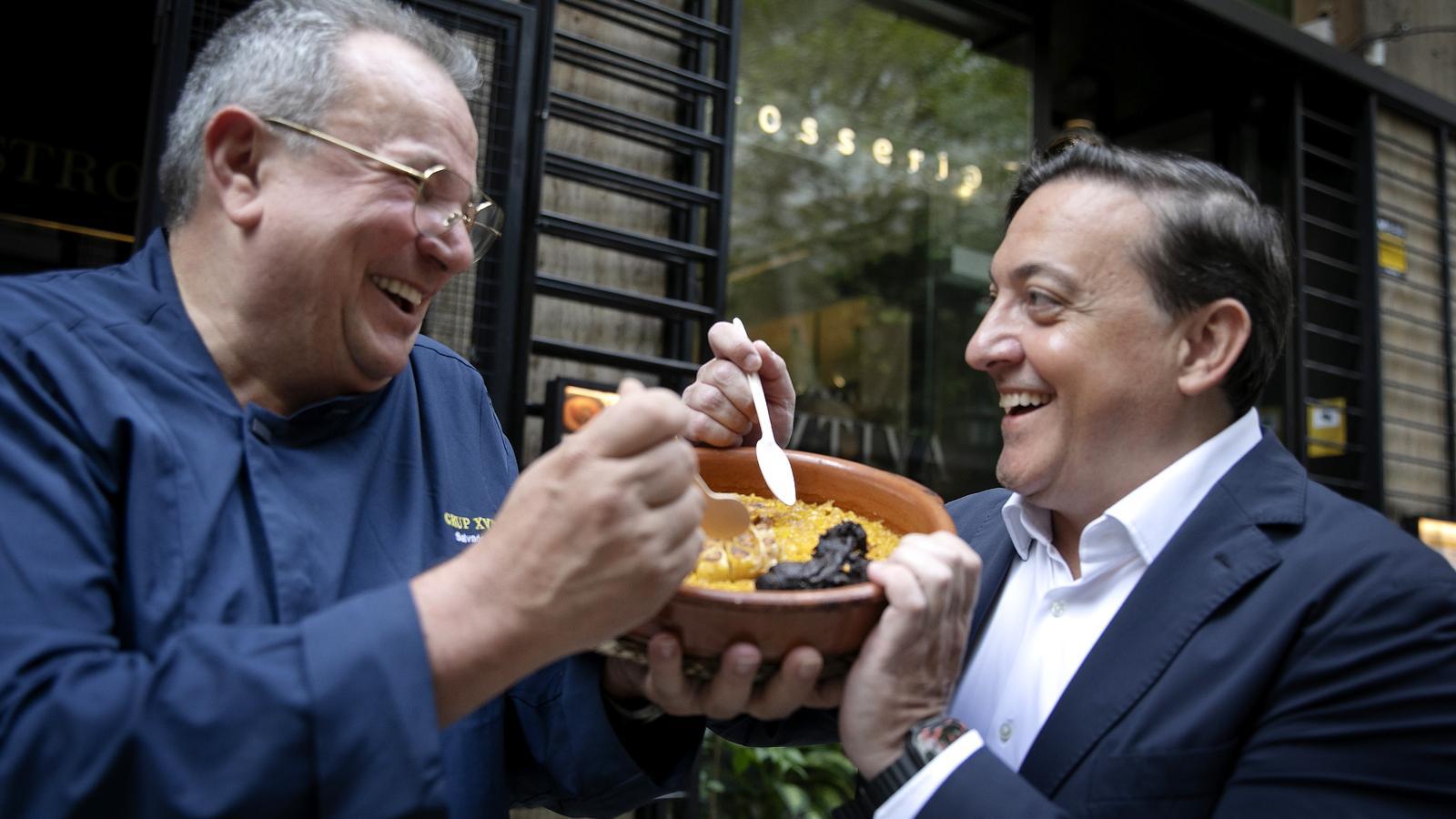
When I arrive, two proud gentlemen are leaving. They are wearing suits, they are work colleagues and they are happy to have been able to have a meal of these characteristics during the week. And the fact is, rice makes it a party. It can be a popular festival, a weekend with family, or the starting signal for a vacation, it doesn't matter. The fact is that for many people it is synonymous with good humor and company. Until, alas, you encounter atrocities like those served on the Rambla of Barcelona, which you wouldn't wish even on your worst enemy. Today we are in this place that has dignified the various rice preparations, of which there are many. We will find the classic Valencian paella, which the head chef, Salvador Martín, a true Valencian paella maker, ensures is the canonical one (with meat, butter beans, green beans...). But also a preparation very difficult to find outside of Xàtiva: baked rice.

I send the photo of the baked rice to a chef friend of mine who is from Xàtiva, and he gives it his approval. Meanwhile, Salvador is mixing the cloves of garlic and the blood sausage with the rest of the ingredients. “Do you know why it is called ‘passejat’ (walked) rice?”, he asks me. Well, because before (and now only partially) many people prepared it at home and took it to the bakery oven to be cooked. According to Salvador Martín, it turns out best in an oven with those characteristics. Salvador, however, is not a fan of closing doors to himself. And he shows me new creations that they have designed at the restaurant that are very successful. An example of this is the oxtail rice. And another, which the foreign public likes very much, is the one with octopus and shellfish. However, the one that has the most success is the ‘senyoret’ dry rice. If we add the fideuàs to it, you will find more than 25. If you go alone, or you like a preparation just for you, they prepare it individually as long as it is not Saturday at peak time, when they do not have burners available. But the possibility of going to this restaurant is infinite. Because attention: they never close. They offer non-stop cooking every day of the year. All 365. I ask Àlex about the classic debate on whether you can have rice for dinner. The restaurateur acknowledges that it might take a little longer to digest, but that there is no problem. In fact, foreigners do not even consider it. Along the same lines goes Miquel Pardo, chef of the year and known for his rice dishes. He serves rice at his two restaurants, Melós and CruiX, and argues that people eat pizza for dinner, which is just as hard or harder to digest, and they don't even think twice about it.
French fries at Camp Nou
Let's go back to the origins. Maria Antònia Ribera, a native of Barcelona, married Miquel Àngel López, a Valencian who made his professional career as a sports journalist. As a result, she opened three potato chip stalls inside the Camp Nou, an initiative that lasted a short time, but which proved that she was made for entrepreneurship. She began working in catering, until she ended up, in a meteoric rise, being the director of all the La Dorada restaurants and managing 800 employees. But what she wanted was to have her own establishment. So she worked in many places, and ended up opening a venue on Marimon passage. It was called Marimon, and it was located where the Coure is currently found. And then, later on, with all this background, she made her dream come true: in 2001 she opened the first Arrosseria Xàtiva. To learn how to master the art of rice, she relied on the expert hands of Aunt Nievecitas, from Xàtiva. She is the origin of this restaurant that is very clear about what it wants to be.
They offer weekday menus at a very good price that include a rice dish. It costs twenty euros. Eating à la carte costs between forty and sixty. They have a decent wine list with good wines but not particularly expensive. And some of their own wines that they have developed with Xavi Nolla, from Vins de la Memòria. And they take care of the details, such as the logo, in which the A of Xàtiva is upside down. You understand why, right? Àlex López, who besides being a restaurateur is a historian and journalist, explains to me that we will find the answer at the Almodí Museum in Xàtiva.
