"If only all houses were like this!": a place where neighbors are family
We enter the home of a group of children, in Barcelona and Cardedeu, to get to know what it is like to live in a housing cooperative
-
CAT -
CAST
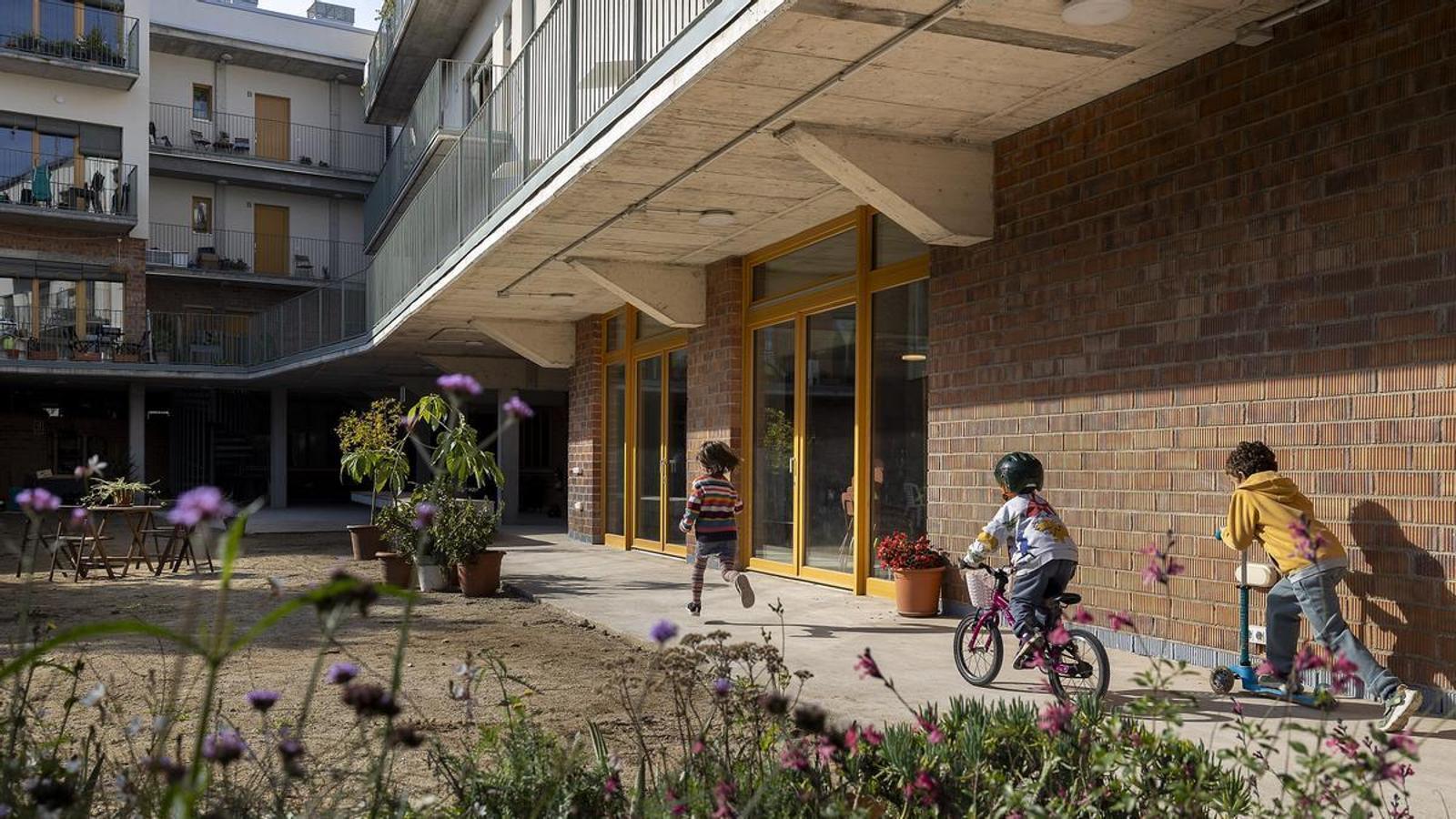
At the entrance of Cal Paler Nou, in Cardedeu, there is a weekly children's schedule hanging on the door. It is the formula found by the children who live there to know who to wait for and who not to each day when they go to school. "At 08:45 we have to be ready at the street door and that way we all go to school together, those who go to Can Manent go one way and those who go to Dolors Granés, another," explains Nuc, who admits that some days he is late.
This is one of the many new aspects of the day-to-day life of these children, who a few months ago filled a new cooperative housing development in the Vallesana town with life. This is because, as Eva Ortigosa from Sostre Cívic, the promoting entity of Cal Paler, explains, "cooperative housing makes possible, due to its way of functioning, a dynamic of internal self-organization that means child-rearing does not fall exclusively on the nuclear family, but rather formulas are sought that allow for the distribution of daily tasks." Going to and from school are an ideal situation to explain this distribution, although it is a practice that can also occur in other types of more conventional housing.
The formulas for sharing tasks and responsibilities do not arise only from the will of adults, but the older children also look for their own strategies to organize themselves. Beyond the entry schedule, Nahuel and Nuc, who are ten years old, also come up with collective solutions when they have a sudden need. For example, a rumble in the stomach that announces it is dinner time. They explain that sometimes the adults are late with meetings and assemblies and that, on occasion, they themselves have organized to make a meal. "We found them one evening at home – explains Nico, Nahuel's father – making themselves some omelets because they were hungry," they explain amidst laughter. "We also planned to wash the dishes, but Nuc had to be home at 9:30 PM," explains the little chef.
The magic of the Multipurpose Room
At Cal Paler, just like at La Balma, or La Borda in Barcelona, or La Raval in Manresa, among many others throughout Catalonia, the logic of the spaces is the same: decent housing for each living unit, and community spaces to share, grow, and take care of one another. The Multipurpose Room is, without a doubt, the space that all the children highlight with the most enthusiasm when asked what they like most about their home.
The reason is that their home is the entire building, or at least that is how they perceive it, because they have friends on every floor, toys in various spaces, and adult role models who, if they have any need, can help them find a solution. “Sometimes we don’t find each other, because one has gone out to look for the other using one staircase and the other using the other one,” explains Max, who also lives at Cal Paler.
The Multipurpose Room, as its name suggests, is a space that can have various uses, where meetings are generally held, but there is also space for play and even, in some developments, it is possible to cook there. It is one of the children's favorite spaces, as it is one of the places where they can play and at the same time share time and activities with adults: cooking, preparing parties and celebrations, or organizing tasks.
Alba Marín from the La Dinamo Foundation, one of the entities that also works to promote cooperative housing in right-to-use, explains that one of the things that families who have been living together for a few years highlight most is the degrees of autonomy that children gain living in an environment like this: "Common spaces also allow children to develop greater autonomy because the environment is known and trusted." She also points out as a differential element of the model "the possibility of generating stable bonds with other adults in the cooperative, who become references beyond the family core. This expands the children's affective and support networks."
The truth is that we can find this intergenerationality in practically all apartment blocks in any town or city, but what makes the establishment of bonds different is the processes when making decisions that affect the community, and these processes, in most of the cases we see of cooperative housing in right-to-use, begin before laying the first stone of the foundations.
Children from families that are part of a cooperative housing project can also be part of the processes, according to Marín. "The children's dimension can be incorporated at different stages of the project's development, especially in the architectural design, the definition of community spaces, and the elaboration of coexistence agreements," she points out.
Lleó, who is now seven years old, has lived in La Balma, in the Poblenou neighborhood of Barcelona, since he was two. La Balma is one of the first developments, along with La Borda in Sants, that introduced the cooperative housing model in right-of-use. He also insists that the best thing about his home is the multipurpose room, which his friends from school "go crazy" for when they visit. "I wish all houses were like this!" he says, because he knows that in most apartments, shared spaces like stairways, hallways, or rooftops are just transit areas, not places to enjoy. "We celebrate many birthdays here, because we let other neighbors in the area use our multipurpose room when they need to," he says.
It is at La Balma where Lleó and the other children who live there have also recently formed very tender bonds with an elderly couple who moved in, welcomed by their daughter, who had already been a member of the project since the beginning. "It's like having two more grandparents," they explain, because the role they have with the children is precisely one of familiarity. "They even grumble if they haven't seen the kids in a few days!" explain Alejandro and Mar, Lleó's parents, with a smile.
Agreements and disagreements
Aina, who is also a neighbor at Cal Paler, lived in Barcelona until a few months ago. For her, the move has meant many changes, she says: home, town, and school. This year she started second grade at one of the public schools in Cardedeu, just like her little brother, Biel, who is four years old. He and Guiu, who is three and also has a new home like them, cannot sit still, running up and down the property's patio. "Here we want to put a giant enclosed slide that makes a corkscrew," Aina explains, "and also a swimming pool, so we don't have to use fans in the summer," she says.
The pool, however, raises doubts among the rest of the kids, because they consider that they will only use it for a few months, and that for the rest of the year they will have to think of something to be able to make use of the space. While we are doing the interview, a brainstorm of very fun ideas emerges between Aina, Nuc, and Nahuel to cover the pool during the cold months. It is noticeable that they are accustomed to seeing meetings, exchanges of opinions, and finding agreements. "We also decided to build a pear-shaped treehouse, but right now, we don't have any trees in the patio," the youngest members of the community explain, a bit worried.
But what happens when there are problems? Leo's mother, Mar, explains that at La Balma, conflicts between children are resolved among themselves. "If they get angry, each one goes to their own home, and after a while, they look for each other again to make peace," she says. The children also do not usually generate coexistence conflicts with the adults, since the rules and agreements have been reached in advance and everyone knows the limits and conditions of use for the spaces.

Creative solutions
At Cal Paler, there is a good example of how cooperative housing, understood as a process of collective creation, can manage to resolve specific personal situations to accommodate the coexistence of all kinds of families. This is the case of Max, from the colleta (little group) of Nuc and Nahuel, who has his room divided between two dwellings within the same Cal Paler building. His parents separated years ago, and even though they lived on the same property, they had two separate dwellings and, therefore, Max had everything in duplicate. At Cal Paler, they have found the possibility of continuing to live in separate but contiguous houses, and connecting a single room to each person's dwelling. Thus, Max now has a single nest room, and he goes through one door or another depending on who he is staying with.
At La Borda, in Sants, the possibility of expanding or reducing the dimensions of the dwellings was also considered, according to the vital needs of the people living there. Needs are not the same when you have small children as when they have become independent, and being able to adapt a flat to this reality without moving must be feasible. The possibilities for adapting spaces, and the fact of generating such a close-knit community of care, make cooperative housing key to developing life projects. Ortigosa explains that they have seen how many women who had made the decision to be single mothers took the step once they were already part of a cooperative housing project. "If there is one thing this model gives you, it is stability and security, and when you have that covered is when you can develop your life project, not before," she says.
Adaptation and coexistence in cooperative housing are one of the differential facts of the model compared to other forms of community living. It is the group of neighbors who decide which needs the spaces must cover, and not the other way around, and this also means that differences are generated between one development and another. At La Borda, for example, it was decided to create a guest space, a room with its own bedroom and bathroom that is accessed from the multi-purpose room, which can be used by people coming to visit family or friends who live at La Borda. This saves space in the apartments, which no longer need to have a space to accommodate guests. At La Balma, a space was also created designed for care, so that when the neighbors get older and need special attention, they can receive it within the same building. At Cal Paler, they decided to have a soundproof rehearsal studio so as not to disturb anyone. The optimization of shared spaces means that homes can save space on things like washing machines, explains little Aina. “We have a room with five washing machines and when you need it, you go and use it; you don't need to have one at home taking up space!”, and she adds that it seems like a “super good” idea.
Every day can be a festival
Anyone who lives with children knows that their imagination is infinite and so is their energy. The newest little residents of Cardedeu, Guiu and Biel, often organize festivals at Cal Paler day in and day out, according to Olga and Joana, their respective mothers. “They connected from the very first moment, and at the beginning it was very difficult to get them to come home for dinner,” and they explain that they have now agreed on a schedule. Both of them really like giants, and in addition to the small rubber ones they have to play with, they improvise more solid structures with chairs that they make dance to the rhythm of imaginary gralles. Guiu’s eyes open wide when he explains that they also have fire beasts that spit fire from their molars, but Aina, who is a very sensible girl, explains in a low voice that they are making that up.
On the afternoon that ARA visits them, the kitchen of the multipurpose room at Cal Paler smells like broth. Since the pots in the community space are large, one of the neighbors left a pot simmering all day, under the intermittent surveillance of those using the coworking space. In the evening, the soup is ready, and the cook invites anyone who wants to take a container home: “Fresh broth for eighty!”, the children shout.
Cooperative housing in right-of-use is a way of living that is halfway between renting and buying. In this model, the ownership of the building is always collective (owned by a cooperative) and the members have the right to live there for life by paying an affordable monthly fee.
It is an alternative designed to guarantee the right to housing and prevent apartments from becoming a business or an object of speculation. According to data from the Llargavista Observatory, there are currently around thirty developments where cooperative members already live stably. If we add up the developments that are already inhabited, those under construction, and the established driving groups, the sector exceeds 70 projects across the country.
The apartments that are part of cooperative housing are free from speculation because they are not individual property. This means they cannot be sold or sublet, nor can they be passed on as an inheritance. The right-of-use has an expiration date, which is intended to cover at least the life of one generation, but the next will have to decide whether or not to continue being part of the project. If they do not, they will be disconnected from the housing and will not be able to exercise any rights over it.
