Marta Marín-Dòmine: "Will I see my friends and the people I love die? I prefer to go myself before"
Writer and researcher
-
CAT -
CAST
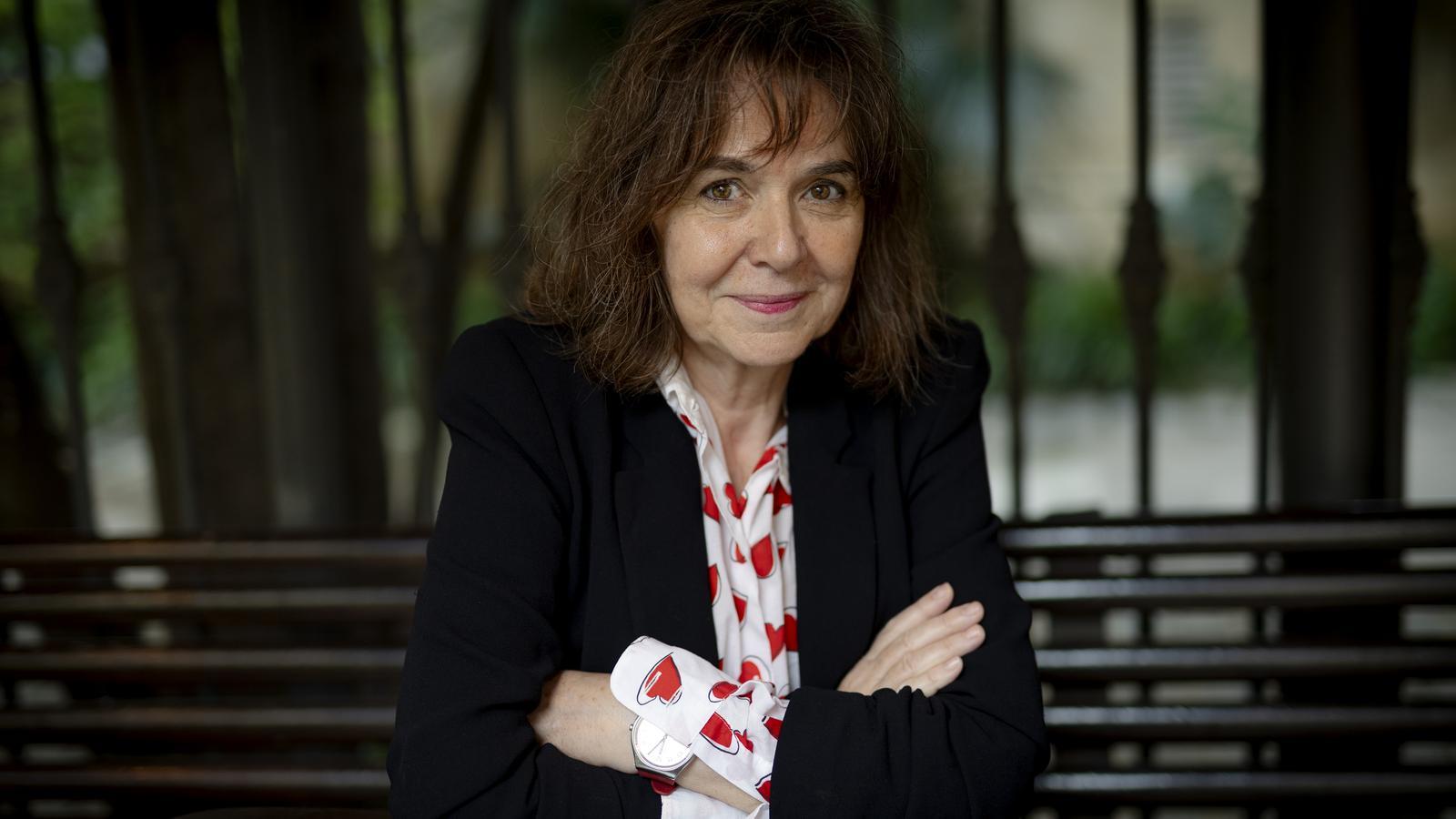
BarcelonaThe writer and researcher Marta Marín-Dòmine (Barcelona, 1959) debuts as a diarist with Una dona que passa (Club Editor). She retraces a year of her life, combining personal, political, and cultural reflections, from the memory of how she was dismissed as director of the Born Centre of Culture and Memory to a trip to Canada, the country where she had lived and worked for more than two decades, to recover a small part of the belongings she had left behind. In between, family memories appear, along with her relationship with some friends, constant contact with culture –from the books of Annie Ernaux to films like Barbie (Greta Gerwig, 2023) and the death of journalists such as Anna Pérez Pagès– and a concerned look at current political, social, and ecological events.
This diary covers an entire year, from September 2023 to September of the following year, based on the testimony of a “woman passing by”.
— The woman who passes through my book is a woman who wants to be invisible. I am already an old woman and I do not complain about any invisibility, nor about any visibility I had before.
The book mentions that George Sand already stated, in the 19th century, that for a woman to walk without being perceived allows one to experience an important sense of freedom. Under what circumstances can a woman manage to satisfy this aspiration?
— The value of this passing unnoticed has historically been masculine, because the masculine has been considered the universal, and I would like it to also be attributable to women, as other writers have already claimed before. I have a memory related to this that I have not included in the book. One day, while walking along the Portal de l’Àngel when I was about 18 years old, in front of me two thugs pounced on a lady and shouted at her: “Old woman!” At that moment I thought: how can old age be an insult? It has been difficult for us women to be able to go through with the naturalness of the body at all our ages, from when we are girls until maturity.
A woman passing by begins in September 2023. It was the same month I published I will say I made it up, which had won the BBVA-Sant Joan prize. It was a moment of reconnection with readers after the great reception of Running away was the most beautiful thing we had (Club Editor, 2019), but things did not go as I expected.
— When I presented I will say that I made it up I was already writing another book. I have always been very interested in the literature of the self. It was through this literature that I started reading diaries. I realized an obvious fact immediately: most are written by men, and in many cases few women appear in them. When they do appear, it is a bit for show. My intention was to do an exercise in which only women appeared: friends, writers, philosophers, neighbors, shopkeepers, the cleaning lady... Furthermore, I chose to write in the feminine, and it was very difficult for me because I did not want A woman passing by to be read as a manifesto.
It didn't seem like that to me. I read it as a journey into a mind that never stops questioning the world around it and stands up to it whenever it deems it necessary.
— It is written by a person who is not illustrious. Instead of showing the power of the illustrious, they want to explain the strength of everyday life.
The first upheaval she has to experience during the diary is professional. In September 2023, she was dismissed as director of the Born Centre of Culture and Memory.
— In less than half an hour I stopped directing the center. It was communicated to me in a meeting by the then head of Culture of the City Council [Xavier Marcé], when the councilor for Democratic Memory [Jordi Rabassa] should have dealt with it. There were people who told me that I could challenge the dismissal legally, but I no longer wanted to stay there. Shortly after, they offered me to take charge of the City Council's Memory Plan, and I said no, a bit out of nobility and also for ethical reasons.
He/she directed El Born for two years. He/she had returned to Barcelona due to the COVID-19 pandemic, after spending more than twenty years in Canada, where he/she had specialized in the study of memory from the university, had directed several documentaries and had translated into English K. L. Reich, by Joaquim Amat-Piniella.
— I had advanced my return because the university had made me offers to retire earlier. After some time being in Barcelona, I was offered the directorship of the Born and I accepted it. A central theme in my life has been the question of the idea of home. I had left Barcelona to check if far from here I could build my own space. So many years later I returned, with that irony of the saying “Travel the world and return to the Born”. After two years directing the center, I even considered whether I should go to Canada again. In the summer of 2024, I ended up traveling there.
The chronicle she makes in A woman passing by leaves the reader with a heavy heart. Firstly, she was surprised by the changes Toronto had experienced in just five years: the new neighborhoods, the growing presence of fentanyl... After seeing some of the friends she had there, she went to look for the suitcase where all that time she spent there was concentrated and had an unpleasant surprise.
— It was a painful return. I had to wait to get that suitcase back because the friend who was keeping it for me had caught covid and we couldn't see each other. The day we were finally able to meet we were wearing masks and she, when she gave me the suitcase, realized that everything inside was moldy because of a great storm that had flooded the basements.
All the past that that suitcase contained had been damaged.
— Absolutely everything. With one exception: a photo.
Summarizing twenty years of a life in just one photo must be difficult.
— Yes.
Do you have it in a privileged place in the house?
— Well, no. I am a disaster with objects. The day I went to get that suitcase was very sad. I had to throw away my past. And because of COVID, I could barely hug my friend. I could still tell even tougher things. During my time in Canada, I had been married to a Canadian, but we ended up divorcing. We had kept in touch. Because of the pandemic, I could only attend his funeral via Zoom.
A woman passing by condenses fragments of many vital stages. She explains that, when she was very young, she had lived on a rooftop on Joaquín Costa street.
— I lived in one of those appendages that were built on the rooftops of some estates. At that time I must have already been studying Catalan philology. I used to hang out with anarchist circles back then. I remember that a little earlier, on Saint George's Day, we would meet at the Liceu and walk down the Rambla with a bunch of artichokes. It was our way of laughing at roses, which seemed to us like a bourgeois symbol.
Since she was little, her favorite game was to go on a trip to another country.
— I had a conflict with the feeling of belonging. My father did too. I was not comfortable here for political reasons. My mother, on the other hand, who was the one who authentically came from a foreign family, was fascinated by Barcelona.
They were from a family in the El Clot neighborhood where they gave just the right amount of gifts and aspired to be “a little well-off,” to “be able to afford some extra once a year.” “Waiting is characteristic of modest people. For others, possessing has made waiting unnecessary,” they write in the book.
— Culture allowed me to reach the position of a university person and to publish. One of the things that gratifies me most about writing is being a little ant that speaks for those who are not seen.
A woman passing by explains the Sant Jordi she experienced with the book I will say I made it up. The days prior, she participated in a collective photo with all the award-winning writers that year which unsettled her.
— Everyone was posing for the photo, putting on their best face, and a very well-known author who was next to me said: "You've only been back for four days and you won't stop winning awards." The only thing I could think to reply with was irony, because she is someone truly very well-recognized: "Well, you can imagine that I have many favorites." Not only did she not understand the humor, but she was even offended. I left that photo with an anxiety attack. A few months had passed since I had been removed from the Born, I wasn't exactly going through my best moment of health either, I was waiting for a diagnosis...
You explain yourself how they had “devalued” you professionally. At 64 years old you found yourself for the first time queuing at the employment office.
— It was an uncomfortable moment, but it wasn't a tragedy either. It didn't take me long to start working as a freelancer, and I continue at that point. I write, I work, and I am lucky to have many friends. There are some very young ones, with whom I have many points in common, and others who are my age.
In the diary, one of these friends suffers from a serious infection and is admitted to the hospital. It makes you worry to think that she might not make it.
— Going to see my friend, walking with her and observing that city within the city that is a hospital led me to ask myself one of the questions that I have been pondering as I grew older: will I see my friends and the people I love die? I prefer to go first.
