What are forest schools? A rising model
Despite the logistical and economic difficulties, more and more families are opting for this type of education, which enhances physical and socio-emotional capacities
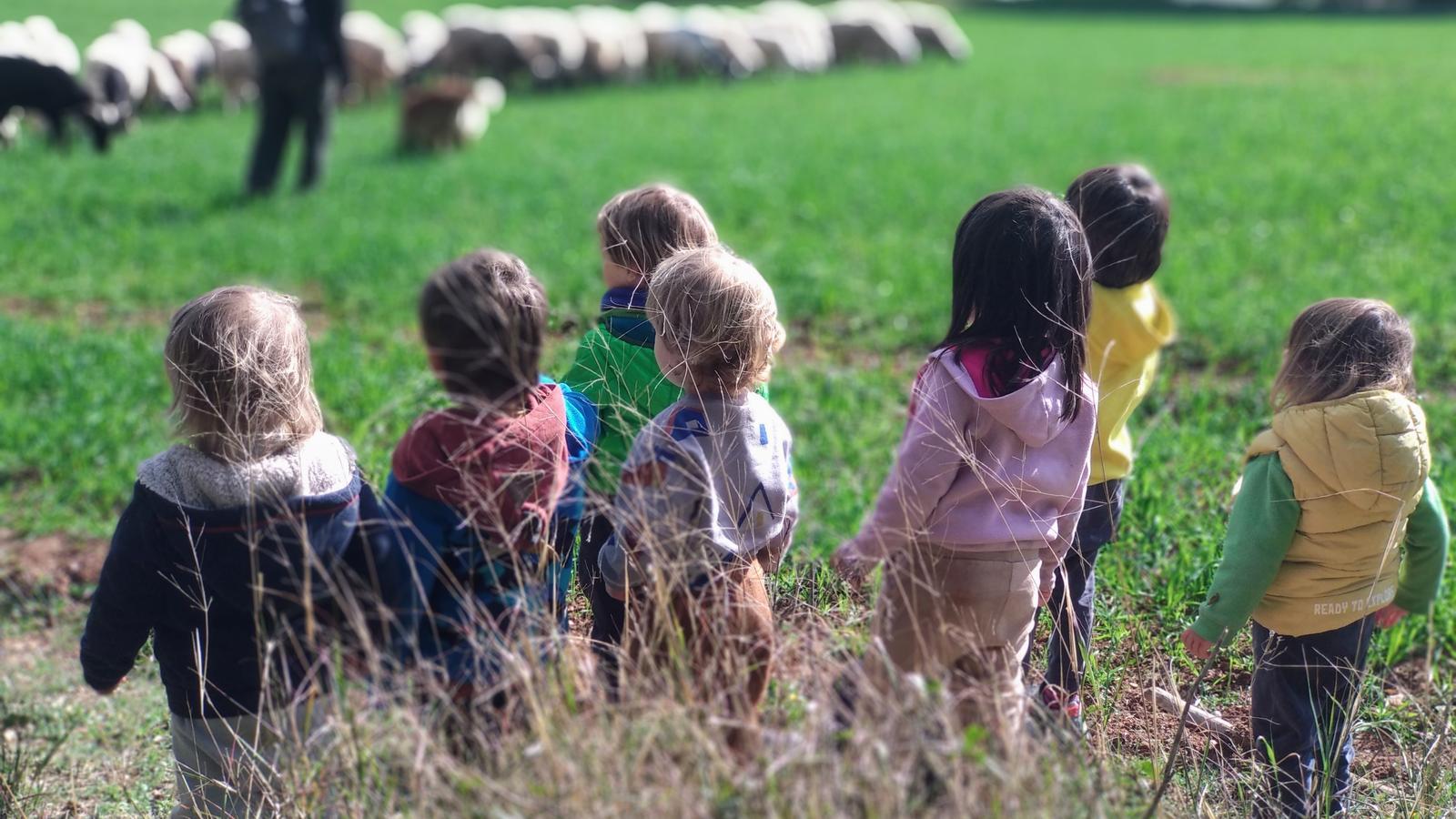
-
CAT -
CAST
Maria Castellana has a very special relationship with nature. From a very young age, she would spend her summers at a campsite, spending her days barefoot in the forest or on the beach. Perhaps that is why she developed a sensitivity that led her, as an anthropologist, to work on projects for the protection of endangered species. Later on, she made the leap into education, and her first job as a teacher was at a school where she would go out into nature with the children two days a week. At that time, she discovered La Moixaina, a project of living education for the early childhood stage where the school schedule was outdoors every day. "It made a huge impact on me," she admits. It was a type of education that was starting to arrive in Catalonia: forest schools.
The first forest school as we know them now was founded in Denmark by Ella Flatau in the middle of the last century. “In the Nordic countries there was already a philosophy of making the most of the outdoors, and what she did was not seen as so crazy,” explains Maria. In fact, among all these previous projects, in our country we find the Rosa Sensat Forest School from 1914, which already held most of its classes in nature to improve children's health, and which still exists.
The Flatau model moved to the United Kingdom, where it gained momentum and began to be considered as an alternative included within the educational system. It was precisely in England where Maria, who had already founded her own nursery school project in Vallgorguina, trained in 2018 and from where, together with other pioneers, she imported the model to Catalonia.
Beyond taking advantage of the natural environment, forest school is based, like living school, on generating participatory learning based on the interests and needs of children, which change and are different in each one. This work promotes autonomy and responsibility, two essential skills for working on risk management outdoors, which does not mean avoiding danger or discomfort, but learning to live with it. “Danger is there when you don’t know it,” Maria opines. “When you know what can happen and what you have to do, you can manage it. Our children know what is safe and what is not.”
A model not included in the public system
Another characteristic of forest schools is "holistic development", that is, not working by differentiated areas. A way of working very similar to the most essential project-based pedagogy. This makes it very difficult for forest schools to work during school hours, since legal regulation does not include this model. In fact, most forest schools only work with preschool, which is a non-compulsory stage. Or, as in the case of Maria's current forest school, La Ginesta, they operate with a weekend offer that complements the ordinary school.
The regulations make homologation very complicated and make it difficult for this type of school to exist in compulsory education, an adversity that other models, such as the Waldorf school, have also encountered. In fact, Maria complains that there are many requirements and that "a lot of paperwork" is requested, but she believes that "if the Department of Education supported this type of school there would be many more, because many teachers come disillusioned with the system".

The other great difficulty, obviously, is the economic one. Forest schools are currently sustained in a totally private manner and families have to finance everything. “There are people who have to have two jobs to pay for it,” states Maria. The same is said by her colleague at La Ginesta, Laia Petra, who together with two more educators in 2023 launched a project during school hours in Palautordera called La Molsa. Laia acknowledges that they work many hours and that the economic earnings are very low. “We would have to set very high fees, but we do not want it to be such an elitist offer,” she reflects. An opinion with which Dèlia, a mother from the school, agrees: “If the educators were well remunerated, we families would have to pay even more”.
The benefits
Spending the day in the open air, with natural light and purer air, and getting used to the different temperatures of the year makes the body healthier. “Children who go to forest school from Monday to Friday almost never get sick,” says Maria. That is why adapting to the weather every day is very important. When it rains, for example, forest schools do not avoid the outdoors, but instead wrap up warmly with boots and raincoats.
Both Dèlia and Xavi, another parent from La Molsa, agree on the great advantages that the forest school has had on their children's development. “It puts you to the test as a family in terms of trusting that everything will be fine, and they have to take a bath because they come home covered in mud up to their eyebrows –confesses Xavi–. But you see how they arrive with a smile every day, and that is priceless”.
Families and professionals consider that the results are not only reflected in the children's physical capabilities and motor skills and their knowledge about nature, but they are also convinced that when they finish they are fully prepared to take the step to primary school. In this sense, Maria adds that they are children with a lot of self-esteem because “they have been able to try things and are responsible”.
Dèlia explains that it is possible for a boy or girl to reach the last year without knowing how to write their name. However, this does not mean that they will not be capable of it. Adapting to the learning and development rhythm of each child ensures that, when the moment arrives, learning can be faster and more fluid. That is why the forest school ratios are very important, as they are lower, allowing for better support of children in their interests and moments.
On the other hand, Xavi, who already has a son in a public primary school, believes that forest school prepares children well, because there are also conflicts and hostilities but the educators accompany them and experience it. “Nature allows them to get to know themselves better and to listen to themselves,” says this father, who has two children who have gone through this methodology.
Family profile
Both Xavi's family and Dèlia's family are from Barcelona, and after spending time in Terrassa and Sant Celoni, respectively, they arrived in Palautordera. However, and despite the fact that the towns in the Montseny area have grown in recent years, Dèlia confirms that there are also many families from the school who have always lived in the area.
Regarding the employment situation, Dèlia and her partner are secondary and vocational training teachers. In the case of Xavi and his partner, since becoming parents, they have changed jobs. He requested a leave of absence from his job as a nursing and pharmacy assistant to become a therapist for children, adolescents, and families, and she has started working as a doula, that is, accompanying other women through the process of pregnancy, childbirth, and the early days of a baby's life. “Being involved in projects like these where care and the child are at the center makes you think differently and open your mind,” he says.
However, at La Molsa there are family profiles with all kinds of professions. Laia insists: “We have teachers, educators, and pedagogues, but also chemists, doctors, engineers, firefighters, tour guides, circus artists, police officers…” The common thread, says Xavi, is the “outlook on life, of taking great care of childhood, especially up to 6 or 7 years old”. Environmental awareness is also one. “Everything is very well taken care of: at birthdays, instead of sweets, there are nuts”.
In any case, families do need to have the ability to adapt to the schedule from 9:30 AM to 2:30 PM and to the fact that the forest school is itinerant. This means that the school has several locations that it alternates throughout the week. Families explain that they coordinate to drop off and pick up the children. "There is a lot of solidarity and bonding between us and with the people who accompany, as well as many gatherings," says Xavi. And he adds: "It requires more presence and it might seem like a difficulty, but for me, it is a benefit. It is very beautiful and it makes us more present".
Forest schools in primary education?
Another advantage of forest school is that self-regulation is much more fluid, because there is much more space. Naturally, children choose to do things alone or together if they need to. "There are many resources, so they don't need to compete to have them and they connect with the idea that life is abundant," says Maria. "Furthermore, it encourages cooperation and communication, because there are more situations where they need to collaborate, such as when they build a hut." In fact, she narrates the case of children from mainstream schools who are problematic in class and who, when doing a forest school activity, have shown much more concentration and presence.
These characteristics, together with the benefits of resilience and creativity that help with concentration, encourage considering the expansion of the forest school model during school hours into primary education. Xavi, for example, says that if it were included in the public offering, he would go for it without hesitation. Dèlia, on the other hand, qualifies: “Our son currently lives in a bubble and we don't want that to be prolonged. We believe in public school, so we will try to ensure he can continue doing forest school as an extracurricular activity, but that he remains in contact with the reality of the world, which is very diverse.”
Beyond the fact that it is not possible today due to regulatory issues, everyone agrees that the model would need an age-appropriate adaptation. “There are learnings that need to be sat down and systematized,” Maria acknowledges. In any case, this does not mean that the model is not compatible with the compulsory stage, says Laia, who points out: “Learnings can come in many ways that are not books and blackboards, sitting in a chair.”
Currently, both Laia and Maria offer forest school training for other teachers and educators. For this reason, they consider it great news nowadays that many educational centers are including the vision and philosophy of the forest school in part of their pedagogical proposal. For example, there are schools that take children into nature once a week. However, Maria concludes: “I hope that one day a network of forest schools or centers with this philosophy can be created in Catalonia or Spain”.

