Néstor Rego: We have been experiencing decades of fiscal plunder in Galicia
BNG candidate for the general elections of 29-N

-
CAT -
CAST
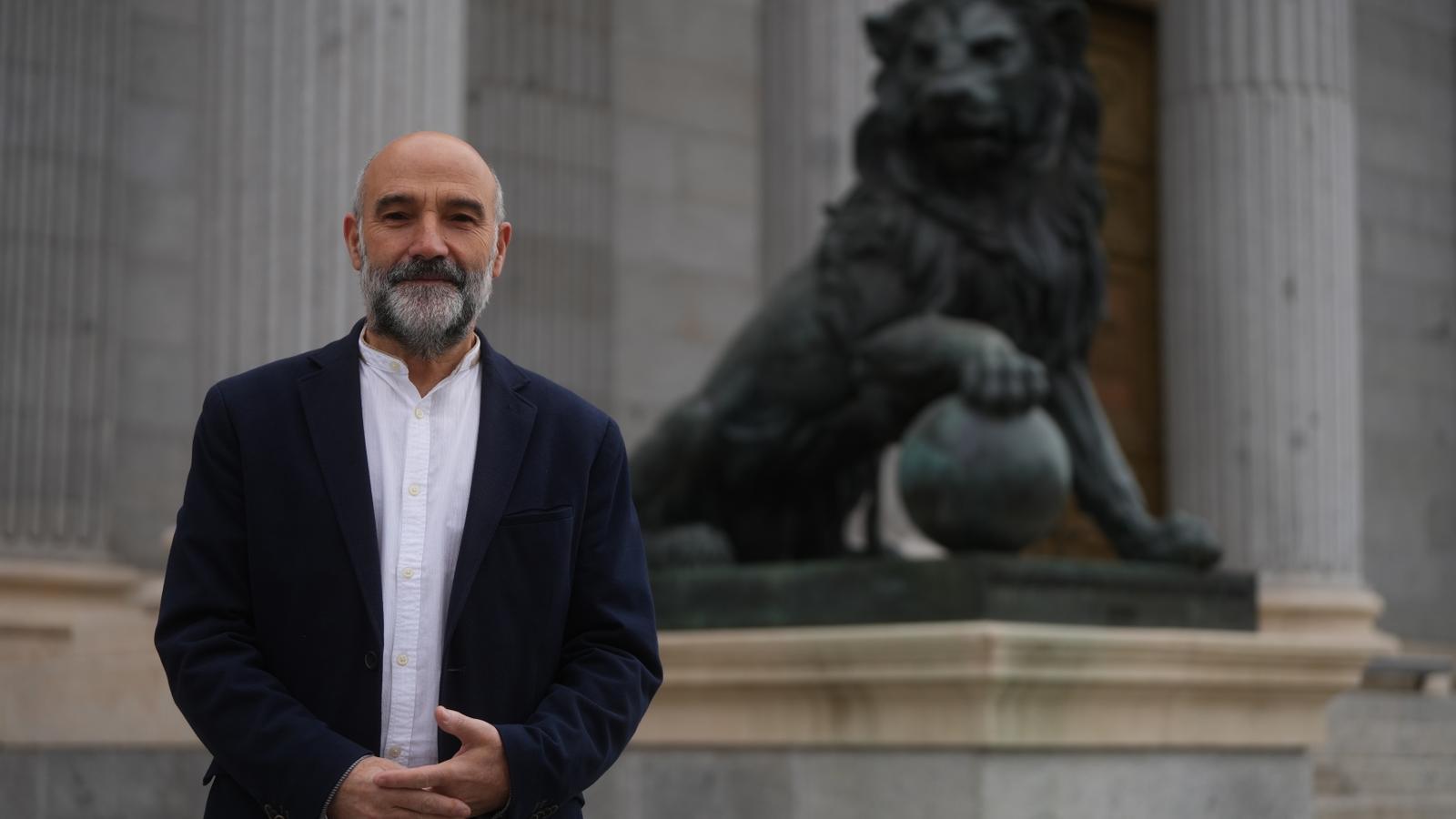
MadridNéstor Rego (Vicedo, Lugo, 1962) has been a BNG deputy in Congress since December 2019. He is once again leading the list for the Galician nationalists ahead of November 29th, with the certainty that the party will grow and the hope that it will have more leverage to pressure the PSOE. He prides himself on the fact that they never signed a legislative agreement with Pedro Sánchez and recalls that they voted against, for example, the labor reform, the housing law, or the democratic memory law.
How do you assess the resignation of Óscar Puente? Do you think it came late?
— He did it at the right time. In the first few days, we did not speak of resignation because we understood that the priority had to be to attend to the victims. Once that happens, it was inevitable to assume political responsibilities. But there must be an in-depth investigation, urgent and effective measures must be implemented to improve railway safety, and the reversal of the privatization process must be evaluated.
What is your assessment of the Spanish legislative term?
— A legislature with ups and downs. There have been some advances, but it is also true that there have been other measures that have been left up in the air as a result of the early election. Unfortunately, the tone of this government is that it always leaves things half-done or fails to meet part of its commitments, and this generates disappointment in its own electorate. That is why it is important to tell the people who trusted in the PSOE or Sumar that the solution can never be to stay at home.
Has the BNG ever considered breaking the relationship with the PSOE?
— There were many moments of tension in which, indeed, these types of issues were on the table. Especially when you see that there are breaches that have no political justification, which are simply a matter of will. We know that the PSOE does not move if you do not force it to move. We did not have the capacity [with one deputy] to permanently condition the majorities. This is now our goal: we aspire to a representation that allows us to have more weight.
Do you have the feeling that the Moncloa has looked more towards Junts than at the left-wing parties?
— I understand that, from their position of seeking support, they had to speak with everyone. Probably, the difference lies in the fact that the sovereignist political forces in Catalonia have played their cards differently. It is evident that there were issues that could have moved further to the left. Although it is true that the PSOE lost many good opportunities to advance socially when it had enough majority to be able to do so in the last legislature.

What do you think of the new financing model that the PSOE and ERC agreed upon?
— We had no doubt about presenting an amendment to the totality because it is a model that not only does not change the common regime system, which is very harmful for Galicia, but actually makes it worse because it lowers parameters such as population dispersion or aging. We oppose it with all determination and defend an economic agreement model.
But is it feasible to achieve it?
— Everything will depend on the strength that the BNG can have. In 2024, the State collected 17 billion in Galicia and returned 10 billion. It is evident that it would benefit us enormously. It would not be a privilege, it would be a matter of justice. We have suffered many decades of fiscal plunder of our country. Therefore, it would mean putting an end to a historical discrimination that has no justification whatsoever.
In Catalonia, the slogan Spain is robbing us gained traction. Do you share this view in the case of Galicia?
— It is the reality. We prefer to be didactic about what it means. Indeed, the Spanish state appropriates a very important part of the taxes that we Galicians pay. We do not live because there is a flow of resources that come from Spain's solidarity, the flow goes in the opposite direction.
The BNG is also in favor of the transfer of immigration powers to Galicia. Do you understand the misgivings of Podemos regarding the law promoted by Junts?
— It is only justified from an absolutely centralist and Spanish nationalist position and cannot be justified from a supposedly progressive position. Saying that they oppose Catalonia having powers because Junts wants to use them for regressive measures regarding immigration is absurd. It does not hold up when it is evident that the possibility of there being a Popular Party and Vox government that implements much more regressive measures is much closer. Deep down, there is a centralist impulse that leads to defending these types of issues disguised as the defense of human rights. But no.
What did you think of the movements to the left of the PSOE?
— We saw it from a distance. Because the reality is that in Galicia this space is very diminished [neither Sumar nor Podemos have representation in the Galician parliament] and the BNG has a very solid position and it is possible that we could head an alternative government [there are elections next year]. The whole spectacle previously given by the Spanish left I think says very little about it and, above all, I think it discourages many people.

Do you believe that in Galicia the Broad Front and Podemos should have refrained from running?
— We will not tell anyone whether they can or cannot run, but it is evident that if there are political forces saying the priority is to stop the reactionary bloc, the logical thing is for them to act accordingly. Let them be a little consistent and contribute to it.
Was an alliance of the BNG with other left-wing parties, such as Bildu or Esquerra, viable?
— From the beginning it was clear that we would not form any coalition. It was about the BNG being able to run without any element that could condition it as what it is: a sovereignist force that defends the interests of Galicia.
