Santiago Gerchunoff: "Before children were had while a thousand other things were done and now they are projects that are on the same list as doing a doctorate or a trip to India"
Philosopher, professor and writer
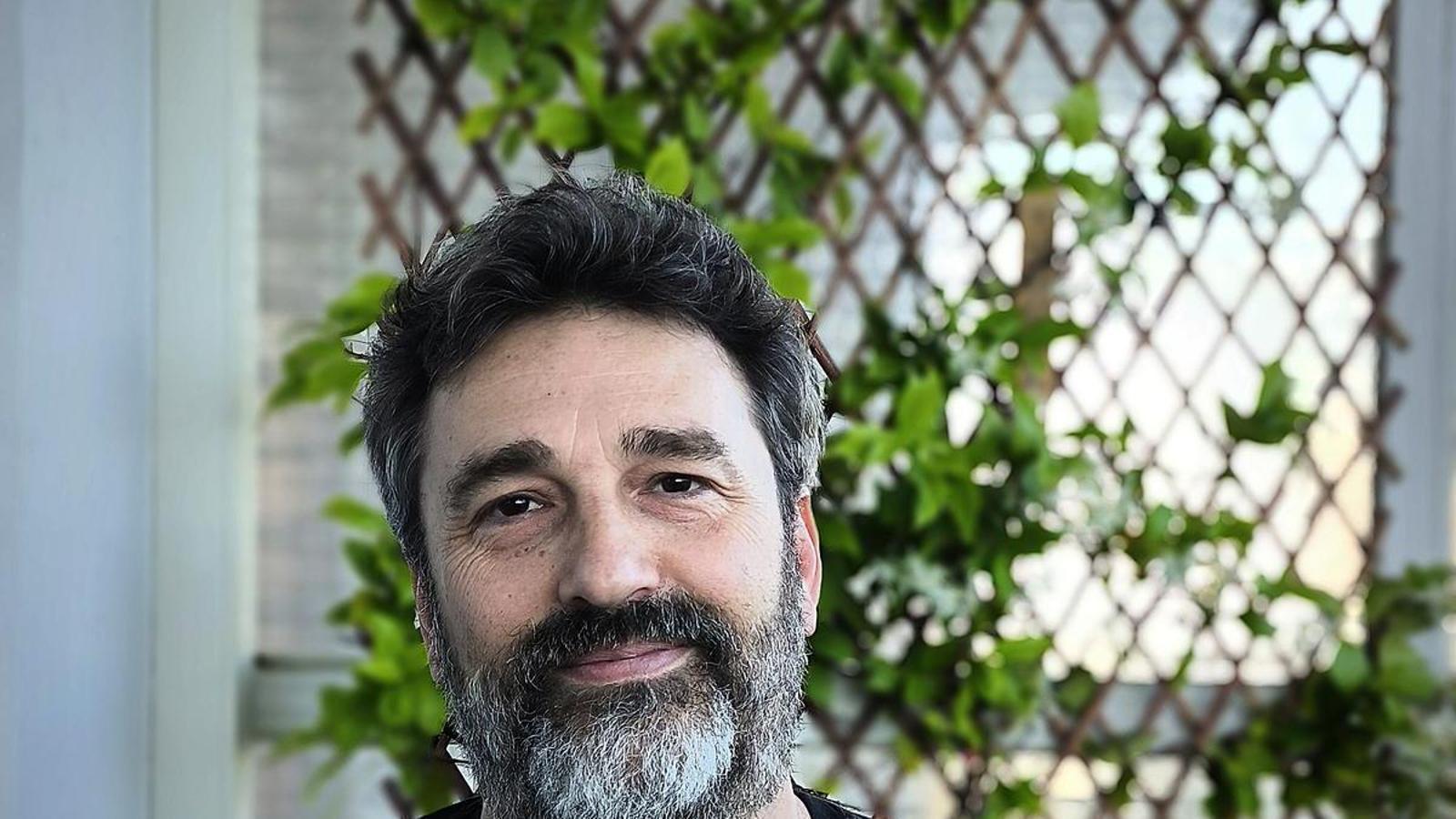

Among the thousands of books and parenting manuals that currently fill bookstores, we come across the brief essay En la era de los niños cosa:Ensayos contra la crianza como emprendimiento, by Santiago Gerchunoff (Buenos Aires, 1977), where the philosopher, writer, and university and high school professor dissects current parenting and how it has become professionalized to the point that children have become objects to be improved. The book is a collection of short essays he wrote some time ago while raising his daughters, who are now 13 and 19 years old, readapted with a common thread: the concept of thing-children.What are thing children?
— Summarize this idea of raising a child as a passive object – which we believe is ours – and not as a subject. There are experts who know how it works, we can add or remove things from it, as if the child were a Meccano that we have to assemble with a previous manual that works if the pieces are placed in a certain way.
When children just come without a manual.
— Studying the theory and then applying it doesn't work, you make your way by walking and you learn to play the flute by playing it, and raising children is where practice is given its maximum degree. When you are raising your children, you learn while doing it.
But we are at a time when more parenting books are being published.
— It is very symptomatic of what I talk about and criticize in the book, and I include myself in it. The current way of raising children includes all of us parents, we cannot escape it. And it has to do with something positive, which is that we love our children and want to do it well. We think of having children so much as a project, it is such a voluntary action that it then paves the way for manuals and courses to be sold to us to do it better. Everything is crossed by the market, but added to this is the loneliness in which we raise children today: where is my tribe? Today, couples and single-parent families raise children very much alone without having any idea and without the support of grandparents, cousins, or aunts/uncles. Before, we also didn't know how to raise children, but now loneliness is added and we are the perfect prey for manuals.
You speak of the child as a project and of upbringing as entrepreneurship. What are the symptoms?
— Before, children were had while we lived our lives and did a thousand other things, and now they are projects that we consciously choose and that are, in the crudest sense, on the list of projects we embark on along with getting a doctorate, buying a car, taking a trip to India... and having a child. Now we reserve a part of our lives for raising them, and before attention was more divided, and therefore, children were freer. And once a child is a project within this individualistic and liberal logic, we want to develop it in its best version, and we dedicate ourselves to this task. And a child is something very different from an object.
In one of the essays you talk about families' participation in school and you say they should participate less.
— Parents have invaded the school grounds and what is curious is that the school was born as the opposite, as a space where the family is not involved, where there are no hierarchies or ideologies that we can inherit from home. The idea of public school is that it is a space that frees them from family particularities. It is the embryo of the future public space. And this eagerness to participate, this demand from the school for families to get involved and participate, is a new submission of children. In general, today children have practically no blind spots where parents do not see what they are doing and can exercise their autonomy. There is such a level of control that the child's entire space is invaded by the presence of mothers and fathers.
Does it translate into a loss of pedagogical authority for teachers?
— Yes, today the authority of education professionals is questioned because parents have interfered. There is the idea that education could be organized by parents. And the idea of school is the opposite, to recognize that there are other authorities, school is to go out into the world and grow up. Parents' WhatsApp groups are surveillance instruments where all gossip circulates, children no longer even have their own gossip spaces.
How did we get here?
— The reasons are very deep and it is the last stage of individualism that has completely invaded our lives, including parenting. People make a space in their lives to have a child, for a project that truly fulfills them, and if you have one like that, you believe you have to dedicate yourself completely to the child. The era of child-centric also is very much marked by this. You see it at birthday parties. Before, they were an opportunity for children to be entertained, and now they are invaded by parents, and whoever doesn't go to the party seems to be a bad father or a bad mother. It seems you have to invest all the time you have in the child's upbringing and supervision.
We all want autonomous children, but we have them hyper-vigilated and geolocated.
— In the book I make a politically incorrect praise of skipping school, of not going to school. This is now impossible because as a teacher when I take attendance and mark an absence, the parent's mobile phone rings and they know about it. I'm not encouraging them to skip school, what I mean is that with this control there is no room for transgressions. And now children have moved the transgression to their mobile phones or tablets, where we can control them less, although they can't talk to their friends there without supervision either. The lack of space without the gaze of parents that children have today is a serious problem. And here technology has found a loophole, I see it in young parents today, who have all sorts of technological gadgets to control the child's optimal state, as if it were an object, a Tamagotchi baby.
How should child-rearing be? What can we do about it?
— I refrain from giving instructions. The child is trapped in this fantasy of hypercontrol. What I miss from before is a bit more unconsciousness and spontaneity and less attention. We must accept uncertainty more, we cannot control how our children will be. But I repeat, all these problems are the result of good intentions and love.
You also make a critique of certain children's literature.
— There is an invasion of educational and edifying content in children's literature. Parents or educators who ask for books to work on jealousy, fear, grief..., as if books were tools to insert an emotion. It seems that all fiction books are educational manuals that have to serve a purpose, and thus you kill the taste for reading. Before, reading was an escape route, and now it has been relegated to homework; and how can a child be interested if it is just another thing they are forced to do?

