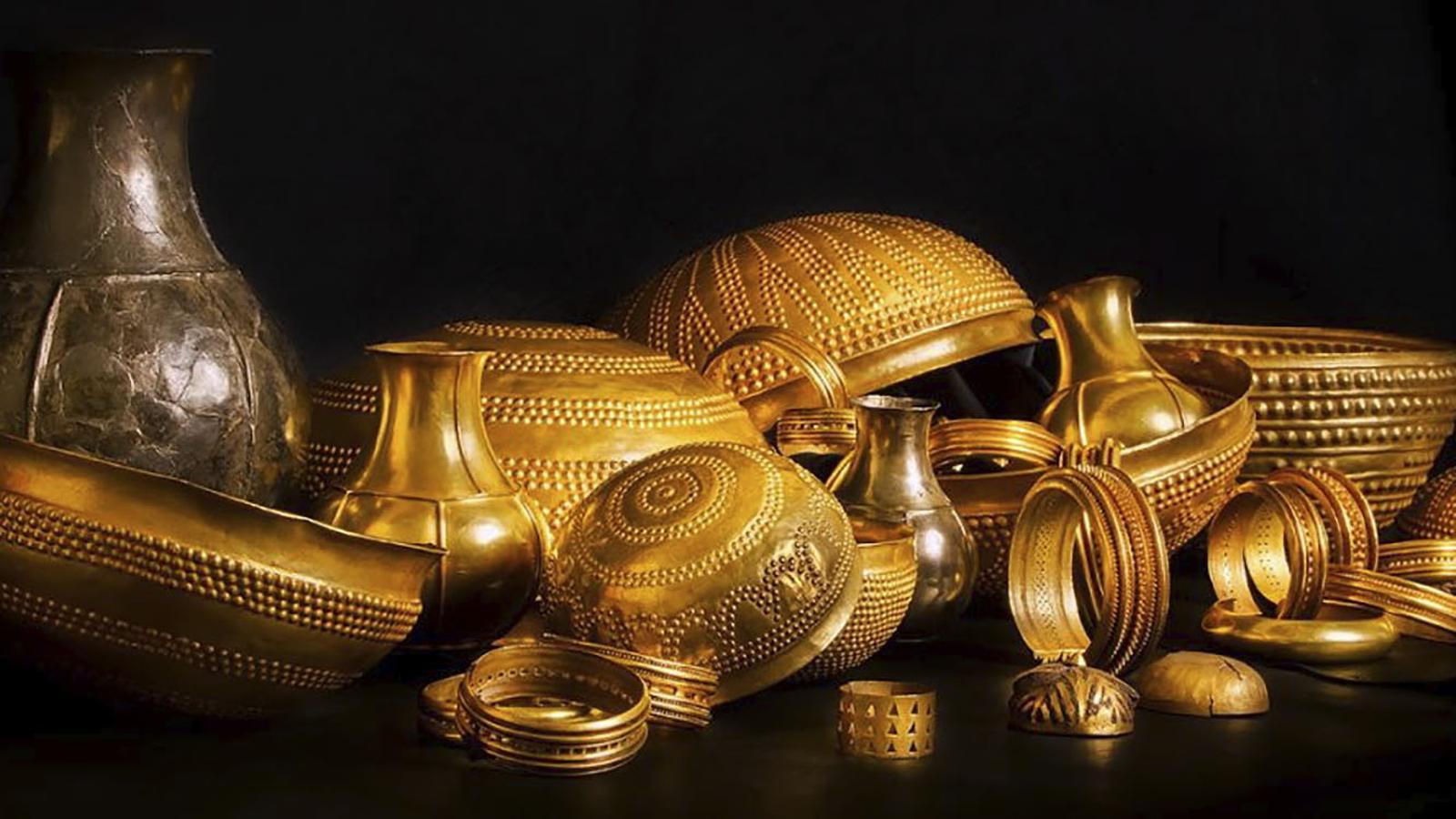
Villena's treasure is stolen, one of the most valuable of the Bronze Age
The thieves took it at dawn from the Archaeological Museum of Villena, in L'Alt Vinalopó

-
CAT -
CAST
BarcelonaThis morning the Villena treasure, one of the most valuable Bronze Age sets in Europe, was stolen from the Archaeological Museum of Villena (Alt Vinalopó). "We are absolutely devastated —Fulgencio Cerdán, the mayor of the municipality, has admitted, in tears—. For all of us from Villena, this robbery destroys us. They have taken part of our heritage, our wealth, and our pride. I want to convey all my support to the citizens, who must be going through as bad a time as I am".
The Civil Guard and the Judicial Police are already investigating the robbery. The museum alarm sounded at 5:20 a.m. By 5:24 a.m., the robbery had already been consummated and there was no one in the museum. Before that, at 5:16 a.m., the alarm at the Villena sports center had gone off, likely to divert the police's attention. Regarding how the thieves accessed the premises, the City Council dismisses the possibility that they entered through the windows, as they are armored. "It all happened very quickly —the mayor acknowledged—. Although the local police and the Civil Guard acted very quickly, they were not in time to stop the thieves, who left in two vehicles".
A set of highly valuable goldsmithing
The Villena Treasure is a set of goldsmithing dated around 1000 BC, mainly made of gold pieces and valued at 1.7 million euros. Among other items, it includes 11 bowls, 28 bracelets, and three bottles; it also comprises three silver bottles, two mixed amber and gold pieces, another of iron and gold, and a final iron bracelet. According to the museum's website, it is considered the most important set of golden tableware from the Bronze Age, alongside the treasures from the royal tombs of Mycenae, Greece. "The thieves have taken a good part of the treasure —comments Fulgencio Cerdán, the mayor of Villena—. Only the three silver vessels, one bracelet, and part of the ornamentation of the young king's scepter that guards the treasure remain." Of the four crowns belonging to the Virgin of Virtues of Villena and the Child, only one remains, that of the Child. "We believe the thieves dropped it in their haste," admits the mayor. On the contrary, the so-called little treasure —made up of trousseau pieces— is intact, as is the "earring," which remains in its display case, "intact." The earring, from the 6th century BC, is a circular gold pendant decorated with openwork filigree, in the shape of a cross, which is considered a "symbol" of the locality.
The archaeologist José María Soler and his collaborators discovered the Villena Treasure in 1963 inside a pot hidden in the bed of a dry riverbed in the municipality, which has about 35,000 inhabitants, located in the Alt Vinalopó region, in the northern interior of the province of Alicante. The first piece discovered was a bracelet that could not be identified as jewelry at the time. Among the material that had been deposited for construction work on Ferriz street, this bracelet was seen, although at first, they thought it might be a part of a truck's engine.
The head of the construction work, Ángel Tomás, left it on display waiting for someone to come and claim it. Fortune willed that it ended up in the hands of the local jeweler Carlos Miguel Esquembre, who turned to the expert eye of the director of the Municipal Archaeological Museum, José María Soler. This allowed the excavations to begin in the dry riverbed, which after several days, on December 1st, led to the most important archaeological find of the Bronze Age in all of Europe: a set of 59 pieces of gold, silver, iron, and amber weighing almost 10 kilograms.
This morning's robbery has left the archaeological community "in a state of shock", admits Manuel Olcina, technical director of the Archaeological Museum of Alicante. “The Villena treasure is one of the great universal archaeological sets – he assures –: It has an impressive historical, heritage, and artistic value".
